 EduVerticals Editorials
Posted 10 hours ago

Key TakeawayReading BriefKey Takeaway: An Online MBA in India from a UGC-DEB entitled university carries full legal equivalence to a regular on-campus MBA when verified via DigiLocker ABC ID and DEB ID. Published 2-year programme fees range from INR 66,000 (IGNOU) and INR 1,10,440 (DU SOL) in public institutions to INR 1,80,000-INR 3,70,000 in NAAC A+/A++ private universities such as VIT, Manipal University Jaipur, NMIMS, Amity, LPU, and Symbiosis.
Choosing the right Online MBA in India requires separating accredited, high-ROI degree programmes from short-term certificates that carry zero statutory university credit. Working professionals, engineers transitioning into product or general management, and fresh graduates evaluating career acceleration all need clear facts on three fronts: regulatory validity under UGC-DEB rules, transparent all-in tuition fees (including application and exam charges), and realistic salary payback.
This flagship pillar guide unifies EduVerticals research across all Academic Catalog Universities and Degree Specialisations, linking directly to institutional profiles and deep-dive topic comparisons.
Before comparing marketing claims, benchmark shortlisted institutions across total published tuition, accreditation tier, and learning format. Below is our verified snapshot across leading Indian central, state, and private deemed universities:
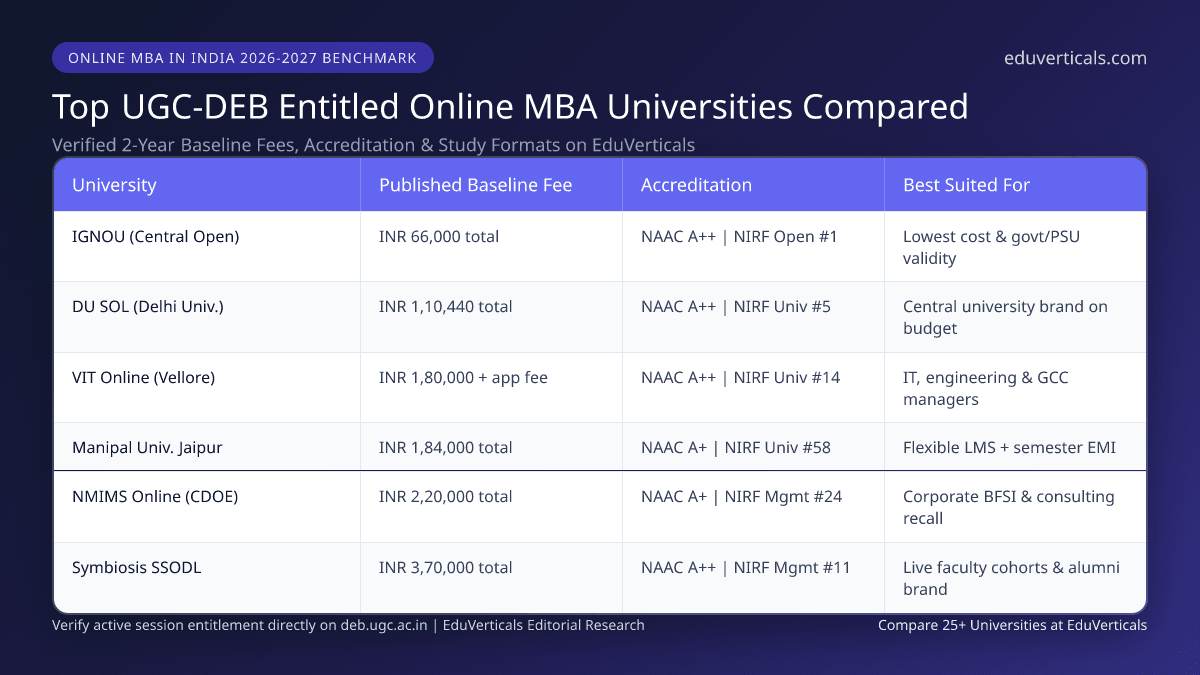
Dive deeper into head-to-head matchups in NMIMS vs Symbiosis vs Manipal Online MBA, Amity vs LPU vs D.Y. Patil Online MBA, and our VIT Online MBA 2026 Review.
Evaluating sticker tuition alone misses real out-of-pocket costs and payback period. Reputable institutions disclose registration charges (typically INR 500-2,500), semester instalment plans, and whether term-end examination charges are bundled or billed per paper.
Pros: Zero relocation or hostel costs, uninterrupted salary income while studying (saving INR 10-20 lakh in opportunity cost versus a two-year residential MBA), and typical tuition payback within 9-18 months post-promotion.
Cons: No guaranteed day-zero campus recruitment pipeline like full-time Tier-1 IIM/XLRI programmes; career outcomes depend heavily on leveraging your existing work history, projects, and internal corporate mobility.
Under University Grants Commission (Open and Distance Learning Programmes and Online Programmes) Regulations, only universities holding valid institutional NAAC scores (>=3.01) or top NIRF rankings can deliver Online MBAs seamlessly. A crucial distinction separates Online MBAs (live LMS lectures, digital proctored exams, continuous assessments) from traditional Distance/ODL programmes (self-learning print/PDF modules with physical exam centres).
Recruiters increasingly screen MBA graduates for functional depth rather than generalist management theory. Choosing the right elective basket—or pairing complementary domains through dual specialisation—determines whether your degree opens roles in product analytics, corporate treasury, supply chain strategy, or enterprise AI transformation.
Most Online MBA learners study 8-12 hours per week alongside a full-time role. Weekly time allocation typically includes weekend live sessions, recorded module review during commute hours, quarterly quizzes, and remote proctored end-semester examinations scheduled on flexible time slots.
Ready to narrow your options to 3 accredited universities that fit your budget and experience? Compare live fees on our Online MBA Course Catalog or book a free shortlist review with an academic mentor at EduVerticals Admissions Desk.
Editorial BriefReading BriefImportant: Always verify institutional approvals independently using primary government portals: UGC-DEB Entitled Universities List (deb.ugc.ac.in), NIRF India Rankings (nirfindia.org), and Academic Bank of Credits (abc.gov.in). See how we audit published fee schedules in the EduVerticals Editorial Policy.
Keep the details close
Explore key programme specifications, recognition terms, fee components, and career outcomes side by side before applying.
Yes. Under UGC (ODL and Online Programmes) Regulations, an Online MBA awarded by a UGC-DEB entitled university is legally equivalent to a traditional full-time campus MBA for private-sector promotions, PSU roles, government examinations, and doctoral admissions.
Bring programme options, estimated fees and study flexibility into one view, with the trade-offs and questions to verify.
Tailored shortlist from our admission partners. Verify fees and eligibility before applying.


Our admissions mentors bring 26+ years of combined higher-education advisory experience to help you compare accredited online degrees.