Online MBA Fees in India (2026): Complete Breakdown Under ₹1 Lakh, ₹1–3 Lakh & No-Cost EMI Plans
Online MBA Fees in IndiaAffordable Online MBAOnline MBA with EMIOnline MBA Under 1 LakhOnline MBA Scholarship 2026NMIMS FeesManipal FeesEduVerticals
EduVerticals Editorials
Posted 2 hours ago
Executive Summary: In 2026, a UGC-DEB entitled Online MBA in India costs anywhere from ₹57,200 at public state universities to ₹2,25,000 at premier private universities—while specialized Executive MBAs range from ₹3,50,000 to ₹21,00,000. However, the headline number rarely tells the full story: choosing between a one-time lumpsum payment and a 4-semester plan can change your outlay by ₹18,000 to ₹24,000, and per-subject examination fees can add another ₹10,000 to ₹20,000.
Building on our popular overview of The Most Affordable Online MBAs in India, this 2026 Financial Audit gives you the exact, verified numbers from our official university catalogue—including lumpsum vs. semester payment differences, registration deposits, exam fees, and how to unlock zero-cost EMI or corporate L&D sponsorship.
1. Tier 1: Online MBAs Under ₹1.10 Lakh (Best for Strict Budgets)
If your primary goal is earning a 100% valid, UGC-DEB entitled Master of Business Administration without crossing the ₹1 lakh mark, three accredited public and heritage universities lead the pack:
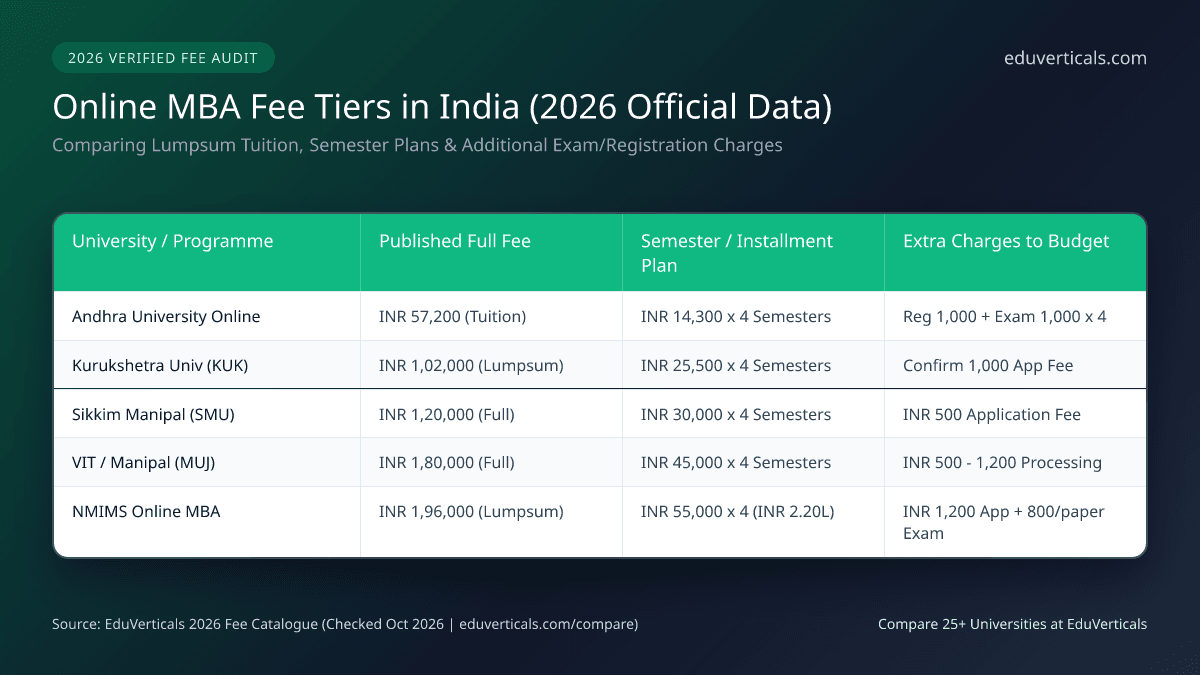
Andhra University Online MBA (₹57,200 Tuition / ₹62,200 Grand Total): Tuition is ₹14,300 × 4 semesters, with ₹1,000 registration and ₹1,000 × 4 semester exam charges bringing the published fee-table total to ₹62,200.
IGNOU Online / ODL MBA (~₹62,000–₹66,000): Paid semester-by-semester (~₹15,500–₹16,500 per semester) with minimal exam form charges per paper.
Kurukshetra University (KUK) Online MBA (₹1,02,000): Payable as ₹25,500 × 4 semesters (with a ₹1,000 registration/application component). See Kurukshetra University on EduVerticals.
This is the "sweet spot" of Indian online higher education—combining strong placement cells, modern mobile LMS apps, and interactive weekend faculty sessions:
Sikkim Manipal University (SMU) Online MBA — ₹1,20,000: Four semesters at ₹30,000 per semester (plus ₹500 application fee) with dual specialization included. Conditional 10% concessions can bring it down to ₹1,08,000.
Uttaranchal University Online MBA — ₹1,44,000 (Baseline): Annual total ₹1,44,000 (or ₹37,000 × 4 semesters = ₹1,48,000), with time-limited scholarship offers occasionally priced around ₹99,600 (confirm current intake terms).
Manipal University Jaipur (MUJ) Online MBA — ₹1,80,000: Four semesters at ₹45,000 per semester plus ₹500 application fee. Conditional 15% early-bird/category concessions can reduce net tuition to ₹1,53,000.
VIT (Vellore Institute of Technology) Online MBA — ₹1,80,000: Published headline programme fee across 4 semesters (including ₹10,000 registration deposit), plus ₹1,200 admission processing fee.
2026 Verified Online MBA Fee Audit: Comparing tuition, semester installments, and extra charges across top Indian universities.
Dr. D.Y. Patil Vidyapeeth (DPU) Online MBA — ₹1,89,400: Base Online MBA is ₹1,89,400; upgrading to the MBA with optional edX certification is ₹2,19,400.
LPU Online MBA — ₹2,00,000: Four semesters at ₹50,000 per semester (inclusive of ₹2,000/semester exam fee) + ₹1,000 registration. Check whether time-limited student grants apply to your intake.
NMIMS Online MBA — ₹1,96,000 (Lumpsum) to ₹2,20,000 (Semester Plan): One-time full payment saves you ₹24,000 compared to paying ₹55,000 × 4 semesters (₹2,20,000) or ₹1,05,000 × 2 years (₹2,10,000). Budget extra for ₹1,200 admission processing and ₹800 per subject per exam attempt.
Amity University Online MBA — ₹2,07,000 to ₹2,25,000: Standard total is ₹2,25,000, with one-time self-pay offers at ₹2,07,000.
Chandigarh University Online MBA — ₹2,38,000 (Baseline): Includes three value-added certificates, with conditional early-bird rebates around ₹1,90,400.
4. How to Save ₹20,000–₹50,000 on Your Online MBA Tuition
Compare Lumpsum vs. No-Cost EMI: If a university gives an 8%–12% discount for one-time payment (like NMIMS saving ₹24,000 or Amity saving ₹18,000) AND offers a zero-interest 12-month credit card/NBFC EMI on the lumpsum amount, you capture the lumpsum discount without draining your savings!
Check Defence, Alumni & Merit Concessions: Almost every private university offers 10% to 20% fee waivers for armed forces personnel, women returning from career breaks, and applicants with >75%–80% undergraduate marks.
Pitch Your Employer’s L&D Budget: As we detailed in our analysis of Why Companies Are Funding Executive Education Again in 2026, corporate tuition assistance can cover 50% to 100% of an Online MBA when tied to a 12–24 month retention agreement.
Filter Universities by Your Exact Fee Range: Use the interactive fee slider on Compare Online MBA Universities or generate a custom fee quote breakdown on .
Frequently Asked Questions
Common Questions Answered
For top NAAC A+ and A++ private universities (such as VIT, Manipal, Symbiosis, D.Y. Patil, LPU, NMIMS, and Amity), the average 2-year total fee ranges between ₹1,50,000 and ₹2,20,000 (roughly ₹37,500 to ₹55,000 per semester).
01 / The Facts, Side by Side
University Comparison Report
Bring programme options, estimated fees and study flexibility into one view, with the trade-offs and questions to verify.
Tailored shortlist from our admission partners. Verify fees and eligibility before applying.
Meet Our Mentors
We have a team of over 12 experienced mentors with over 26+ years of collective experience available to guide you at a moment's notice.
Online and distance learning programs provide:
- Flexibility to learn at your own pace from anywhere.
- Access to recorded lectures and digital study materials.
- Opportunities to balance work, education, and personal commitments.
- Affordable options compared to traditional on-campus programs.
- Industry-relevant curriculum designed by academic experts.
Choosing the right university depends on:
- Accreditation and recognition of the institution.
- Quality and relevance of the curriculum.
- Availability of academic and career support services.
- Feedback and reviews from alumni and current students.
- Flexibility in learning schedules and delivery modes.
Yes, online degrees from accredited universities are widely recognized and equivalent to regular degrees. Employers value the skills and qualifications gained from online programs, especially when offered by reputed institutions.
Assessment methods for online programs vary but typically include:
- Online quizzes and assignments.
- Virtual proctored exams.
- Group projects and case studies.
- Real-time presentations and viva sessions.
Many universities allow credit transfers, subject to:
- Compatibility with the curriculum of the new program.
- A minimum grade requirement in previously completed courses.
- Approval by the academic administration of the new university.
 EduVerticals Editorials