Online MBA vs Distance MBA in India (2026): UGC-DEB Rules, Live LMS vs ODL Self-Study, Exams & Salary ROI
Online MBA vs Distance MBAODL vs Online MBAUGC DEB Rules 2026Distance MBA IndiaOnline MBA IndiaIGNOU vs NMIMS OnlineEduVerticals
EduVerticals Editorials
Posted 1 hour ago
Executive Summary: In everyday conversation, Indian students often use “Distance MBA” and “Online MBA” interchangeably—but under the UGC (Open and Distance Learning Programmes and Online Programmes) Regulations, they are two legally and operationally distinct delivery modes. Distance MBA (ODL mode) relies on printed self-learning books, regional study centres, and physical pen-and-paper exam halls. Online MBA (OL mode) delivers a digital-first business school experience with live weekend classes, interactive LMS case studies, global online proctored exams, and dedicated corporate placement support.
Choosing the wrong format can mean discovering mid-semester that you are required to travel 400 kilometres to write offline pen-and-paper exams for six consecutive weekdays—or realizing that your curriculum lacks live corporate projects and placement support. Here is the definitive 2026 breakdown of Online MBA vs Distance MBA in India.
1. Regulatory Distinction: How UGC-DEB Separates ODL Mode vs Online Mode
The University Grants Commission’s Distance Education Bureau (UGC-DEB) issues two separate entitlement lists every academic session:
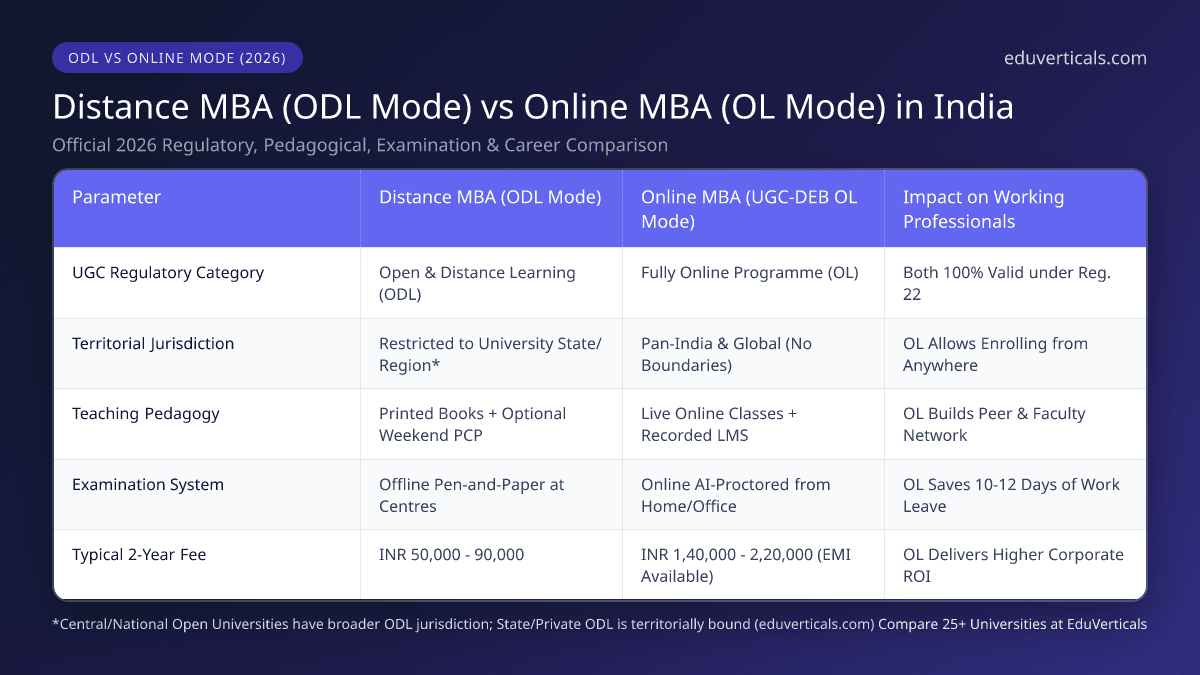
Open and Distance Learning (ODL) Mode (Distance MBA): Designed around physical Learner Support Centres (LSCs), printed Self-Learning Material (SLM), optional in-person counselling sessions, and physical examination halls. Importantly, state and private universities offering ODL degrees are strictly bound by territorial jurisdiction—meaning admissions and exams must occur within the university’s designated state/headquarters.
Online Learning (OL) Mode (Online MBA): Granted only to high-performing universities (typically NAAC A+/A++ or NIRF Top-100) with robust digital infrastructure. Online mode has zero territorial jurisdiction limits—a working professional in Bengaluru, Mumbai, London, or Dubai can legally enrol in NMIMS Online (Mumbai), VIT Online (Vellore), or Manipal Online (Jaipur) and complete the entire degree remotely.
2. Pedagogy & Learning Experience: Printed Books vs Interactive Digital Classrooms
An MBA is fundamentally a network-and-case-study degree. How you learn directly shapes whether you can speak confidently in a product, finance, or strategy interview.
In a Traditional Distance MBA: You receive couriered textbooks or static PDFs. Most students study in isolation two weeks before exams, memorize theoretical definitions, and never interact with industry practitioners or peers.
In a Modern Online MBA: You log into an AI-enabled Learning Management System (LMS) via web or mobile app. Every weekend, you attend live interactive classes with faculty and working professionals from TCS, Deloitte, HDFC, Accenture, and Amazon. You work on capstone simulations, Harvard/Ivey business cases, and industry tools (Power BI, Tableau, Python, Financial Modelling).
2026 Comparison Matrix: Distance MBA (ODL Mode) vs Online MBA (UGC-DEB OL Mode) in India
3. Examinations & Completion Rates: The Hidden Cost of Offline Exams
For a full-time working professional, leave days are money. Let’s compare the examination reality of both formats across four semesters:
Distance MBA Offline Exams: You must appear at a physical exam centre during fixed weekday afternoon/morning schedules across 6–7 papers per semester. Across four semesters, that requires 24+ days of office leave and travel. If a client escalation or work trip clashes with an exam date, you miss the paper and delay your degree by 6 months.
Online MBA Remote Proctored Exams: You use an on-demand exam slot-booking system to schedule your exams on Saturdays, Sundays, or evening slots from your home laptop. You save 20+ days of paid leave and graduate on schedule in 24 months.
4. Corporate Employer Perception & Salary ROI in 2026
While government departments and PSUs treat ODL and Online degrees identically for pay-scale increments, private-sector hiring managers make a sharp distinction during interviews:
Skill & Tool Readiness: Corporate recruiters favour Online MBA graduates from NAAC A+/A++ universities because their transcripts reflect modern functional electives (Business Analytics, Digital Marketing, FinTech, Operations) and live capstone projects.
Fee vs Payback Math: A Distance MBA costs ₹55,000–₹80,000, whereas a top Online MBA costs ₹1,50,000–₹2,00,000 (a difference of roughly ₹1 lakh, or ₹4,000/month on EMI). Yet transitioning into a mid-management role 6 months faster—or landing a 30%–45% salary hike instead of a 10% appraisal—repays that ₹1 lakh difference within the first 3 to 5 months after graduation.
Compare Accredited Online MBA Programmes: Explore 25+ UGC-DEB entitled Online MBA universities and build your personalized comparison using the .
Frequently Asked Questions
Common Questions Answered
Under UGC-DEB norms, the mode of delivery (Online or Open and Distance Learning) is recorded as per statutory format, and Regulation 22 explicitly mandates that both are legally equivalent to conventional degrees for employment and higher education.
01 / The Facts, Side by Side
University Comparison Report
Bring programme options, estimated fees and study flexibility into one view, with the trade-offs and questions to verify.
Tailored shortlist from our admission partners. Verify fees and eligibility before applying.
Meet Our Mentors
We have a team of over 12 experienced mentors with over 26+ years of collective experience available to guide you at a moment's notice.
Online and distance learning programs provide:
- Flexibility to learn at your own pace from anywhere.
- Access to recorded lectures and digital study materials.
- Opportunities to balance work, education, and personal commitments.
- Affordable options compared to traditional on-campus programs.
- Industry-relevant curriculum designed by academic experts.
Choosing the right university depends on:
- Accreditation and recognition of the institution.
- Quality and relevance of the curriculum.
- Availability of academic and career support services.
- Feedback and reviews from alumni and current students.
- Flexibility in learning schedules and delivery modes.
Yes, online degrees from accredited universities are widely recognized and equivalent to regular degrees. Employers value the skills and qualifications gained from online programs, especially when offered by reputed institutions.
Assessment methods for online programs vary but typically include:
- Online quizzes and assignments.
- Virtual proctored exams.
- Group projects and case studies.
- Real-time presentations and viva sessions.
Many universities allow credit transfers, subject to:
- Compatibility with the curriculum of the new program.
- A minimum grade requirement in previously completed courses.
- Approval by the academic administration of the new university.
 EduVerticals Editorials