 Aditi Chouri
 Posted 8 months ago
The business world is undergoing a massive transformation driven by data and artificial intelligence. Decisions that were once based on intuition or past experience are now guided by data patterns, predictive models, and intelligent systems. From how companies market their products to how they manage supply chains and customer relationships, data has become the backbone of modern organisations.
In this context, traditional management education is evolving. Companies no longer want managers who only understand finance, marketing, or operations in isolation. They seek professionals who can interpret data, understand artificial intelligence applications, and align technology with business goals. This growing demand has given rise to specialised programs such as the MBA in Data Science and Artificial Intelligence.
An MBA in Data Science and AI is designed for individuals who want to build managerial careers while staying relevant in a technology driven economy. This blog explores the program in detail, including its structure, relevance, career opportunities, advantages, challenges, and long term value.
An MBA in Data Science and AI is a postgraduate management program that blends core business education with data analytics and artificial intelligence concepts. Unlike a purely technical degree, this program focuses on applying data and AI tools to real business scenarios.
Students learn how to analyse data, interpret insights, and use those insights to drive strategic decisions. They are not trained to become software developers but rather to become managers who can work effectively with data scientists and technical teams.
For example, a graduate of this program should be able to understand customer data trends, evaluate predictive models for sales forecasting, and decide how artificial intelligence can improve operational efficiency.
The relevance of this program lies in the changing nature of business decision making.Modern organisations generate enormous volumes of data through customer interactions, digital platforms, transactions, and operational processes. Without skilled professionals to analyse and interpret this data, it remains underutilised.Artificial intelligence has further expanded the scope of data usage. Businesses now use AI for demand forecasting, fraud detection, personalised recommendations, and process automation. Managers who understand these technologies can make informed decisions and avoid costly implementation mistakes.An MBA in Data Science and AI prepares professionals to bridge the gap between technical teams and business leadership, making it one of the most future oriented management programs.
This program is suitable for candidates from diverse academic and professional backgrounds.
Engineering and science graduates who want to move into leadership roles often choose this MBA to complement their technical foundation with business knowledge.
Commerce and management graduates who want to specialise in analytics and AI can also pursue this program, provided they are willing to develop quantitative and analytical skills.
Working professionals in fields such as marketing, consulting, operations, and IT who want career advancement or role transition can benefit significantly.
For example, a marketing professional with data science exposure can design data driven campaigns and move into strategic roles faster than peers with only creative skills.
Eligibility requirements vary across institutions, but most programs require a bachelor’s degree in any discipline from a recognised university. Some institutions prefer candidates with prior exposure to mathematics, statistics, or programming, although this is not always mandatory.
Admission processes generally include a management entrance examination, followed by group discussions and personal interviews. During interviews, candidates are evaluated on analytical thinking, problem solving ability, clarity of goals, and awareness of data driven business trends.
Work experience is often considered an advantage but is not compulsory.
The curriculum is carefully designed to balance management fundamentals with data and AI concepts.
Students study traditional MBA subjects such as marketing management, financial management, operations management, organisational behaviour, economics, and business strategy. These subjects help build a strong foundation in managerial thinking.
This component includes business statistics, data analysis, data visualisation, predictive analytics, decision science, and big data concepts. Students learn how to work with datasets, identify patterns, and derive insights relevant to business decisions.
AI focused subjects introduce concepts such as machine learning, natural language processing, AI applications in business, and ethical issues related to artificial intelligence. The focus is on understanding how AI systems work and how they can be applied responsibly.
Most programs emphasise experiential learning through case studies, live projects, internships, and capstone projects. This ensures that students can apply theoretical knowledge to real world business problems.
For instance, a capstone project might involve analysing retail sales data to predict seasonal demand and recommend inventory strategies.
An MBA in Data Science and AI helps students develop a unique combination of skills.
Analytical skills are strengthened as students learn to interpret complex datasets and evaluate business scenarios objectively.
Strategic thinking improves as students learn to connect data insights with organisational goals.
Communication skills are enhanced through presentations and reports, enabling students to explain technical findings to non technical stakeholders.
Leadership and collaboration skills are also developed, preparing students to manage cross functional teams.
Graduates of this program have access to a wide range of career opportunities across industries.
Roles such as Business Analyst, Data Analyst, Analytics Manager, and Decision Scientist focus on using data to support business strategies.
Graduates can work as AI Product Managers, Digital Transformation Managers, or Technology Strategy Consultants. These roles involve overseeing AI driven initiatives and aligning them with business objectives.
Management consulting firms value professionals who can combine strategic thinking with analytical capabilities. Graduates may work as strategy consultants or analytics consultants.
Industries such as banking, healthcare, retail, manufacturing, logistics, and education actively hire professionals with this skill set.
For example, in banking, AI driven managers may work on credit risk assessment and fraud detection systems.
Salary levels depend on the institution, prior experience, and job role. Entry level positions often offer competitive compensation compared to general MBA roles. With experience, professionals can progress into senior leadership positions with significant salary growth.
More importantly, career sustainability is high because data and AI skills are expected to remain relevant as businesses continue to digitise.
One major advantage is strong market demand. Organisations actively seek professionals who understand data driven decision making.
Another advantage is career versatility. Graduates can work across industries and functions, providing flexibility and long term growth opportunities.
The program also offers future readiness. As automation increases, roles requiring strategic judgment and analytical reasoning become more valuable.
Despite its benefits, the program has certain challenges.
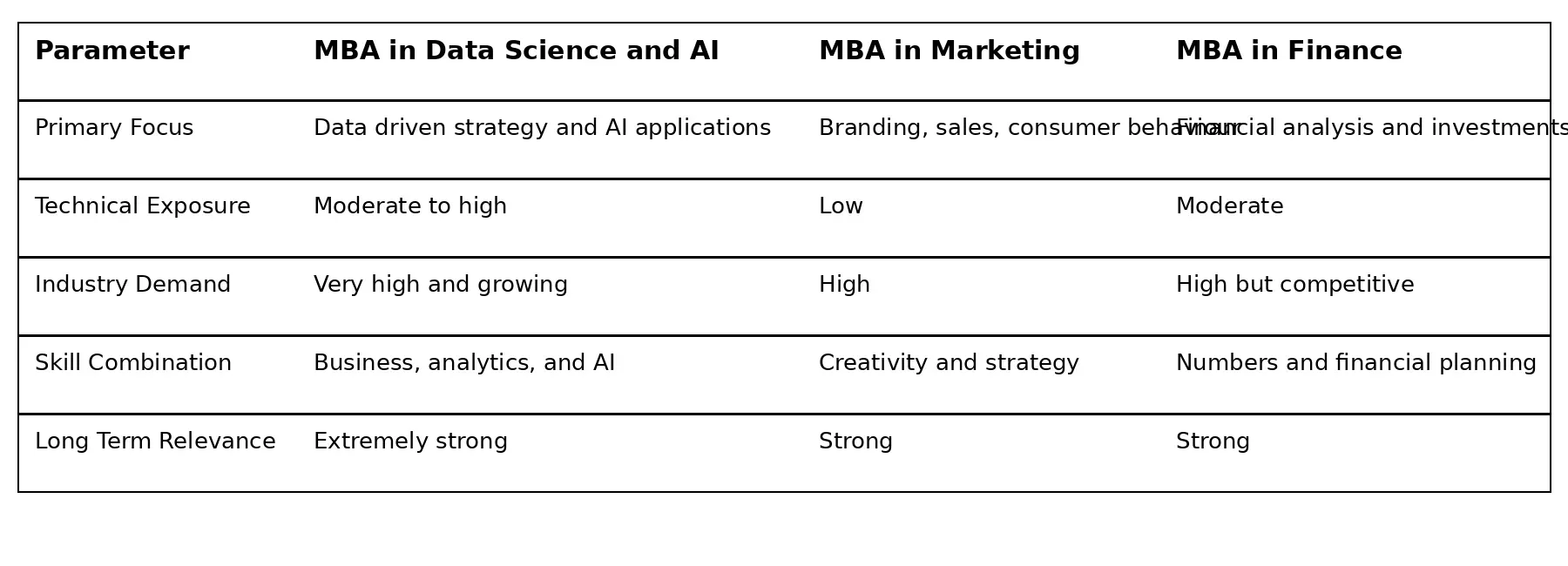
Consider a logistics company facing high delivery delays and rising costs. A manager with an MBA in Data Science and AI can analyse route data, predict traffic patterns, and recommend AI driven optimisation models. This leads to reduced costs, faster deliveries, and improved customer satisfaction.
Such examples highlight how this program prepares professionals to solve complex business problems using data and intelligence.
An MBA in Data Science and AI is ideal for individuals who want to work at the intersection of business and technology. It suits those who enjoy analytical thinking, problem solving, and strategic planning.
However, candidates should approach the program with clear career goals and a willingness to continuously upgrade their skills. The degree is not a shortcut to success but a foundation for long term growth.
The MBA in Data Science and Artificial Intelligence represents a new era of management education. It equips professionals with the ability to lead organisations in a data driven world while maintaining strong business fundamentals.
With increasing demand, diverse career opportunities, and long term relevance, this program is a powerful choice for individuals who want to build impactful and future ready careers. When pursued with clarity and commitment, an MBA in Data Science and AI can transform not just careers, but the way businesses make decisions.
1. Is an MBA in Data Science and AI suitable for non-technical students?
Yes, an MBA in Data Science and AI is suitable for non-technical students as long as they are willing to develop basic analytical and quantitative skills. The program focuses more on applying data insights to business decisions rather than deep programming. Many institutes provide foundation courses to help students from non-technical backgrounds.
2. What is the difference between an MBA in Data Science and a technical data science degree?
A technical data science degree focuses on programming, algorithms, and model building, while an MBA in Data Science and AI focuses on managerial decision making, strategy, and business applications of data and artificial intelligence. MBA graduates typically work in leadership and strategy oriented roles rather than purely technical positions.
3. What career roles can I expect after completing an MBA in Data Science and AI?
Graduates can work in roles such as Business Analyst, Analytics Manager, AI Product Manager, Strategy Consultant, and Digital Transformation Manager. These roles are available across industries including banking, healthcare, retail, manufacturing, and technology services.
4. Do I need prior work experience to pursue an MBA in Data Science and AI?
Prior work experience is not mandatory but is often preferred by institutes. Candidates with work experience are able to relate concepts more effectively to real world business problems. Fresh graduates can also succeed if they have strong analytical aptitude and clarity of career goals.
5. Is an MBA in Data Science and AI worth it in the long run?
Yes, the program offers strong long term value because data driven decision making and artificial intelligence are becoming core to business operations. Professionals with both business understanding and data expertise are expected to remain in demand across industries for many years.


We have a team of over 12 experienced mentors with over 26+ years of collective experience available to guide you at a moment's notice.