
logo

The Mid-Career Stagnation Trap in India’s Tech & Service Economy: How Upskilling Changes Your 5-Year Salary Curve

Mid Career Stagnation India5 Year Salary Curve MBAOnline MBA ROI CalculatorCareer Plateau IT IndiaUpskilling for Working ProfessionalsEduVerticals
EduVerticals EditorialsEduVerticals Editorials

Posted 2 hours ago

The Mid-Career Stagnation Trap in India’s Tech & Service Economy: How Upskilling Changes Your 5-Year Salary Curve
Executive Summary: Between ages 26 and 33, millions of Indian professionals hit the "Mid-Career Stagnation Trap"—where annual inflation-adjusted salary increments flatten to 6%–8% because their skillset remains stuck in execution while AI automates routine tasks. Economic modelling of a 5-year career horizon shows that investing ₹1.8L–₹4.0L in a UGC-DEB Online or Executive MBA (while losing ₹0 in salary) and executing a post-graduation managerial transition compounds into ₹10L–₹18L+ in cumulative extra earnings over five years.

Have you noticed a troubling pattern in corporate appraisal cycles recently? During the first 2–3 years of your career, jumping from ₹3.5 LPA to ₹6–8 LPA feels relatively straightforward. Then, suddenly, around Year 4 to Year 7, the ceiling hits.

Your annual increment drops to a modest 6% to 8% (barely matching urban lifestyle inflation in Bengaluru, Mumbai, Pune, or NCR). Meanwhile, younger graduates trained in AI tools can execute basic coding, content, or reporting tasks at half your cost, while senior leadership roles require P&L ownership, strategic planning, and a Master’s qualification. Earlier, we analysed Is an Online MBA Worth It? An Analytical Review of ROI, Costs, and Career Impact. Now, let’s examine the 5-Year Compounding Salary Curve that powers the personalized reports on .

1. Why the "Status Quo" Career Path Loses Purchasing Power in 2026

In India’s service and technology economy, compensation follows a step-function rather than a smooth line:

  • Band 1 (Individual Executor — ₹4 LPA to ₹8 LPA): Compensated for hours worked and tickets/tasks closed. Highly vulnerable to Generative AI co-pilots and wage compression.
  • Band 2 (Domain & Team Manager — ₹10 LPA to ₹22 LPA): Compensated for cross-functional coordination, client retention, budget allocation, and team output.
  • Band 3 (Business Unit / Product / P&L Leader — ₹25 LPA to ₹50+ LPA): Compensated for revenue growth, EBITDA margin expansion, and strategic capital decisions.

Waiting passively for 7% annual seniority raises will never move you from Band 1 to Band 2, or from Band 2 to Band 3. Crossing that chasm requires a structural credential and capability upgrade.
Mid Career Salary Stagnation India Upskilling MBA ROI Curve
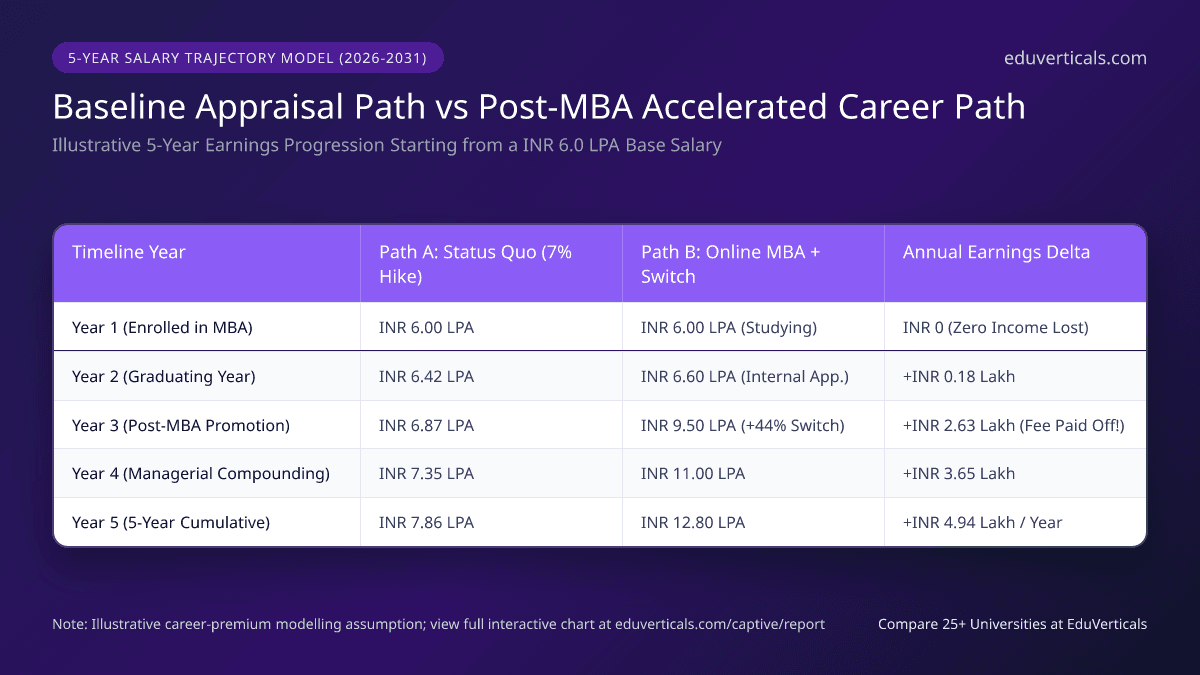
Illustrative 5-Year Salary Trajectory Model: Comparing a 7% status-quo increment path against an Online MBA + managerial transition curve.

2. Breaking Down the 5-Year Salary Curve (Path A vs. Path B)

Consider a professional currently earning ₹5 LPA to ₹6 LPA (as modelled in our interactive salary story on ):

  1. Years 1 & 2 (The Study & Application Phase): While enrolled in a 2-year Online MBA (e.g., VIT, NMIMS, or Manipal), you continue earning your full salary. By Semester 3, you start volunteering for cross-functional budgeting, analytics, and project-management initiatives at work.
  2. Year 3 (The Inflection Point — Promotion or Lateral Switch): Armed with your completed MBA degree and 2 additional years of work experience, you pitch for an internal promotion to Manager/Product Owner or make a lateral switch—shifting your base from ~₹6.8 LPA (Status Quo) to ₹9.5+ LPA. That single year’s ₹2.6L+ salary delta pays back your entire ₹1.8L–₹2.0L MBA tuition!
  3. Years 4 & 5 (Compounding on a Higher Base): Because every subsequent percentage raise and bonus now compounds on a ₹10L+ managerial base rather than a stagnating ₹7L executor base, the 5-year cumulative earnings gap widens dramatically.

Transparency Note: Salary curves are modelling illustrations based on typical corporate appraisal and lateral-switch benchmarks, not guaranteed institutional placement promises. Your individual outcome depends on your base domain, chosen specialization, and interview execution.

3. Three Steps to Break Out of Career Stagnation This Quarter

  • Step 1 — Audit Your Missing "Band-Jump" Skill: If you are strong in technical execution, add Finance & Strategy; if you are strong in sales/ops, add Business Analytics & Data Storytelling.
  • Step 2 — Pick a Zero-Opportunity-Cost Accredited MBA: Never quit a paying job unless you are entering a Top-5 residential flagship with a low base salary. Keep your cash flow intact with a Tier-1 Online or Blended Executive MBA.
  • Step 3 — Generate Your Personalised 5-Year Report: Click below to see your custom shortlist and salary projection.
See Your Personalised 5-Year MBA Salary Graph: Open to view the interactive 5-year salary story and discover which accredited programmes fit your budget and experience.
Frequently Asked Questions

Common Questions Answered

After 4 to 6 years of experience, pure technical or operational execution hits a billing ceiling. Companies reserve higher salary bands (₹12 LPA to ₹30+ LPA) for professionals who can manage client accounts, own product P&Ls, lead cross-functional teams, and make data-backed financial decisions.

01 / The Facts, Side by Side

University Comparison Report

Bring programme options, estimated fees and study flexibility into one view, with the trade-offs and questions to verify.

Tailored shortlist from our admission partners. Verify fees and eligibility before applying.

Meet Our Mentors

We have a team of over 12 experienced mentors with over 26+ years of collective experience available to guide you at a moment's notice.

Got Questions?

Online and distance learning programs provide: - Flexibility to learn at your own pace from anywhere. - Access to recorded lectures and digital study materials. - Opportunities to balance work, education, and personal commitments. - Affordable options compared to traditional on-campus programs. - Industry-relevant curriculum designed by academic experts.
Choosing the right university depends on: - Accreditation and recognition of the institution. - Quality and relevance of the curriculum. - Availability of academic and career support services. - Feedback and reviews from alumni and current students. - Flexibility in learning schedules and delivery modes.
Yes, online degrees from accredited universities are widely recognized and equivalent to regular degrees. Employers value the skills and qualifications gained from online programs, especially when offered by reputed institutions.
Assessment methods for online programs vary but typically include: - Online quizzes and assignments. - Virtual proctored exams. - Group projects and case studies. - Real-time presentations and viva sessions.
Many universities allow credit transfers, subject to: - Compatibility with the curriculum of the new program. - A minimum grade requirement in previously completed courses. - Approval by the academic administration of the new university.