 EduVerticals Editorials
Posted 5 months ago
The landscape of postgraduate management education has undergone a structural shift. Prospective candidates are increasingly questioning the traditional requirement of pausing their careers for two years to pursue a conventional campus-based degree.
With corporate acceptance reaching parity and digital learning infrastructure maturing, the central question shifts from delivery format to financial viability: Is an online MBA worth the investment?
This analysis evaluates the Return on Investment (ROI), comparative costs, structural benefits, and credential verification required to determine if an online MBA aligns with your career trajectory.
To understand the financial viability, one must analyze both direct costs and opportunity costs. A traditional, full-time residency MBA from a premium institution demands a significant capital outlay alongside two years of forfeited income. Conversely, an online MBA allows professionals to maintain their current income streams while earning their credentials.
Average Tuition Fees: ₹1,50,000 - ₹3,00,000
Opportunity Cost: Zero (Retain full-time salary)
Average Starting Salary: ₹6,00,000 - ₹18,00,000 LPA
Time to Break Even: 6 to 12 Months
Location Constraints: None (Asynchronous learning)
Average Tuition Fees: ₹10,00,000 - ₹25,00,000
Opportunity Cost: High (2 Years of lost income)
Average Starting Salary: ₹8,00,000 - ₹25,00,000 LPA
Time to Break Even: 3 to 5 Years
Location Constraints: High (Requires relocation or daily commuting)
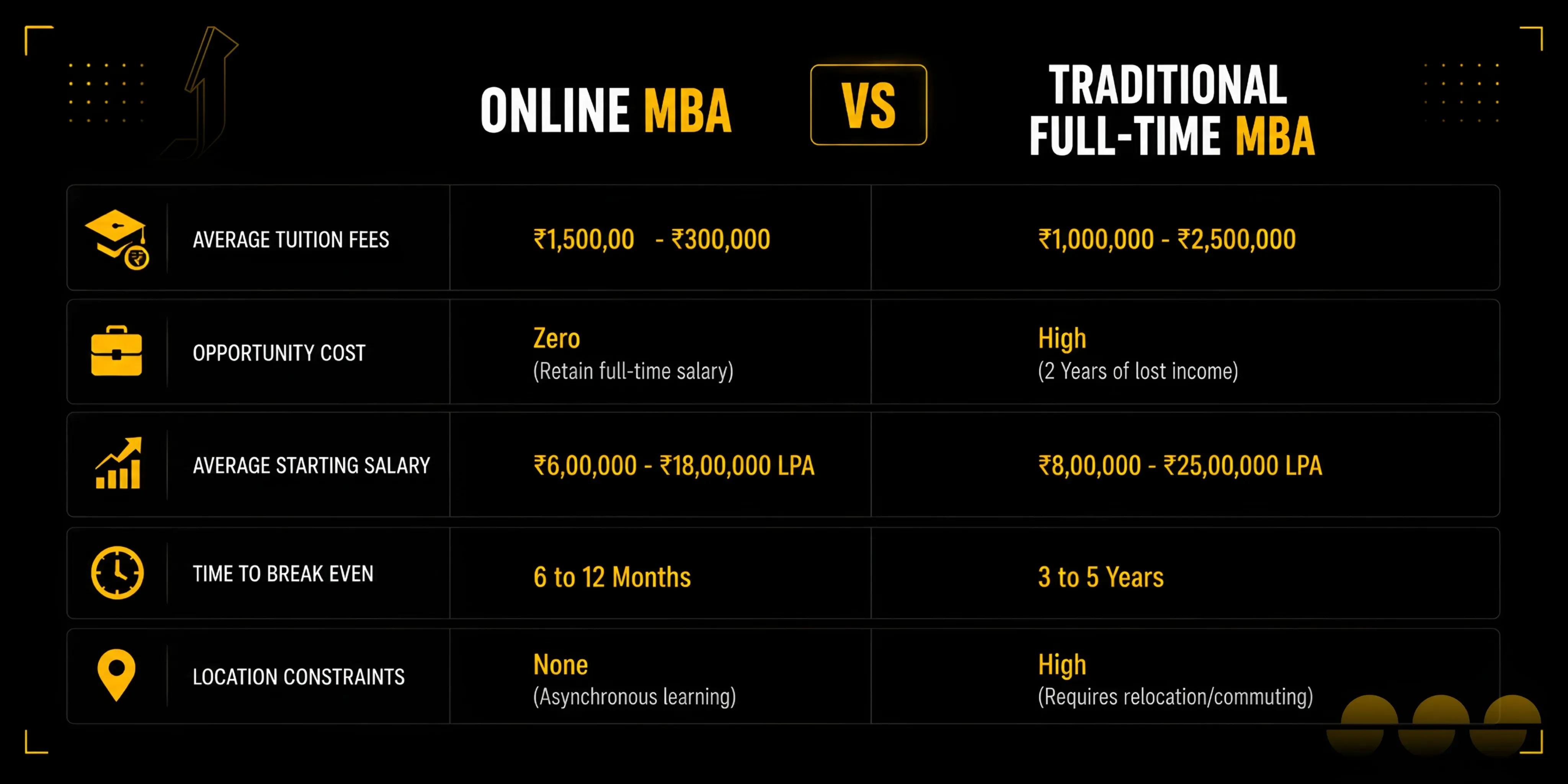
Because the initial capital requirement for an online program is substantially lower, the timeline to achieve a complete break-even on your investment is drastically compressed.
The primary advantage of executive online education is the ability to apply theoretical frameworks to real-world corporate challenges in real-time. Concepts learned during weekend modules regarding strategic management, financial accounting, or data analytics can be deployed immediately within your current role, enhancing visible performance and accelerating internal promotions.
Modern online degrees utilize sophisticated educational technology platforms. These portals provide asynchronous access to high-definition recorded lectures, live interactive webinars, collaborative discussion forums, and digital case study libraries, ensuring a seamless learning experience equivalent to an on-campus environment.
Online cohorts typically consist of diverse, mid-career professionals working across various geographies and industries. This demographic diversity allows students to build a robust professional network via virtual cohorts, peer-to-peer evaluation groups, and institutional alumni networks, without being limited by regional boundaries.
The value of an online qualification relies heavily on the regulatory compliance of the awarding institution. To ensure a degree is recognized by global corporations and public sector undertakings, verify the following credentials before enrollment:
UGC-DEB Approval: In India, the University Grants Commission’s Distance Education Bureau (UGC-DEB) must explicitly recognize the university to offer the specific online program.
NAAC Grading: Prioritize institutions holding a National Assessment and Accreditation Council (NAAC) A+ or higher grading, as this indicates adherence to rigorous educational standards.
Industry-Aligned Curriculum: Ensure the program offers specialized tracks (e.g., Marketing, Data Analytics, Financial Management) that feature curriculum updates aligned with current market demands.
The corporate perception of online degrees has evolved significantly. Leading organizations recognize that candidates who successfully balance a full-time professional workload with the academic rigor of a management program demonstrate exceptional time management, discipline, and self-motivation.
Graduates regularly transition into mid-to-senior management roles, experiencing average salary increments ranging from 30% to 70%, depending on prior work experience and individual performance during placement drives.
Is an online MBA valid for government jobs and higher education?
Yes. As long as the degree is granted by a university recognized by the UGC-DEB, it is legally valid and treated on par with conventional degrees for public sector employment and subsequent academic pursuits.
What is the ideal work experience required for an online MBA?
While the minimum eligibility typically requires a graduation degree with passing marks, professionals with 2 to 7 years of work experience derive the maximum value from the peer discussions and case-study-based curriculum.
An online MBA represents a highly efficient pathway to career acceleration for working professionals who require flexibility and rapid financial ROI. It eliminates the financial strain of traditional residential programs while delivering the identical academic credentials necessary to break through mid-career ceilings.
At Edu Verticals, we specialize in guiding ambitious professionals toward strategic educational choices. We bridge the gap between academic aspiration and industry requirements by offering structured pathways to top-tier higher education courses and comprehensive placement programs designed to secure measurable career advancement.


We have a team of over 12 experienced mentors with over 26+ years of collective experience available to guide you at a moment's notice.