
logo

How to Choose the Right Online MBA in 2026: A Step-by-Step Framework by Budget & Experience

How to Choose Online MBAOnline MBA Decision Guide 2026Best Online MBA IndiaOnline MBA by BudgetExecutive MBA vs Online MBAEduVerticals
EduVerticals EditorialsEduVerticals Editorials

Posted 41 minutes ago

How to Choose the Right Online MBA in 2026: A Step-by-Step Framework by Budget & Experience
Executive Summary: With over 75 UGC-DEB entitled universities and 15+ IIM/Tier-1 blended programmes competing for your attention in 2026, picking an Online MBA based on television ads or aggressive sales calls is a recipe for buyer’s remorse. The smartest way to shortlist is to cross-match two objective variables—your post-graduation work experience (0–2 yrs, 2–5 yrs, or 5+ yrs) and your total all-inclusive fee comfort (Under ₹1L, ₹1–3L, ₹3–8L, or ₹10L+)—before comparing NAAC/NIRF credentials and weekly study hours.

Every week on , thousands of Indian professionals run personalized comparisons to answer one deceptively tricky question: "Which Online or Executive MBA is actually right for MY profile?" A fresh B.Com graduate earning ₹4.5 LPA in Jaipur has completely different academic, financial, and placement needs than a 31-year-old Senior Software Engineer in Bengaluru earning ₹18 LPA.

In this comprehensive 2026 decision guide, we share the exact 5-step methodology our admissions analysts and AI recommendation engine use to match learners with their highest-ROI programme.

Step 1: Anchor Your Budget Bracket (Including Hidden Exam & Immersion Costs)

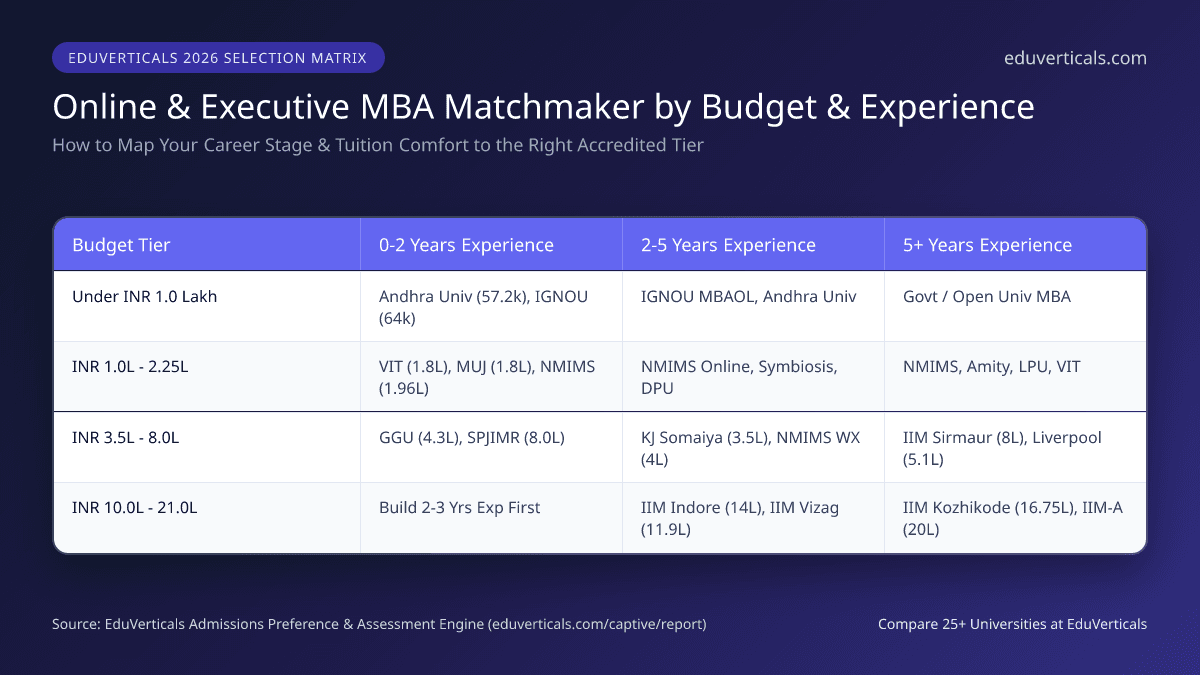
Before looking at university brochures, establish your all-inclusive 2-year expenditure ceiling. In India’s 2026 online higher-education market, programmes cluster into four distinct pricing bands:
How to Choose Right Online MBA by Budget and Experience 2026
2026 Online & Executive MBA Matchmaker Matrix across budget brackets and work experience levels.

Step 2: Filter by Mandatory Post-Graduation Work Experience

Work experience is a hard gatekeeper in executive education. Applying to a programme where you don’t meet the statutory post-qualification experience cutoff leads to automatic rejection:

  1. 0 to 2 Years Experience: Focus on UGC-DEB Online MBAs (VIT, NMIMS Online, Manipal, Symbiosis, DPU, Amity, LPU) or SPJIMR Blended PGDM (which accepts recent graduates with strong profiles).
  2. 2+ Years Full-Time Experience: Unlocks IIM Indore Executive MMS (₹14L), IIM Sirmaur EMBA (₹8L), Liverpool Business School + IIM Udaipur pathway (₹5.1L), and (for 4-year B.Tech graduates) IIM Ahmedabad BPGP BA & AI and K J Somaiya Executive MBA.
  3. 3+ Years Full-Time Experience: Unlocks the entire spectrum of IIM Executive MBAs—including IIM Kozhikode EPGP, IIM Visakhapatnam EMBA, IIM Amritsar EMBA, IIM Ahmedabad General BPGP, and NMIMS MBA (WX).

Step 3: Audit Weekly Bandwidth & Examination Format

Be honest about your calendar. If you travel frequently for client engagements, an executive programme with strict 6-hour Sunday morning live attendance penalties may hurt your grades. Conversely, if you procrastinate without live peer accountability, a purely self-paced course may leave you unmotivated. Always check:

  • Synchronous vs. Asynchronous Ratio: Executive MBAs (IIMs, NMIMS WX, KJ Somaiya) emphasize live interactive faculty classes, whereas standard Online MBAs (VIT, MUJ, LPU, Amity) let you watch recorded lectures anytime plus optional live weekend doubt sessions.
  • Campus Immersion Requirement: Standard Online MBAs require zero campus visits (100% online). IIM and Blended Executive MBAs require 1 to 3 short residential campus modules (5–7 days each).

Step 4: Run Your Personalised Comparison Report

Instead of opening 20 browser tabs and deciphering conflicting PDF brochures, you can automate steps 1 through 3 in 60 seconds:

Try the Interactive Decision Engine: Head over to or Compare Online MBA Universities to get a personalized, side-by-side breakdown of verified fees, accreditation scope, and 5-year salary projections.
Frequently Asked Questions

Common Questions Answered

First, verify active UGC-DEB entitlement (or IIM Act statutory degree status) and NAAC A+/A++ accreditation. Second, match the programme tier to your years of full-time work experience and realistic 2-year budget.

01 / The Facts, Side by Side

University Comparison Report

Bring programme options, estimated fees and study flexibility into one view, with the trade-offs and questions to verify.

Tailored shortlist from our admission partners. Verify fees and eligibility before applying.

Meet Our Mentors

We have a team of over 12 experienced mentors with over 26+ years of collective experience available to guide you at a moment's notice.

Got Questions?

Online and distance learning programs provide: - Flexibility to learn at your own pace from anywhere. - Access to recorded lectures and digital study materials. - Opportunities to balance work, education, and personal commitments. - Affordable options compared to traditional on-campus programs. - Industry-relevant curriculum designed by academic experts.
Choosing the right university depends on: - Accreditation and recognition of the institution. - Quality and relevance of the curriculum. - Availability of academic and career support services. - Feedback and reviews from alumni and current students. - Flexibility in learning schedules and delivery modes.
Yes, online degrees from accredited universities are widely recognized and equivalent to regular degrees. Employers value the skills and qualifications gained from online programs, especially when offered by reputed institutions.
Assessment methods for online programs vary but typically include: - Online quizzes and assignments. - Virtual proctored exams. - Group projects and case studies. - Real-time presentations and viva sessions.
Many universities allow credit transfers, subject to: - Compatibility with the curriculum of the new program. - A minimum grade requirement in previously completed courses. - Approval by the academic administration of the new university.