
logo

Skills-First Hiring vs Accredited MBA for Director Promotions: The Corporate Promotion Ceiling Decoded in 2026

Skills First Hiring IndiaAccredited MBA Promotion CeilingOnline MBA Director RolesUGC DEB Management DegreeGCC Promotion CriteriaCorporate Career ProgressionExecutive MBA ROIEduVerticals
EduVerticals EditorialsEduVerticals Editorials

Posted 1 day ago

Skills-First Hiring vs Accredited MBA for Director Promotions: The Corporate Promotion Ceiling Decoded in 2026
Executive Summary
Reading Brief
Executive Summary: Over the past five years, corporate media and tech evangelists aggressively championed "skills-first hiring," claiming that formal academic credentials were obsolete in an era of online bootcamps and digital badges. In late 2026, mid-career professionals are confronting the harsh unwritten reality of Corporate India and multinational enterprises: while micro-credentials may help you secure an entry-level lateral role, advancing beyond the ₹40 Lakhs threshold into Director, Vice President, and CXO compensation bands still requires a UGC-DEB accredited postgraduate management degree. Understanding this corporate promotion ceiling is critical for every ambitious professional.

The narrative surrounding skills-first recruitment was not entirely false—it accurately reflected entry-level dynamics. Tech startups and fast-growing digital agencies were eager to hire self-taught coders, digital marketers, and data analysts who demonstrated immediate technical competency on GitHub or Behance, regardless of whether they possessed a university degree.

However, when an individual approaches the corporate middle-management threshold (8 to 12 years of experience), the evaluation matrix shifts completely. Senior enterprise roles are not about executing individual technical tasks; they demand P&L ownership, multi-million-dollar capital allocation, strategic stakeholder diplomacy, and statutory governance compliance. At this executive altitude, enterprise HR nomination committees, risk officers, and institutional boards impose strict credential screening criteria.

1. Why the Promotion Ceiling Is Legally and Statutorily Enforced

The persistent requirement for formal, accredited management degrees in Director and VP appointments is driven by institutional, legal, and regulatory mechanisms:
  1. Corporate Governance & Board Nomination Mandates: Under SEBI LODR rules, Companies Act provisions, and global corporate governance codes, board nomination committees must certify that senior officers managing multi-crore budgets possess formally recognized academic qualifications from accredited institutions.
  2. Global Visa & International Mobility Restrictions: For professionals in multinational GCCs seeking transfer to London, Zurich, Singapore, or New York under L-1A executive visas or European Blue Cards, immigration authorities require recognized master’s degrees evaluated by World Education Services (WES) or equivalent statutory bodies.
  3. Client Due Diligence in Enterprise Services: When Indian IT and consulting giants (such as TCS, Infosys, and LTIMindtree) bid for multi-billion-dollar global banking or healthcare contracts, client procurement mandates require bios of project leadership, explicitly demanding accredited MBA or post-graduate qualifications.
  4. Internal Job Posting (IJP) HR Algorithmic Filters: Enterprise HR software (Workday, SAP) automatically filters out candidates lacking a recognized master’s degree for Director and VP job bands, regardless of managerial performance.
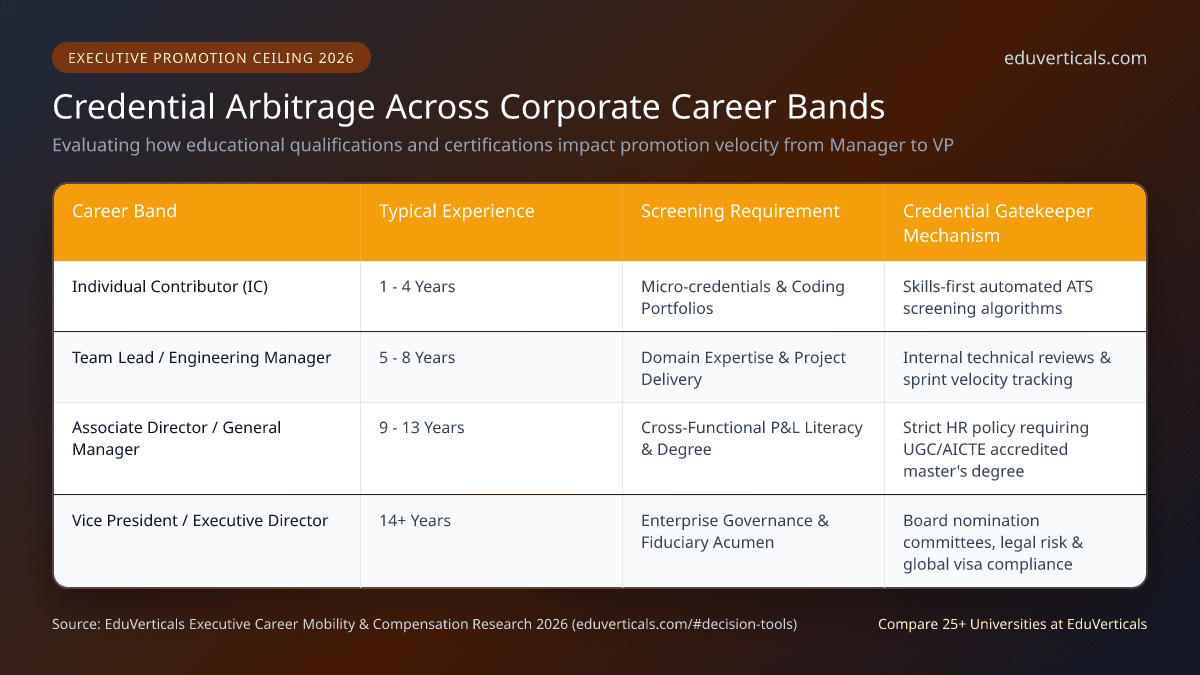
Skills First Hiring vs Accredited MBA Promotion Ceiling 2026
Credential Arbitrage Across Corporate Career Bands: Why Accredited Degrees Unlock Director and VP Promotions.

2. Micro-Credentials vs. Accredited Management Degrees: The ROI Reality

Many mid-career managers fall into the trap of collecting endless superficial micro-certificates. They complete short online certificates in generative AI, agile scrum, or digital strategy, hoping these digital badges will unlock executive promotions. While valuable for tactical skill enhancement, non-accredited certificates carry zero statutory or institutional weight in executive promotion committees.

In contrast, an accredited Master of Business Administration from a recognized university signals comprehensive intellectual endurance, holistic financial literacy, and institutional legitimacy. Senior executives who couple their technical domain depth with an accredited MBA consistently out-earn and out-promote peers who rely exclusively on unaccredited technical certificates.

Interactive Career Pulse

Select your career goal to tailor advice

Decision note · Verified comparison01 / 03

What is the primary factor limiting your advancement to Director/VP roles?

Mentor RecommendationLacking Accredited Master’s Degree

Enroll in a UGC-DEB entitled Online MBA to bypass HR algorithmic qualification filters.

Tailored shortlist from our admission partners

3. How Working Professionals Overcome the Credential Barrier

Historically, acquiring an accredited MBA required sacrificing two years of career momentum and forfeiting millions of rupees in forgone salary to attend a residential campus. In 2026, the regulatory recognition of UGC-DEB entitled Online MBAs has revolutionized executive career planning. Working professionals can earn full-fledged, statutory management degrees from Tier-1 institutions while remaining in full-time employment.

Prospective students can explore authoritative analyses such as Is Distance MBA from DU Worth It? and Online MBA from IGNOU Analysis on EduVerticals to understand statutory equivalencies. Furthermore, comparing accredited options on the EduVerticals Academic Catalog enables working managers to evaluate NAAC A++ programmes from NMIMS Global and Vellore Institute of Technology (VIT Online).

  • Verify Statutory Equivalence: Ensure the programme possesses UGC Distance Education Bureau (DEB) entitlement, guaranteeing absolute parity with regular on-campus degrees under Gazette of India notifications.
  • Target NAAC A++ and NIRF Ranked Universities: Top institutional accreditations ensure your degree passes strict global credential audits by WES, UK ENIC, and multinational HR committees.
  • Leverage Capstone Projects for Immediate Corporate Impact: Apply classroom strategic frameworks directly to your current corporate challenges, demonstrating tangible P&L leadership to senior management.
  • Unlock Multi-Lakh Compensation Bands: Position yourself for Director, Associate Vice President (AVP), and VP elevation cycles without leaving your existing organization.
Editorial Brief
Reading Brief
Break Through Your Corporate Promotion Ceiling: Explore top UGC-DEB entitled Online MBA programmes designed for ambitious working managers. Get your tailored shortlist from our admission partners on .

Keep the details close

Common QuestionsThe full picture.

Explore key programme specifications, recognition terms, fee components, and career outcomes side by side before applying.

05 verified FAQs

No. While skills-first hiring helps candidates secure entry-level or junior technical roles, corporate promotion committees and board mandates continue to enforce strict master's degree requirements for Director, VP, and CXO appointments.

01 / The Facts, Side by Side
Live Comparison Dossier

University Comparison Report

Bring programme options, estimated fees and study flexibility into one view, with the trade-offs and questions to verify.

01Fee Structure
02Study Mode
03Career Fit

Tailored shortlist from our admission partners. Verify fees and eligibility before applying.

Meet Our Mentors

We have a team of over 12 experienced mentors with over 26+ years of collective experience available to guide you at a moment's notice.

Got Questions?

Online and distance learning programs provide: - Flexibility to learn at your own pace from anywhere. - Access to recorded lectures and digital study materials. - Opportunities to balance work, education, and personal commitments. - Affordable options compared to traditional on-campus programs. - Industry-relevant curriculum designed by academic experts.
Choosing the right university depends on: - Accreditation and recognition of the institution. - Quality and relevance of the curriculum. - Availability of academic and career support services. - Feedback and reviews from alumni and current students. - Flexibility in learning schedules and delivery modes.
Yes, online degrees from accredited universities are widely recognized and equivalent to regular degrees. Employers value the skills and qualifications gained from online programs, especially when offered by reputed institutions.
Assessment methods for online programs vary but typically include: - Online quizzes and assignments. - Virtual proctored exams. - Group projects and case studies. - Real-time presentations and viva sessions.
Many universities allow credit transfers, subject to: - Compatibility with the curriculum of the new program. - A minimum grade requirement in previously completed courses. - Approval by the academic administration of the new university.