 EduVerticals Editorials
Posted 1 day ago

Executive SummaryReading BriefExecutive Summary: In November 2026, air quality index (AQI) levels across the National Capital Region (Delhi, Gurugram, Noida, and Faridabad) breached the hazardous 450–500 "Severe+" threshold for the fourth consecutive week, triggering mandatory Graded Response Action Plan (GRAP-IV) emergency measures. While public discussions frequently focus on agricultural stubble burning and vehicular tailpipe emissions, economic research published by leading financial institutions and policy think tanks calculates the cumulative economic and human capital toll on North India’s corporate economy at an astounding $85 Billion annually. For multinational Global Capability Centers, IT services conglomerates, and financial institutions operating massive commercial campuses in Gurugram and Noida, seasonal air pollution has ceased to be an unavoidable environmental inconvenience—it has become a board-level operational continuity risk, an ESG governance vulnerability, and the primary catalyst driving corporate workforce decentralization toward Tier-2 satellite cities.
The economic toll of air pollution is not an abstract statistical metric; it manifests directly on corporate profit and loss statements. During the October-December smog corridor, enterprises across Delhi-NCR report a 30% to 35% surge in employee sick leave, double-digit drops in cognitive focus and software engineering output, and skyrocketing group health insurance claim ratios.
Furthermore, mandatory government shutdowns under GRAP-IV—prohibiting non-essential construction, diesel commercial transit, and mandating 50% physical office attendance—expose the fragility of heavily centralized corporate real estate models. When a multinational investment bank or software enterprise houses 20,000 employees inside a single corporate complex in Gurugram, an environmental shutdown in North India disrupts global financial and technology operations.
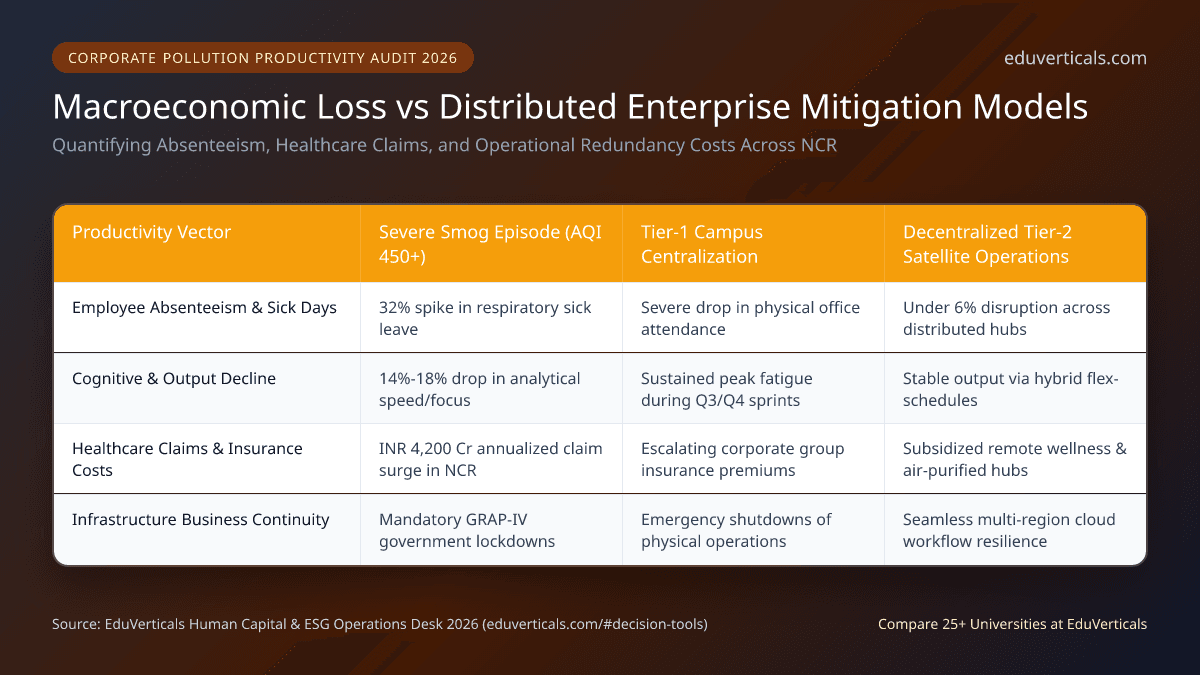
Comprehensive studies conducted across Fortune 500 corporate campuses in late 2026 reveal the hidden operational costs of seasonal pollution:
To insulate their operations from predictable seasonal pollution shocks, leading corporate enterprises are redesigning their organizational architectures around decentralized, hub-and-spoke models:
Rather than signing ten-year leases on monolithic 500,000-square-foot headquarters in Gurugram, companies are establishing distributed satellite operations across Tier-2 and Tier-3 urban centers—such as Chandigarh, Jaipur, Dehradun, Indore, and Kochi. Under this distributed architecture, corporate headquarters serve as executive collaboration nodes, while mission-critical engineering, data operations, and customer support are distributed across climatically resilient regions.
Executing this structural transition requires operations managers, HR leaders, and Chief Operating Officers who understand distributed workforce analytics, enterprise cloud business continuity, and dynamic real estate portfolio optimization.
Select your career goal to tailor advice
Master multi-site operations research, disaster recovery planning, and hybrid workplace frameworks. Explore executive programmes on EduVerticals.
The operational disruptions caused by climate and environmental events have redefined the role of operations executives. In the past, operations management focused primarily on physical facility maintenance, corporate travel coordination, and basic procurement.
In 2026, an effective Vice President of Operations must operate as a corporate risk architect. They are responsible for ensuring that whether Delhi-NCR faces a hazardous pollution shutdown or a coastal city experiences an extreme weather event, corporate P&L execution continues uninterrupted across multi-cloud, distributed human networks.
Professionals who possess technical engineering or project management backgrounds but lack formal management credentials in operations research, financial modeling, and organizational strategy are poorly equipped to lead these corporate transformations. Acquiring an accredited postgraduate business degree is the definitive vehicle for stepping into senior corporate leadership.
Working operations directors, facility leads, and HR managers cannot afford to abandon their current roles to pursue two years of residential education. A flexible, UGC-DEB entitled Online MBA from premier institutions such as Manipal University Jaipur (MUJ) or Symbiosis SSODL provides the ideal framework to acquire executive-level operations acumen.
Through specialized coursework in Operations & Supply Chain Analytics, Strategic Human Capital Management, Corporate Finance, and ESG Governance, working professionals learn how to optimize distributed teams, model capital allocation across regional satellite hubs, and present business continuity risk assessments to corporate boards.
Compare recognized university options, review curriculum specializations, and evaluate semester EMI plans on the EduVerticals Academic Catalog or test your projected career trajectory using .
Editorial BriefReading BriefLead Resilient Enterprise Operations: Explore specialized management programmes in Operations and ESG Leadership on EduVerticals Course Catalog and speak with an enterprise career advisor today.
Keep the details close
Explore key programme specifications, recognition terms, fee components, and career outcomes side by side before applying.
Severe AQI episodes reduce cognitive problem-solving speed by 14% to 18%, trigger a 30% to 35% surge in employee sick leave, and lead to mandatory government physical office closures under GRAP-IV regulations.
Bring programme options, estimated fees and study flexibility into one view, with the trade-offs and questions to verify.
Tailored shortlist from our admission partners. Verify fees and eligibility before applying.


We have a team of over 12 experienced mentors with over 26+ years of collective experience available to guide you at a moment's notice.