 Aditi Chouri
Posted 9 months ago
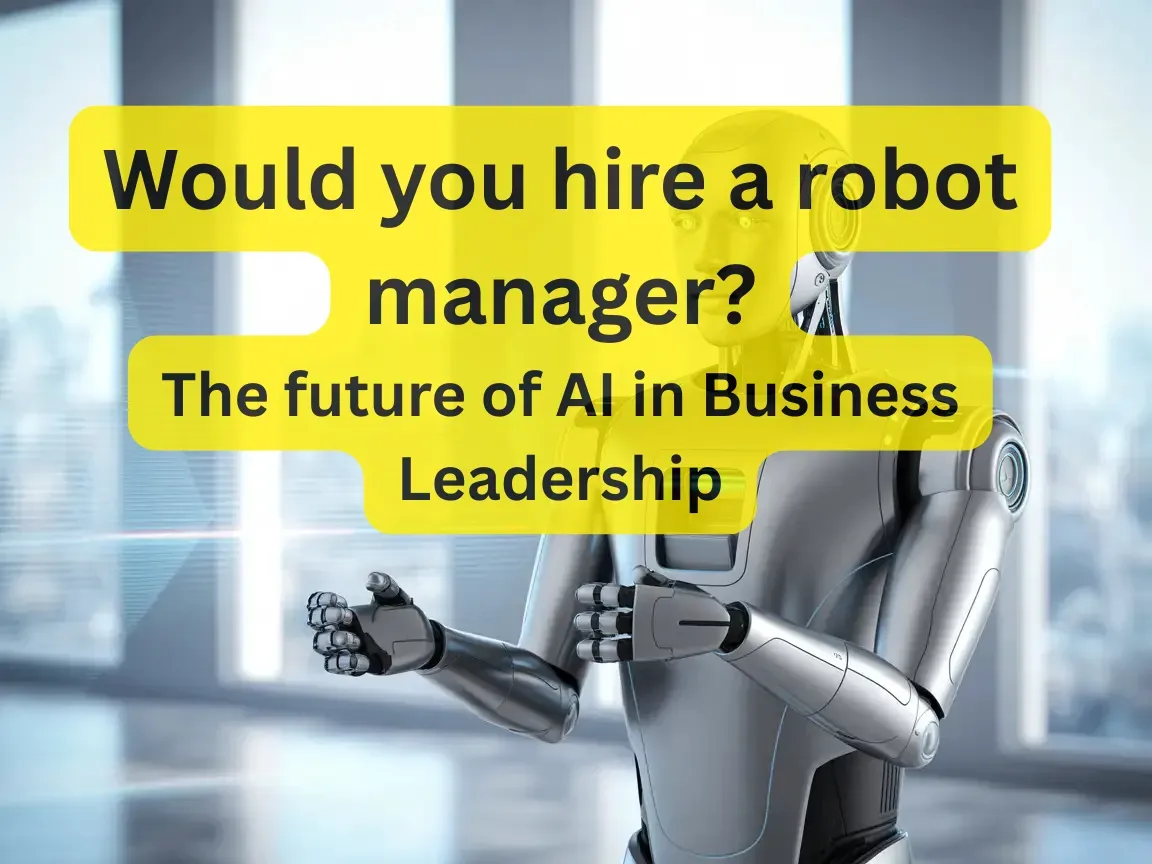
A few decades ago the idea of a robot running a company would have sounded like science fiction. Today it feels uncomfortably close to reality. Artificial intelligence already screens job applications, predicts consumer behavior, recommends strategic decisions and even evaluates employee performance. As technology continues to advance, the line between human leadership and machine guidance is slowly fading. This raises an intriguing question that business leaders across the world are beginning to consider seriously. Would you hire a robot manager.
This is not merely a futuristic thought experiment. It is a question about how organizations will be structured, how decisions will be made and what leadership itself will look like in the coming years. The future of business leadership will not be purely human nor purely artificial. It will be a complex partnership between people and intelligent systems.
Artificial intelligence has already become deeply embedded in modern business operations. In marketing, AI predicts which customers are most likely to purchase. In finance, algorithms analyze risks and detect fraud faster than any human team. In logistics, intelligent systems manage supply chains and optimize delivery routes in real time. In human resources, software tools evaluate resumes, schedule interviews and assess performance metrics.
These systems are not merely supporting workers anymore. In many organizations they are shaping decisions that were once the exclusive responsibility of senior managers. When a system determines which product features should be developed next or which markets deserve greater investment, it is participating directly in leadership functions. The idea of a robot manager no longer belongs to the future. It is already unfolding around us.
Before answering whether a robot could be a manager, it is important to understand what leadership truly involves. Leadership is not just about making decisions. It is about setting direction, motivating people, resolving conflicts, building trust and adapting to uncertainty. It requires emotional intelligence, ethical judgment and the ability to understand the human experience.
For centuries leadership has been considered a deeply human activity. People follow leaders not only because of their knowledge but because of their character, empathy and vision. The challenge for artificial intelligence is whether it can replicate or at least complement these qualities.
There are areas of management where artificial intelligence is already superior to humans. AI can process massive amounts of data without fatigue. It does not suffer from emotional bias, overconfidence or stress. It can evaluate thousands of variables simultaneously and generate optimal solutions based on evidence rather than intuition.
Consider a retail company deciding where to open its next store. A human executive might rely on experience and partial market research. An AI system can analyze demographic trends, consumer behavior, economic indicators, traffic patterns and social media sentiment in minutes. Its recommendation is not based on gut feeling but on measurable probability.
In operational leadership, this level of precision is invaluable. AI driven systems already schedule employees, manage inventory and forecast demand with remarkable accuracy. In these contexts, a robot manager does not feel unnatural at all. It feels efficient.
However leadership is not only about efficiency. It is about people. When an employee feels undervalued, anxious or demotivated, no spreadsheet can capture the full picture. A human manager reads subtle cues, listens between the lines and responds with compassion or firmness depending on the situation.
Artificial intelligence does not experience emotions. It can simulate emotional responses but it does not feel them. It can detect patterns in human behavior but it does not understand what it means to be human. When difficult conversations arise, such as layoffs, ethical dilemmas or personal crises, leadership requires moral reasoning and empathy that no algorithm truly possesses.
There is also the question of accountability. When an AI driven system makes a harmful decision, who is responsible. The developer, the company, the leadership team or the machine itself. This ethical ambiguity becomes more dangerous as AI takes on greater leadership roles.
Some companies are already experimenting with AI leadership. In Japan, a company appointed an AI system to a management role to analyze employee data and recommend promotions and task assignments. The goal was to reduce favoritism and improve productivity. While efficiency increased, many employees reported feeling uncomfortable being evaluated by a machine that could not understand their personal struggles or aspirations.
In China, several organizations use AI systems to monitor employee behavior and performance in real time. These systems track communication patterns, work output and even emotional tone in emails. Managers receive AI generated recommendations on who needs support and who is ready for leadership opportunities. While productivity improved, employees expressed concerns about privacy and psychological pressure.
These examples reveal both the power and the limitations of artificial intelligence in leadership roles. AI can enhance managerial effectiveness, but it also introduces new social and ethical challenges.
The future of business leadership will not be a choice between humans and machines. It will be a collaboration between the two. In this hybrid model, artificial intelligence becomes a strategic advisor rather than a replacement for human leadership.
A human CEO may rely on AI to analyze markets, predict risks and evaluate performance. But the CEO will still define the company vision, build culture and guide people through change. The AI provides intelligence. The human provides wisdom.
This partnership can dramatically improve decision making. When leaders combine emotional intelligence with data driven insight, they gain both clarity and compassion. This is where the true potential of AI in leadership lies.
As AI takes over analytical and administrative tasks, the role of human leaders will shift. Future managers will spend less time on operational details and more time on coaching, creativity and ethical leadership. Soft skills will become more valuable than ever.
Leaders will need to understand how AI works, how to question its recommendations and how to integrate its insights responsibly. The manager of tomorrow will not compete with machines. They will orchestrate them.
This shift will also change how organizations develop talent. Emotional intelligence, communication skills and ethical reasoning will become central leadership competencies. Technical knowledge alone will not be enough.
One of the greatest obstacles to robot managers is not technology. It is human acceptance. People want to feel seen, heard and understood by their leaders. Trust is built through shared experience and emotional connection. A machine cannot share the joy of success or the pain of failure.
Even if AI becomes capable of highly sophisticated communication, employees may still resist taking direction from a non human authority. Leadership is as much psychological as it is functional.
This is why most organizations that adopt AI leadership tools still rely on human managers as the face of leadership. People want a person to follow, not a program.
The introduction of AI into leadership raises deep ethical questions. Should machines influence hiring decisions. Should algorithms determine promotions and layoffs. How transparent should these systems be. How do organizations protect employee dignity and privacy in an AI driven workplace.
Cultural values also play a role. In societies that emphasize hierarchy and authority, AI leadership may be more readily accepted. In cultures that value personal relationships and emotional connection, resistance may be stronger.
There is no universal answer. Each organization will navigate this transition in its own way.
In the coming decade, artificial intelligence will continue to transform business leadership. Not through dramatic takeovers but through gradual integration. AI will become the silent partner in boardrooms, shaping strategy and optimizing performance.
The question is not whether robots will replace managers. The real question is whether human leaders are ready to evolve. Those who embrace AI as a tool for better leadership will thrive. Those who resist change may struggle.
Would you hire a robot manager. The answer for most organizations today is no. But would you hire an intelligent system that helps your managers make better decisions, reduce bias and improve performance. Almost certainly yes.
The future of business leadership will not be dominated by machines nor limited to humans. It will be defined by collaboration between intelligence and empathy, data and wisdom, automation and humanity.
In this new era, the most successful leaders will not be those who compete with artificial intelligence but those who learn how to lead alongside it.


We have a team of over 12 experienced mentors with over 26+ years of collective experience available to guide you at a moment's notice.