 EduVerticals Editorials
Posted 1 day ago

Executive SummaryReading BriefExecutive Summary: According to institutional investment data compiled in the Savills 9M 2026 report, India attracted an extraordinary $5.5 billion in commercial real estate (CRE) capital inflows, decisively overtaking China’s institutional office absorption for the first time in modern economic history. Global pension funds, private equity giants, and Fortune 500 enterprises are aggressively securing Grade-A office footprints across Bengaluru, Hyderabad, Pune, and the National Capital Region (NCR). However, this multi-billion-dollar physical asset expansion is not driven by legacy, low-cost IT support call centers. Instead, it reflects the rapid evolution of India into the world’s undisputed epicenter for Global Capability Centers (GCCs)—multinational innovation hubs driving artificial intelligence, global treasury operations, and quantitative risk modeling. For Indian professionals, this physical real estate boom translates directly into unprecedented demand for hybrid business-and-technology executives capable of commanding global P&L portfolios.
When global institutional investors—including Blackstone, Brookfield, GIC, and Mapletree—allocate capital to commercial real estate, they do not bet on speculative office vacancies. They follow corporate employment commitments. In late 2026, the primary driver of India’s commercial property leasing is the rapid expansion of more than 2,100 Global Capability Centers (GCCs) currently employing over 1.9 million high-skilled Indian professionals. Multinational corporate boards are leasing 500,000-square-foot campuses not merely to achieve basic labor arbitrage, but to anchor core corporate capabilities.
Yet this unprecedented physical infrastructure expansion has collided with a severe talent bottleneck: a scarcity of cross-functional enterprise leaders. While India produces an abundance of talented software coders, mechanical engineers, and financial accountants, multinational corporations report severe shortages of seasoned Managing Directors, Centers of Excellence (COE) Heads, and Global Shared Services Vice Presidents who can bridge technical execution with international corporate governance.
Institutional capital flows in 2026 show marked geographic concentration, reflecting the specialized domain clusters that have developed across India’s leading technology corridors.
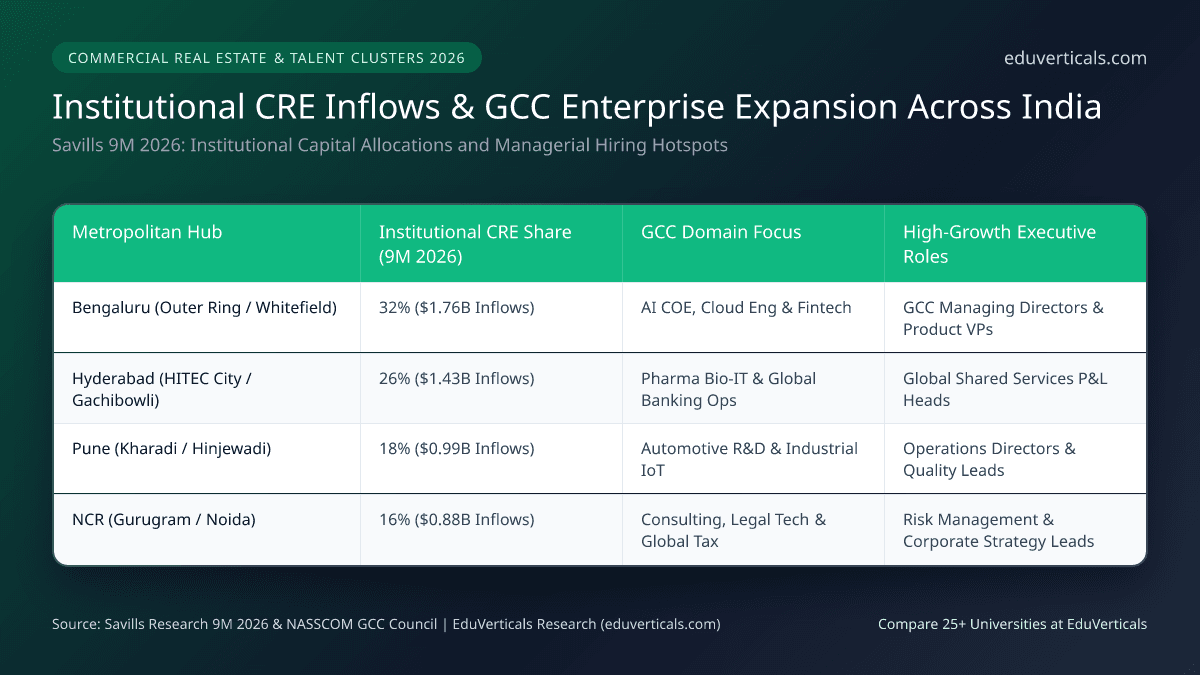
The shift in GCC responsibilities has created an executive leadership paradox. In legacy outsourcing arrangements, Indian project managers were evaluated primarily on service level agreement (SLA) adherence and staff billability. In modern GCCs, executives are evaluated on global product innovation, patent filings, capital allocation efficiency, and cross-border regulatory compliance.
When a multinational enterprise vests an Indian GCC with ownership over a global product line or an entire regional treasury portfolio, the Indian site head must interact directly with the corporate board of directors in New York, London, or Zurich. Technical pedigree is no longer sufficient; leaders must demonstrate boardroom eloquence, macroeconomic fluency, and structured strategic problem-solving.
Select your career goal to tailor advice
Align technical mastery with enterprise P&L management. Review the University Comparison Report or discuss with our team via Free Mentor Call.
Annual compensation for GCC Vice Presidents, Managing Directors, and COE Leaders in India now routinely spans ₹65 LPA to ₹1.5 Crore plus dollar-denominated restricted stock units (RSUs). For experienced tech architects, team leads, and project managers earning ₹20 LPA to ₹35 LPA, the transition to top-tier GCC executive roles requires acquiring recognized, formal postgraduate management credentials.
Because active technology and operations leaders cannot quit their lucrative full-time roles, flexible, UGC-DEB entitled Online MBAs have become the established leadership accelerator across Corporate India. Top programs such as Symbiosis Centre for Distance Learning / SSODL provide specialized curricula covering international business management, corporate strategy, enterprise analytics, and human capital leadership.
As examined in our deep-dive on The Future of AI Business Leadership, the leaders who capture premier leadership positions combine deep domain expertise with formal institutional management qualifications. To explore accredited management programs designed for working professionals, visit the EduVerticals Academic Catalog.
Accelerate Your GCC Executive Trajectory: Explore NIRF-ranked, UGC-DEB accredited executive management degree programs on .
Keep the details close
Explore key programme specifications, recognition terms, fee components, and career outcomes side by side before applying.
India’s commercial real estate boom is propelled by unprecedented multinational investment in Global Capability Centers (GCCs), favorable demographic talent tailwinds, English-speaking technological fluency, and sustained regulatory stability compared to tightening corporate governance in China.
Bring programme options, estimated fees and study flexibility into one view, with the trade-offs and questions to verify.
Tailored shortlist from our admission partners. Verify fees and eligibility before applying.


We have a team of over 12 experienced mentors with over 26+ years of collective experience available to guide you at a moment's notice.