 EduVerticals Editorials
Posted 1 day ago

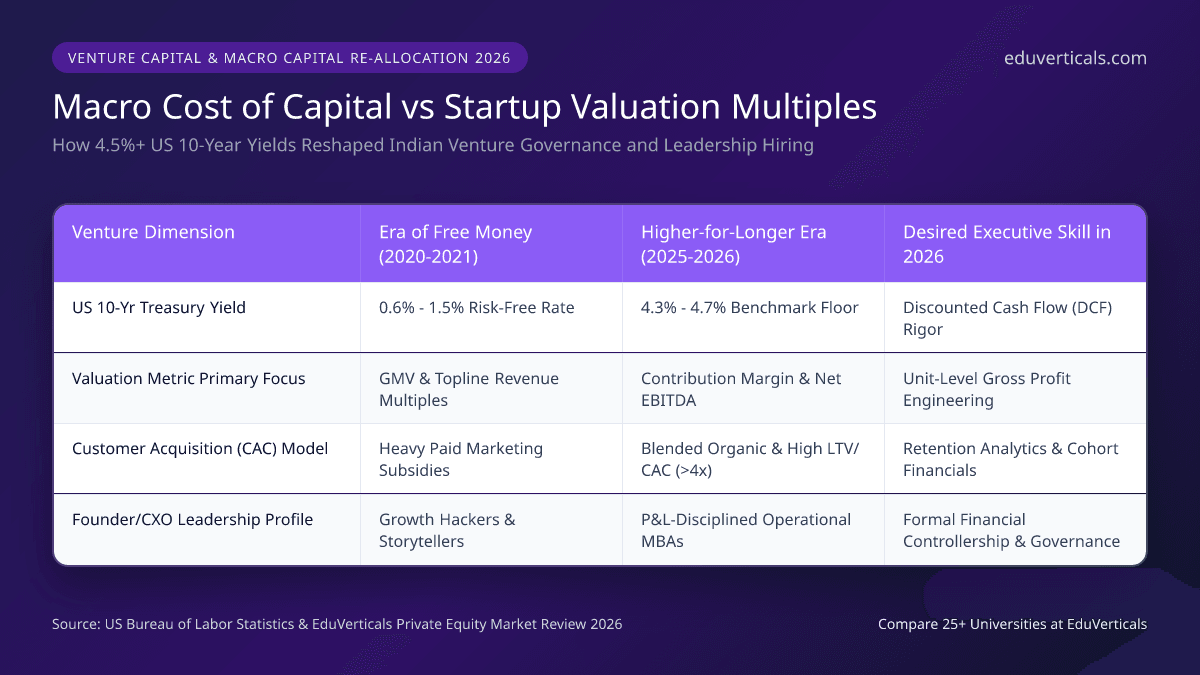
Executive SummaryReading BriefExecutive Summary: Hot wholesale inflation data reported in the US Producer Price Index (PPI) throughout late 2026 has firmly entrenched the Federal Reserve’s "higher-for-longer" monetary stance, cementing benchmark 10-year US Treasury yields above 4.5%. This macroeconomic anchor has completely reorganized the global cost of capital. In India’s startup and venture ecosystem, the era of zero-interest-rate blitzscaling—where unprofitable companies raised mega-rounds on Gross Merchandise Value (GMV) multiples—has permanently ended. Venture capital boards, private equity partners, and sovereign wealth investors are demanding strict unit economics: audited contribution margins (CM2), sustainable LTV-to-CAC ratios exceeding 4x, and clear paths to GAAP-audited EBITDA profitability. In this austere funding reality, corporate boards are ruthlessly replacing charisma-driven generalists with operationally disciplined, P&L-literate MBA managers.
When global bond yields rise, capital becomes expensive everywhere. When institutional investors can earn a guaranteed 4.5% to 5.0% risk-free return simply by holding US government debt obligations, their hurdle rate for allocating risk capital into emerging market equities, growth-stage tech startups, and pre-IPO unicorns increases substantially: investors now demand a minimum internal rate of return (IRR) of 20% to 25% net of currency depreciation. Cash burn is no longer viewed as a badge of aggressive expansion; it is treated as an existential balance sheet hazard.
For Indian startup executives across Bengaluru, Gurugram, Mumbai, and Hyderabad, this macroeconomic shift has fundamentally redefined executive survival. Growth marketers who spent millions on customer discounts and vanity ad spend are being sidelined. In their place, corporate boards are elevating managers who can dissect unit-level economics, calculate exact gross margin contribution per order, optimize vendor payment terms, and navigate rigorous corporate governance.
Understanding the connection between wholesale inflation in Washington and startup hiring in Koramangala or Cyber City requires following the transmission mechanism of global capital.
In the modern tech enterprise, every team lead, product director, and business head is expected to function as a micro-CFO. The era where engineering and product teams built features without understanding server hosting bills or customer churn financial implications is over.
Consider a software-as-a-service (SaaS) or e-commerce platform generating ₹100 crore in annual recurring revenue. Under traditional blitzscaling management, operating expenses might reach ₹160 crore (resulting in a ₹60 crore annual cash burn). A P&L-disciplined management team analyzes the unit economics line by line: renegotiating cloud infrastructure reserved instances to save 30% on hosting, weeding out unprofitable customer cohorts, and automating tier-1 customer success workflows.
Select your career goal to tailor advice
Strengthen financial modeling, pricing, and cohort retention. Review our University Comparison Report or discuss with mentors on a Free Mentor Call.
As Indian startups, unicorns, and mid-market enterprises seek sustainable profitability, hiring demand has shifted toward professionals with formal corporate finance, financial accounting, and managerial economics credentials. Tech leads, product managers, and operations heads who master corporate finance command significant salary premiums, with VP of Finance and Chief Operating Officer (COO) packages spanning ₹50 LPA to ₹1.2 Crore.
For working professionals, enrolling in an accredited, UGC-DEB entitled Online MBA in Finance or Business Analytics provides the exact mathematical and strategic grounding required by modern boards. Premier programs from NAAC A++ institutions offer comprehensive modules in financial statement analysis, corporate valuation, managerial accounting, and enterprise risk modeling.
As highlighted in our deep dive on The Future of AI Business Leadership, the professionals who rise to executive leadership are those who can translate technical capability into audited balance sheet value. To discover accredited online degrees designed for working tech and startup professionals, consult the EduVerticals Academic Catalog or evaluate specialized curricula in the EduVerticals Course Catalog.
Editorial BriefReading BriefTransform from Technical Contributor to P&L Executive: Compare top-tier Online MBA programs in Finance, Business Analytics, and Strategic Management on .
Keep the details close
Explore key programme specifications, recognition terms, fee components, and career outcomes side by side before applying.
When US Treasury yields stay elevated at 4.5%+, the global cost of capital increases. Institutional investors demand higher returns (20-25% IRR) for emerging market risk, shifting capital away from unprofitable startups toward cash-flow-positive, EBITDA-profitable enterprises.
Bring programme options, estimated fees and study flexibility into one view, with the trade-offs and questions to verify.
Tailored shortlist from our admission partners. Verify fees and eligibility before applying.


We have a team of over 12 experienced mentors with over 26+ years of collective experience available to guide you at a moment's notice.