 EduVerticals Editorials
Posted 1 day ago

Executive SummaryReading BriefExecutive Summary: In November 2026, international law enforcement task forces led by the US Department of Justice, the FBI, and European cyber agencies dismantled major transnational cybercriminal networks that generated over $400 million through synthetic-identity remote hiring schemes. Armed with real-time generative video disguises, voice-cloning software, and AI-assisted technical interview copilots, organized threat actors successfully infiltrated hundreds of Fortune 500 corporations, defense contractors, and multinational Global Capability Centers (GCCs). The perpetrators secured high-paying remote roles in software engineering, data analytics, and cloud administration—collecting unauthorized payroll while exfiltrating sensitive intellectual property and creating backdoor vulnerabilities. For Corporate India, which hosts over 1,800 GCCs employing nearly two million remote knowledge workers, talent acquisition is no longer merely a human resources function—it is a frontline enterprise cybersecurity and governance battlefield.
The shift to remote and distributed hybrid work models following 2020 delivered massive operational cost savings and expanded access to regional talent pools. However, it also dismantled traditional, in-person identity verification safeguards. In 2026, generative AI models can generate photorealistic video streams, mimic subtle facial micro-expressions, and deliver real-time voice conversion capable of deceiving veteran hiring managers during standard video interviews.
The threat is particularly acute across India’s Global Capability Centers, where multinational banks, healthcare conglomerates, and enterprise software giants manage core digital infrastructure. When a remote developer hired to maintain payment gateway APIs or medical patient databases turns out to be a synthetic persona operated by a hostile foreign syndicate, the legal, financial, and regulatory fallout is catastrophic.
Modern remote hiring scams have evolved far beyond basic resume embellishment into highly orchestrated cyber operations:
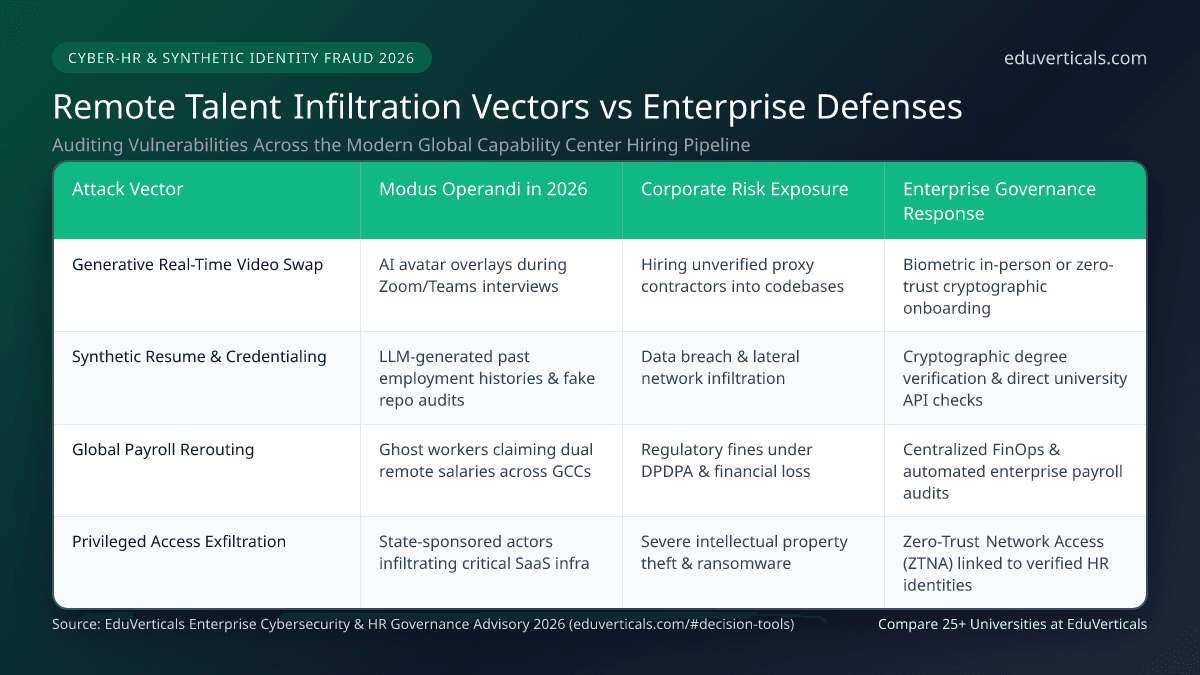
Under the Digital Personal Data Protection (DPDP) Act and updated CERT-In cybersecurity directives, Indian enterprises face statutory fines of up to ₹250 Crore for failing to maintain reasonable security safeguards against data breaches. If an unverified "ghost worker" compromises consumer financial data or proprietary medical records, corporate boards can no longer plead ignorance or blame a third-party staffing agency.
Consequently, Indian GCCs and IT service providers are overhauling their hiring pipelines. Leading enterprises now enforce multi-layered verification: mandatory physical hardware provisioning at regional satellite offices, in-person biometric authentication, direct cryptographic degree verification via university API registries, and continuous keystroke and behavioral telemetry.
Select your career goal to tailor advice
Bridge human capital management with zero-trust identity architectures and background verification protocols. Explore executive programmes on EduVerticals.
For decades, human resources management was viewed primarily through the lens of employee engagement, payroll administration, campus recruitment, and annual performance appraisal cycles. In 2026, that traditional skill set is dangerously incomplete. When an enterprise manages thousands of remote developers across fifty cities, the Chief Human Resources Officer (CHRO) must function as an equal partner to the Chief Information Security Officer (CISO) and General Counsel.
Enterprises are actively recruiting "Cyber-HR Leaders"—professionals who understand human behavioral dynamics and talent acquisition, but who also possess quantitative fluency in information security protocols, zero-trust network architectures, and forensic background auditing.
HR professionals who fail to adapt risk being relegated to administrative processing roles. Conversely, managers who acquire formal credentials in information systems governance, enterprise risk management, and strategic HR analytics are stepping into high-paying VP of People Risk and Director of Enterprise Governance roles with compensation packages exceeding ₹35L–₹65L.
Working human resources managers and operations specialists cannot put their careers on hold for two years to pursue full-time graduate education. A flexible, UGC-DEB entitled Online MBA from premier institutions such as NMIMS CDOE or Symbiosis SSODL provides the structured business and technical literacy required to lead modern enterprise workforce governance.
These accredited programmes offer specialized coursework in Information Systems Strategy, Human Resource Analytics, Corporate Legal Compliance, and Enterprise Risk Management. Students learn how to design automated background verification workflows, conduct internal cybersecurity audits, and lead incident response teams during identity fraud investigations.
Review recognized university accreditations, curriculum details, and semester EMI options on the EduVerticals Academic Catalog or evaluate your executive potential using .
Secure Your Enterprise Workforce: Discover how modern HR and operations leaders are mastering cyber governance and workforce analytics on EduVerticals Course Catalog.
Keep the details close
Explore key programme specifications, recognition terms, fee components, and career outcomes side by side before applying.
Syndicates use generative AI video face-swapping and voice-cloning software during live interviews, allowing unverified overseas operatives to impersonate qualified domestic candidates, obtain remote corporate access, and collect illicit salaries.
Bring programme options, estimated fees and study flexibility into one view, with the trade-offs and questions to verify.
Tailored shortlist from our admission partners. Verify fees and eligibility before applying.


We have a team of over 12 experienced mentors with over 26+ years of collective experience available to guide you at a moment's notice.