 EduVerticals Editorials
Posted 1 day ago
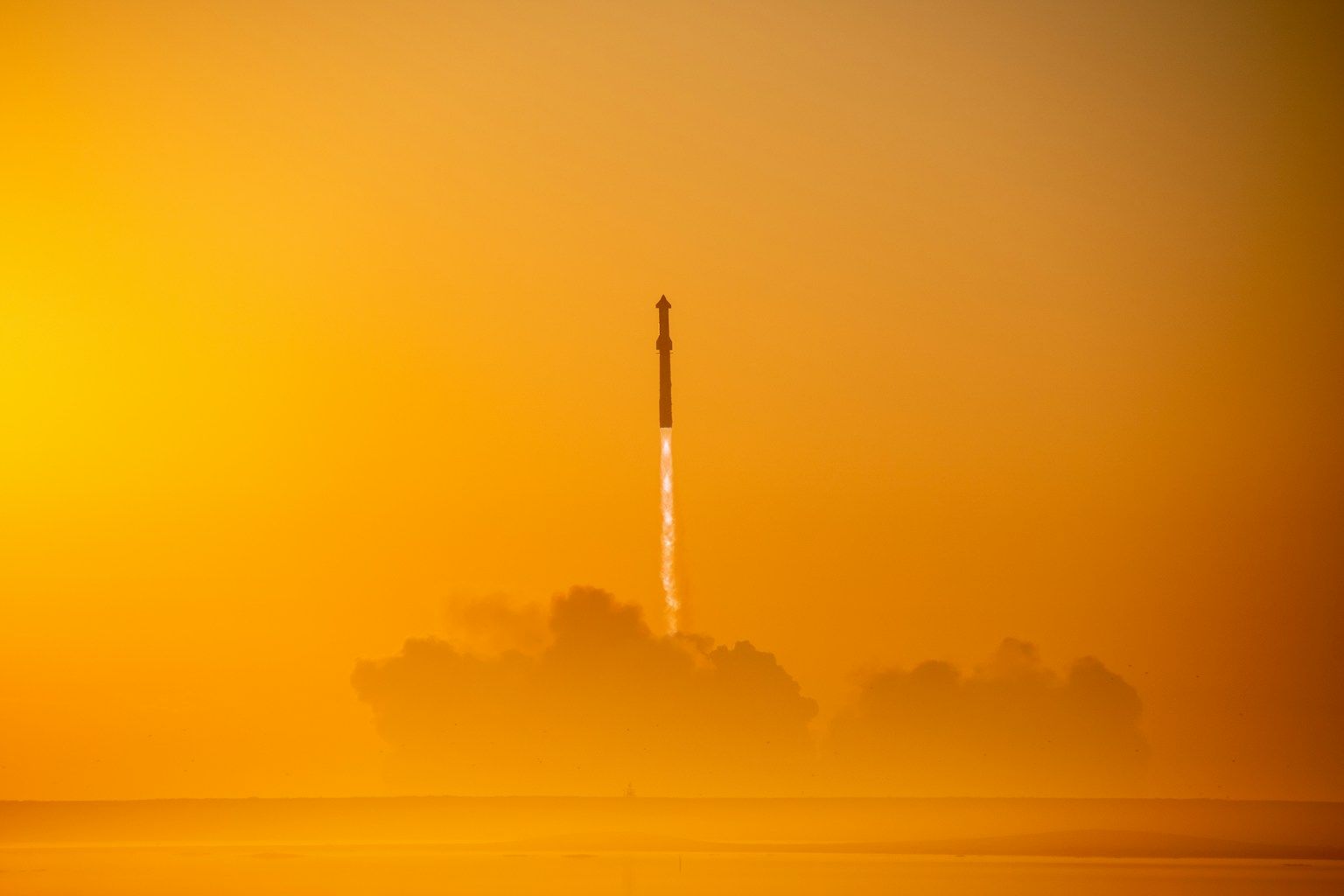
Executive SummaryReading BriefExecutive Summary: In November 2026, the global commercial space economy crossed an irreversible economic threshold. With fully reusable heavy-lift launch vehicles (pioneered by SpaceX’s Starship and matched by next-generation heavy-lift programs globally) achieving regular orbital payload deployment, the cost of lofting hardware into Low Earth Orbit (LEO) has plummeted from $10,000 per kilogram in the early 2000s to below $400 per kilogram today. Concurrently, in India, the private space sector authorized by IN-SPACe has transitioned from initial technology demonstrators to mature commercial scaling—with companies like Skyroot Aerospace, Agnikul Cosmos, Pixxel, and Dhruva Space securing multimillion-dollar international satellite deployment and Earth-observation analytics contracts. The primary constraint on the growth of the $1.8 trillion space economy is no longer rocket propulsion physics; it is the severe shortage of business leaders equipped with deep-tech venture finance, orbital supply chain logistics, and technology commercialization expertise.
For six decades, aerospace was governed by cost-plus government procurement: state agencies like NASA and ISRO funded multi-year, bespoke hardware programs where launch failure was unacceptable and commercial unit economics were an afterthought. The reusability revolution has dismantled that paradigm completely. Space is now an active commercial logistics domain governed by launch cadence, marginal cost per kilogram, insurance hedging, and venture capital returns.
In India, the opening of the space sector under IN-SPACe has catalyzed over 500 private space technology ventures spanning launch vehicle manufacturing, satellite bus assembly, hyperspectral Earth observation, and satellite ground station networks. However, turning advanced physics and rocketry patents into profitable, venture-backed enterprises requires executives who can build financial models, structure cross-border joint ventures, and navigate complex international regulatory regimes.
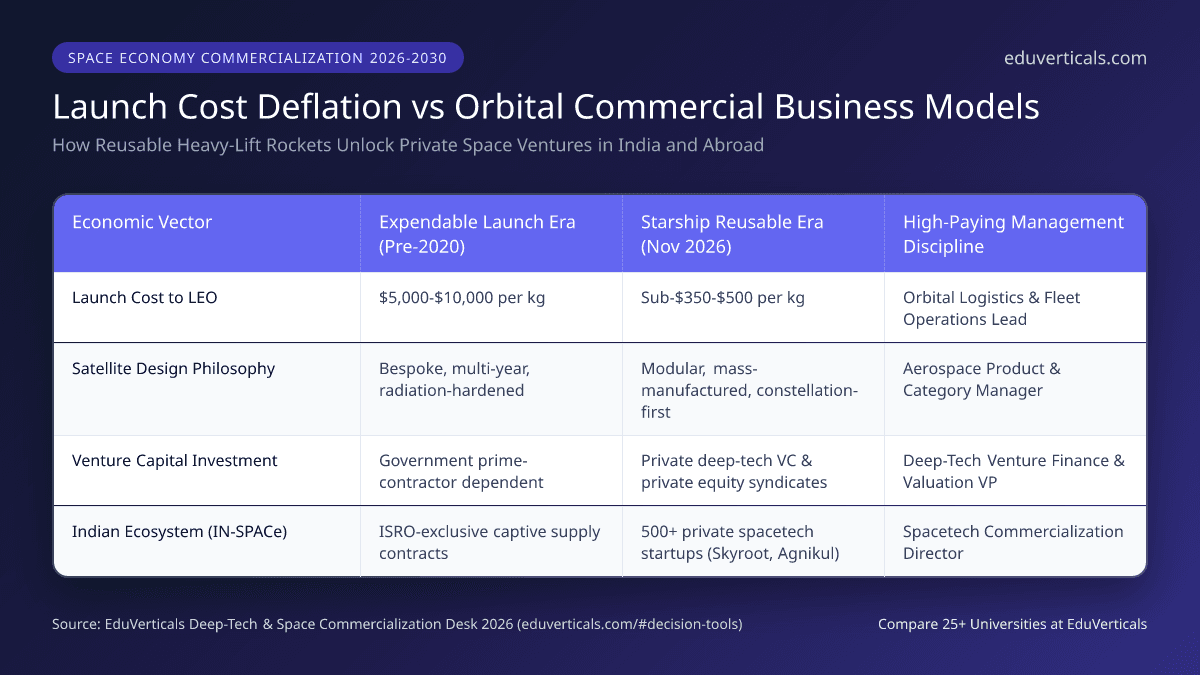
The collapse in launch costs has triggered a profound transformation across commercial space business models:
India’s commercial space transformation represents one of the most remarkable industrial stories of the decade. Rather than serving purely as component suppliers to ISRO, private Indian aerospace ventures are winning contracts from global constellation operators, defense departments, and multinational agricultural conglomerates:
Skyroot Aerospace’s Vikram series and Agnikul Cosmos’s Agnibaan have established reliable, on-demand small-satellite launch infrastructure from private launchpads at Sriharikota. Meanwhile, satellite intelligence firms like Pixxel have deployed commercial constellations of hyperspectral Earth-observation satellites delivering actionable analytics for mining, agriculture, and climate risk underwriting.
Yet as these startups raise Series B and Series C rounds ranging from $30 million to $100 million, their founders face critical management bottlenecks: managing complex international defense trade regulations (ITAR and Indian SCOMET guidelines), scaling multi-facility aerospace assembly lines, and establishing corporate governance structures ahead of domestic and overseas IPOs.
Select your career goal to tailor advice
Master venture capital term sheets, deep-tech valuation models, and milestone-based capital allocation. Explore top executive programmes on EduVerticals.
The aerospace and deep-tech sectors are filled with brilliant engineers with master’s and doctorate degrees in aerospace engineering, orbital mechanics, and thermal physics. However, brilliant technical designs do not guarantee commercial success. A rocket company that builds an innovative engine but fails to manage its cash burn, cannot negotiate supplier payment terms, or miscalculates launch insurance premiums will face insolvency within eighteen months.
Deep-tech venture capital firms (including Blume Ventures, Speciale Invest, and international aerospace funds) frequently cite the scarcity of "commercially fluent technical founders and executive operators" as their primary investment constraint. Technical professionals who can sit in an engineering design review in the morning and lead a Series B investor presentation or defense procurement negotiation in the afternoon command extraordinary influence and compensation.
By pursuing an accredited postgraduate management qualification, aerospace engineers acquire essential competencies in managerial economics, corporate accounting, strategic marketing, and organizational leadership, positioning themselves for Chief Operating Officer (COO), VP of Business Development, and General Manager appointments.
Deep-tech aerospace engineers and program managers operate in intense, high-stakes development cycles where taking two years off for full-time campus studies is career suicide. An accredited, UGC-DEB entitled Online MBA from premier institutions such as Manipal University Jaipur (MUJ) or VIT Online provides the perfect solution.
Through rigorous, asynchronous online courses combined with live weekend executive sessions, working engineers master Financial Decision Making, Technology Commercialization, Data Analytics, and Enterprise Risk Management. They learn how to model project return on investment, evaluate mergers and acquisitions, and lead high-performance engineering organizations.
Check curriculum specializations and evaluate university credentials on the EduVerticals Academic Catalog or test your projected compensation growth with .
Lead the $1.8 Trillion Space Economy: Explore flexible, accredited management degrees designed for engineering and deep-tech innovators on EduVerticals Course Catalog.
Keep the details close
Explore key programme specifications, recognition terms, fee components, and career outcomes side by side before applying.
Sub-$500/kg launch costs allow Indian startups to deploy smaller, modular satellite constellations at a fraction of historic capital costs, making commercial Earth observation, broadband, and IoT services economically viable.
Bring programme options, estimated fees and study flexibility into one view, with the trade-offs and questions to verify.
Tailored shortlist from our admission partners. Verify fees and eligibility before applying.


We have a team of over 12 experienced mentors with over 26+ years of collective experience available to guide you at a moment's notice.