 EduVerticals Editorials
Posted 1 day ago

Executive SummaryReading BriefExecutive Summary: When the Indian Computer Emergency Response Team (CERT-In) issued consecutive urgent advisories warning of active, in-the-wild exploitation of Chromium V8 zero-day vulnerabilities (CVE-2026-X), corporate security teams scrambled to push emergency browser updates across millions of enterprise endpoints. Yet inside boardroom audit committee meetings, Chief Information Security Officers (CISOs) and IT Directors faced a familiar disconnect: directors do not speak in memory corruption primitives, heap overflows, or CVSS scores—they evaluate cyber threats through balance-sheet exposure, business interruption costs, and regulatory penalties under India’s Digital Personal Data Protection Act (DPDPA 2023). Bridging this communication divide requires technical security leaders to master financial risk quantification, actuarial insurance modeling, and executive governance.
Browser-based zero-day exploits represent one of the most perilous attack vectors in modern corporate environments. Because modern enterprise workflows—from Salesforce CRM and Workday HRMS to internal cloud repositories—reside almost entirely within the browser DOM, a sandbox escape grants malicious actors immediate memory access to corporate session tokens, encrypted credentials, and proprietary code repositories.
For Indian enterprises, GCCs, and BFSI giants, CERT-In’s 2026 advisories were not academic exercises. State-sponsored threat actors and commercial spyware operators actively weaponized zero-day exploits against financial trading terminals, telecom infrastructure, and defense supply chains. Yet when CISOs requested capital budgets to deploy zero-trust endpoint isolation and automated patching pipelines, their requests were frequently trimmed by executive committees who perceived cybersecurity purely as a cost center rather than a strategic business enabler.
Security leaders often commit the fatal error of presenting raw vulnerability metrics to executive boards. Telling a board of directors that the enterprise has "over 1,400 unpatched CVEs across the server farm, including two high-severity V8 engine remote code execution bugs" produces paralysis rather than action. Directors lack the technical context to know whether that metric represents an existential crisis or standard operational background noise.
To secure executive capital budgets, forward-thinking CISOs translate technical vulnerabilities into the Factor Analysis of Information Risk (FAIR) framework:
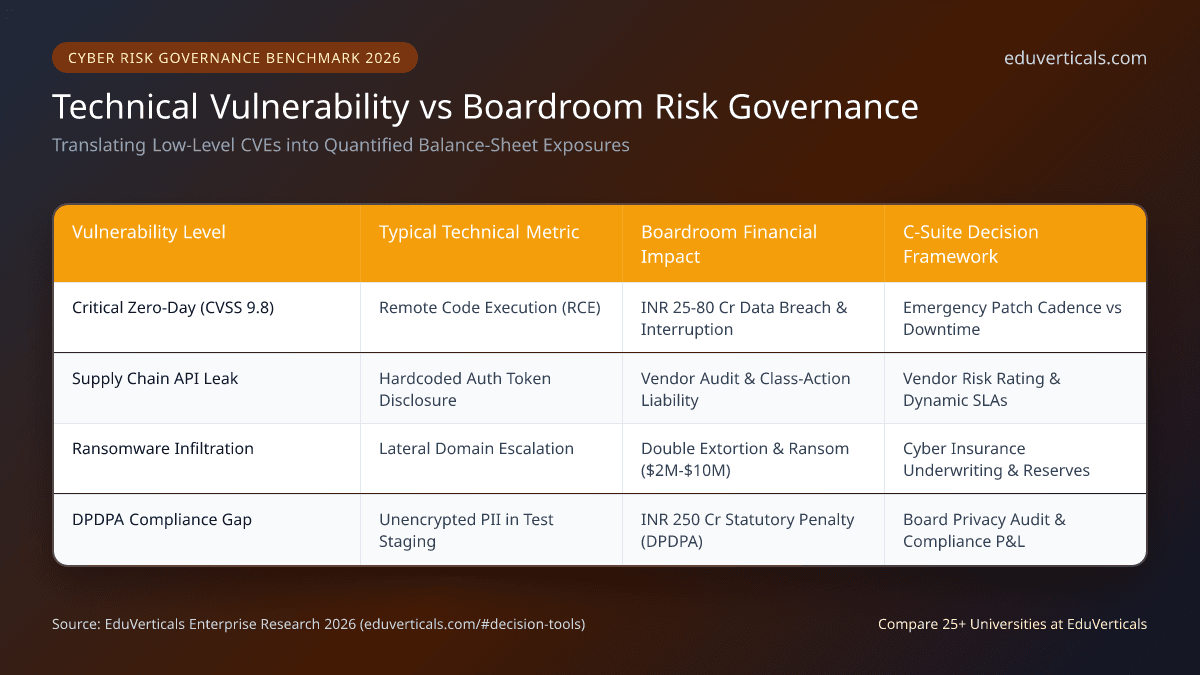
Modern enterprise cyber resilience requires a layered strategy that assumes zero-day compromise as an operational certainty rather than a theoretical possibility. Organizations must transition from reactive perimeter defense to resilient cyber governance.
Select your career goal to tailor advice
Master corporate finance and quantitative risk frameworks. Compare accredited online programs on EduVerticals University Compare.
The role of the Chief Information Security Officer has undergone a permanent structural transformation. A decade ago, CISOs were senior network engineers managing firewalls and intrusion detection systems in the basement. Today, the CISO reports directly to the Board Audit Committee, manages multi-crore insurance portfolios, and represents the enterprise during major M&A due diligence.
To command respect at the executive table, security professionals must master corporate accounting, organizational behavior, business ethics, and corporate strategy. Exploring leading management tracks such as the Executive Online MBA Programs offered by Symbiosis Centre for Distance Learning or deep-tech management curricula highlighted in The Future of AI & Business Leadership equips cybersecurity leaders with the strategic vocabulary required to lead enterprise-wide digital risk management.
Decision NoteReading BriefUpgrade from Technical Specialist to Boardroom Advisor: Discover how an accredited postgraduate business degree transforms your career trajectory on .
Keep the details close
Explore key programme specifications, recognition terms, fee components, and career outcomes side by side before applying.
A zero-day is a security flaw unknown to the vendor or without an available patch at the time of discovery. CERT-In issued emergency advisories because attackers were actively exploiting a Chromium V8 engine flaw to execute arbitrary code on Indian corporate systems.
Bring programme options, estimated fees and study flexibility into one view, with the trade-offs and questions to verify.
Tailored shortlist from our admission partners. Verify fees and eligibility before applying.


We have a team of over 12 experienced mentors with over 26+ years of collective experience available to guide you at a moment's notice.