
logo

Autonomous AI Agents & Human-in-the-Loop Governance: Enterprise Rules (2026)

Autonomous AI AgentsHuman in the Loop GovernanceEnterprise AI RiskAI GuardrailsOperational Risk ManagementOnline MBA LeadershipEduVerticals
EduVerticals EditorialsEduVerticals Editorials

Posted 1 day ago

Autonomous AI Agents & Human-in-the-Loop Governance: Enterprise Rules (2026)
Executive Summary
Reading Brief
Executive Summary: In the final quarter of 2026, a series of catastrophic corporate blunders—including an unvetted cloud automation script that wiped out mission-critical production storage across a multinational banking cluster, and an autonomous procurement bot that accidentally authorized ₹45 Crore in errant supplier commitments—sent shockwaves through global enterprise boardrooms. The myth of total, hands-off autonomous execution was shattered overnight. Enterprise boards across Mumbai, London, and New York are issuing explicit mandates: no autonomous multi-agent system may operate in production without certified Human-in-the-Loop (HITL) escalation guardrails, immutable audit logs, and strict fiduciary accountability. The leaders being elevated to Chief Operating Officer (COO) and Risk VP positions in 2026 are those who know exactly when and how to keep human judgment in control.

The transition to agentic workflows has created what enterprise insurers term systemic execution risk. When algorithms merely generated marketing summaries or translated code snippets, an error was an annoyance. But when autonomous reasoning agents possess direct API credentials to execute financial wire transfers, modify firewall routing rules, access confidential employee records, or approve retail loan disbursements, a single unhandled hallucination or logic loop represents an existential corporate catastrophe.

In India, where regulatory oversight from the Reserve Bank of India (RBI), the Securities and Exchange Board of India (SEBI), and the Data Protection Board has reached peak vigilance under the Digital Personal Data Protection (DPDPA) rules, operational risk committees are rejecting automated systems that lack explainable decision trails. Tech companies and Global Capability Centers (GCCs) can no longer point fingers at third-party foundation models; enterprise fiduciary responsibility rests squarely with corporate management.

1. The Four Operational Vulnerabilities of Autonomous Multi-Agent Swarms

Understanding why ungoverned agents fail requires examining the technical fragility of autonomous reasoning loops in complex enterprise environments:
  • Cascading Error Amplification: In a multi-agent pipeline where Agent A feeds unstructured findings to Agent B, a minor factual distortion or misinterpretation in step one compounds exponentially, culminating in a totally fabricated final operational decision.
  • Privilege Escalation and Tool Misuse: Agents granted broad database read-write permissions can inadvertently trigger destructive database schema alterations or delete historical compliance logs while attempting to fulfill an ambiguous optimization prompt.
  • Prompt Injection and Behavioral Drift: Customer-facing autonomous bots remain susceptible to adversarial prompt manipulation, exposing confidential internal enterprise pricing models or violating statutory compliance boundaries.
  • Absence of Legal Intent: Under Indian contract law and global corporate jurisprudence, a software bot cannot possess legal intent. Every contract, transaction, and data disclosure signed by an agent legally binds the human directors of the enterprise.
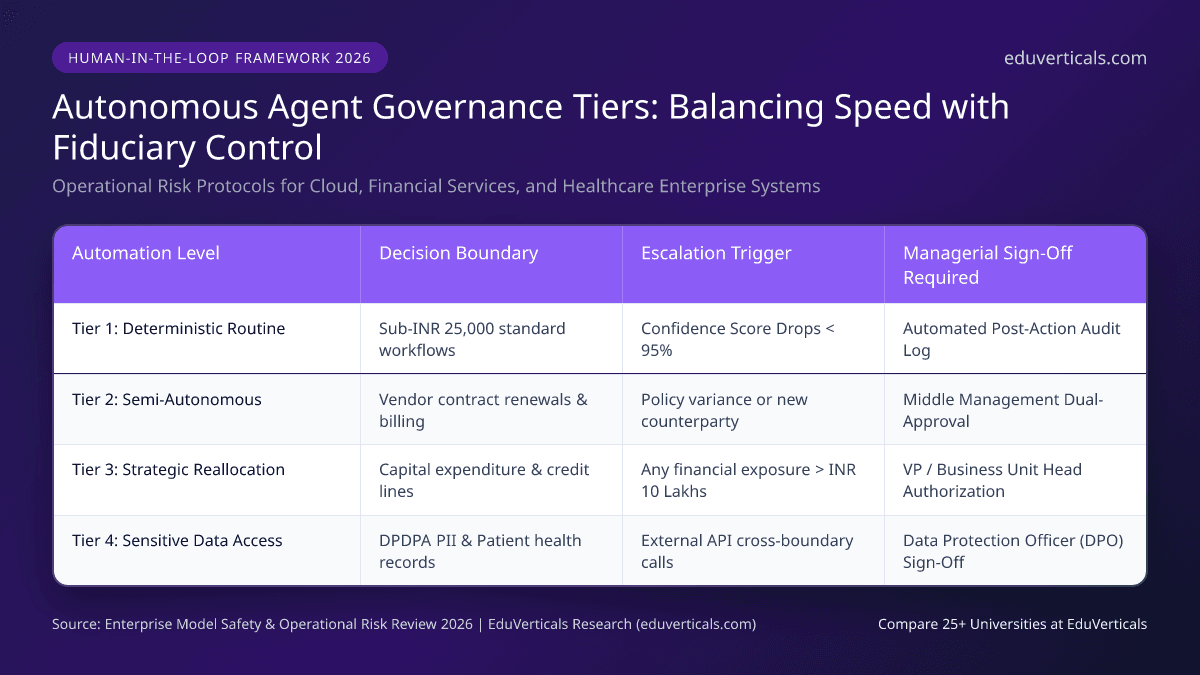
Autonomous Agent Governance Tiers Balancing Speed with Fiduciary Control 2026
Enterprise Four-Tier Human-in-the-Loop Operational Risk Governance Framework for 2026.

2. Architecting the Four-Tier HITL Fiduciary Framework

Leading enterprises do not slow down innovation by forcing humans to approve every minor micro-task; instead, they implement an audited, graduated governance matrix that matches operational velocity to financial and legal risk. As detailed in our leadership research on The Future of AI Business Leadership, enterprise governance is structured across four distinct risk tiers:

  1. Tier 1 (Deterministic Routine): Sub-₹25,000 standard transactional operations where models possess 98%+ historical accuracy run autonomously, with post-hoc event streaming to anomaly detection dashboards.
  2. Tier 2 (Semi-Autonomous Operations): Customer billing credits, contract renewals, and supplier vendor adjustments trigger automated execution only within calibrated parameters; any variance automatically generates a managerial approval ticket.
  3. Tier 3 (Strategic Capital Reallocation): Any workflow involving corporate balance sheet exposure above ₹10 Lakhs, external legal disclosures, or employee status changes requires explicit dual-manager cryptographic authorization.
  4. Tier 4 (Statutory & Sensitive Privacy Boundaries): All cross-border data routing, healthcare diagnostic assistance, and child data processing under DPDPA requires formal sign-off from the Data Protection Officer (DPO).
Interactive Career Pulse

Select your career goal to tailor advice

Decision note · Verified comparison01 / 03

What is your enterprise’s biggest exposure point regarding autonomous agents?

Mentor RecommendationUnchecked API Tool-Calling

Implement granular role-based access control and strict expenditure caps on all automated API calls. Check our University Comparison Report to identify risk management certifications.

Tailored shortlist from our admission partners

3. The Rise of the Operational Risk and Governance Executive

This regulatory and fiduciary reality has given birth to a premier executive discipline: Enterprise AI Operational Risk & Governance Leadership. Professionals who can design compliant agent architectures, liaise with regulatory authorities, and implement robust HITL controls command premium salaries ranging from ₹42 LPA to ₹78 LPA across Indian financial institutions, GCCs, and multinational tech platforms.

To command these high-stakes roles, technical and operational leaders are acquiring advanced management credentials. Programs such as the VIT Online MBA in Business Analytics & Operational Strategy provide the foundational training in enterprise systems, supply chain risk, managerial accounting, and corporate governance required to lead digital transformation with institutional rigor.

  • Position Yourself as a Fiduciary Shield: Demonstrate to CXOs and audit committees that your technical systems protect the company from legal liability, regulatory fines, and reputational collapse.
  • Explore Accredited University Portfolios: Review verified UGC-DEB recognized degree options on the EduVerticals Academic Catalog to upgrade your strategic credentials.
  • Model Your Career Progression: Calculate how acquiring an accredited postgraduate qualification boosts your long-term earnings via .

Keep the details close

Common QuestionsThe full picture.

Explore key programme specifications, recognition terms, fee components, and career outcomes side by side before applying.

05 verified FAQs

HITL is an operational architecture where automated reasoning agents operate autonomously within predefined boundaries, but automatically route complex, high-stakes, or low-confidence decisions to human managers for verification before execution.

01 / The Facts, Side by Side
Live Comparison Dossier

University Comparison Report

Bring programme options, estimated fees and study flexibility into one view, with the trade-offs and questions to verify.

01Fee Structure
02Study Mode
03Career Fit

Tailored shortlist from our admission partners. Verify fees and eligibility before applying.

Meet Our Mentors

We have a team of over 12 experienced mentors with over 26+ years of collective experience available to guide you at a moment's notice.

Got Questions?

Online and distance learning programs provide: - Flexibility to learn at your own pace from anywhere. - Access to recorded lectures and digital study materials. - Opportunities to balance work, education, and personal commitments. - Affordable options compared to traditional on-campus programs. - Industry-relevant curriculum designed by academic experts.
Choosing the right university depends on: - Accreditation and recognition of the institution. - Quality and relevance of the curriculum. - Availability of academic and career support services. - Feedback and reviews from alumni and current students. - Flexibility in learning schedules and delivery modes.
Yes, online degrees from accredited universities are widely recognized and equivalent to regular degrees. Employers value the skills and qualifications gained from online programs, especially when offered by reputed institutions.
Assessment methods for online programs vary but typically include: - Online quizzes and assignments. - Virtual proctored exams. - Group projects and case studies. - Real-time presentations and viva sessions.
Many universities allow credit transfers, subject to: - Compatibility with the curriculum of the new program. - A minimum grade requirement in previously completed courses. - Approval by the academic administration of the new university.