 EduVerticals Editorials
Posted 1 day ago

Executive SummaryReading BriefExecutive Summary: Anthropic’s landmark amended S-1 IPO filing in late 2026 crystallized the defining financial paradox of the artificial intelligence era. While annualized contract values for Claude enterprise deployments surpassed $3.8 billion across Fortune 500 multinationals and Indian Global Capability Centers (GCCs), public filings revealed gross software margins hovering near 38%—a far cry from legacy cloud software margins of 75% to 85%. Runaway GPU cluster amortization, token inference overhead, and dynamic context caching costs have triggered unprecedented boardroom scrutiny. For Indian technology directors, engineering managers, and finance controllers, managing AI is no longer a prompt engineering exercise; it is an urgent discipline of unit economics, margin defense, and capital allocation.
When Anthropic filed its updated prospectus with the US SEC, Dalal Street and Wall Street analysts immediately zeroed in on a single metric: the inference-to-revenue burn ratio. For three years, enterprise software buyers treated generative AI experimentation as an innovation expense. Venture capital subsidized subsidized token pricing, and enterprise licenses were procured on open-ended credit cards. By November 2026, that era of reckless deployment has permanently ended. Enterprise CFOs are freezing pilot projects that cannot demonstrate a positive contribution margin after factoring in GPU compute, retrieval latency, and model fine-tuning cycles.
In India’s tier-1 technology corridors—spanning Bengaluru’s Outer Ring Road, Hyderabad’s HITEC City, and Pune’s Hinjawadi—over 2,100 Global Capability Centers (GCCs) are directly in the crosshairs of this financial realignment. Indian engineering teams who previously focused exclusively on model latency and accuracy benchmarks (MMLU and HumanEval scores) are being summoned into quarterly business reviews to justify their Cloud FinOps and infrastructure payback periods.
Traditional software-as-a-service (SaaS) businesses achieved astronomical valuations because the marginal cost of serving an additional user approached zero. Once the application codebase was deployed on AWS or Azure, each new subscriber delivered 80% to 90% incremental gross profit. Foundation models broke this foundational economic assumption.
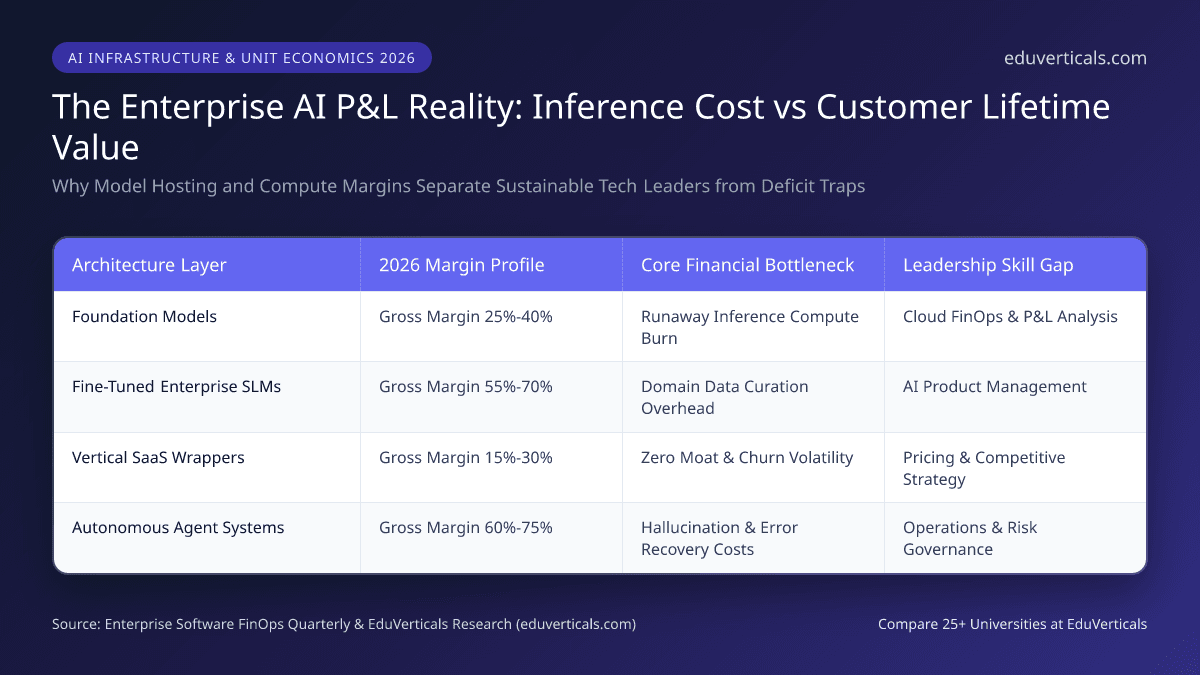
Rather than abandoning artificial intelligence initiatives, sophisticated technology leaders are executing aggressive architectural shifts to rescue unit economics. The primary breakthrough of 2026 is the migration toward hybrid tiered inference architecture. Instead of sending every employee query to an expensive frontier model, systems now route 75% of routine requests to compact, fine-tuned Small Language Models (SLMs) hosted on cost-effective local silicon, reserving multi-billion parameter foundation models strictly for complex strategic synthesis.
As we analyzed in our foundational study on The Future of AI Business Leadership, the technical professionals securing VP and Director-level promotions in 2026 are not the individuals writing raw prompt templates. They are the strategic orchestrators who can design multi-model routing topologies, negotiate volume-tiered reserved GPU instances, and defend an enterprise software gross margin above 60%.
Select your career goal to tailor advice
Implement prompt token caching, strict semantic routing, and cost-per-query telemetry. Compare specialized analytics electives in our University Comparison Report to master cloud FinOps.
The fallout from Anthropic’s public market debut makes one reality undeniable: the ceiling for pure technical individual contributors has lowered, while the compensation for commercially fluent engineering leaders has exploded. In Indian corporate hiring circles, compensation packages ranging from ₹45 LPA to ₹85 LPA + performance equity are routinely awarded to Engineering Directors and Principal Product Managers who possess formal P&L ownership skills.
Technical professionals are increasingly bridging this capability gap through accredited higher education. Rather than abandoning lucrative full-time positions, forward-thinking managers are enrolling in premier UGC-DEB entitled programs such as the NMIMS CDOE Online MBA in Business Analytics & Finance, where they master discounted cash flow (DCF) modeling, corporate treasury, capital budgeting, and operational scalability without losing a single month of senior industry experience.
Keep the details close
Explore key programme specifications, recognition terms, fee components, and career outcomes side by side before applying.
The prospectus revealed that continuous GPU inference, high-memory context caching, and foundation model infrastructure consume 55% to 65% of enterprise contract value, challenging the traditional 80%+ gross margin expectations of enterprise software investors.
Bring programme options, estimated fees and study flexibility into one view, with the trade-offs and questions to verify.
Tailored shortlist from our admission partners. Verify fees and eligibility before applying.


We have a team of over 12 experienced mentors with over 26+ years of collective experience available to guide you at a moment's notice.