
logo

AI Governance, DPDPA Audits & Risk Management Careers in India (2026)

AI Governance CareersIndia DPDPA ComplianceEnterprise AI Risk AuditEU AI Act EnforcementCorporate Legal TechOnline MBA Risk ManagementEduVerticals
EduVerticals EditorialsEduVerticals Editorials

Posted 1 day ago

AI Governance, DPDPA Audits & Risk Management Careers in India (2026)
Executive Summary
Reading Brief
Executive Summary: The regulatory landscape governing enterprise technology experienced a seismic realignment throughout 2026. The full operational enforcement of India’s Digital Personal Data Protection (DPDPA) rules, combined with binding compliance deadlines under the European Union’s landmark AI Act and the Reserve Bank of India’s (RBI) directives on algorithmic underwriting, has permanently ended the era of unregulated corporate AI experimentation. With non-compliance penalties reaching ₹250 Crore per violation in India and up to 7% of global annual turnover in the EU, corporate boards are in a state of high alert. This regulatory enforcement wave has catalyzed one of the most lucrative and resilient executive career tracks of the decade: Enterprise AI Governance, Algorithmic Auditing, and Corporate Risk Management.

Historically, regulatory compliance was viewed as a passive back-office check-the-box function staffed by legal teams after software products were already deployed. In 2026, that sequential approach is an enterprise death sentence. When automated models process millions of customer KYC documents, score retail credit applications, analyze health diagnostic images, or filter job candidate resumes, algorithmic bias or unauthorized data scraping can trigger immediate regulatory shutdown notices and catastrophic public relations disasters.

In India’s expanding corporate hubs—from Mumbai’s Bandra-Kurla Complex (BKC) to Gurugram’s Cyber City and Bengaluru’s technology corridors—every bank, multinational GCC, healthcare network, and listed enterprise is establishing a dedicated Model Risk Management (MRM) and Algorithmic Governance Committee. Chief Executive Officers are actively seeking leaders who can speak the dual languages of deep learning architecture and statutory jurisprudence.

1. The Global Regulatory Pincer: Mapping DPDPA, EU AI Act, and RBI Directives

Corporate compliance leaders in 2026 must navigate a complex mosaic of overlapping domestic and international regulatory frameworks:
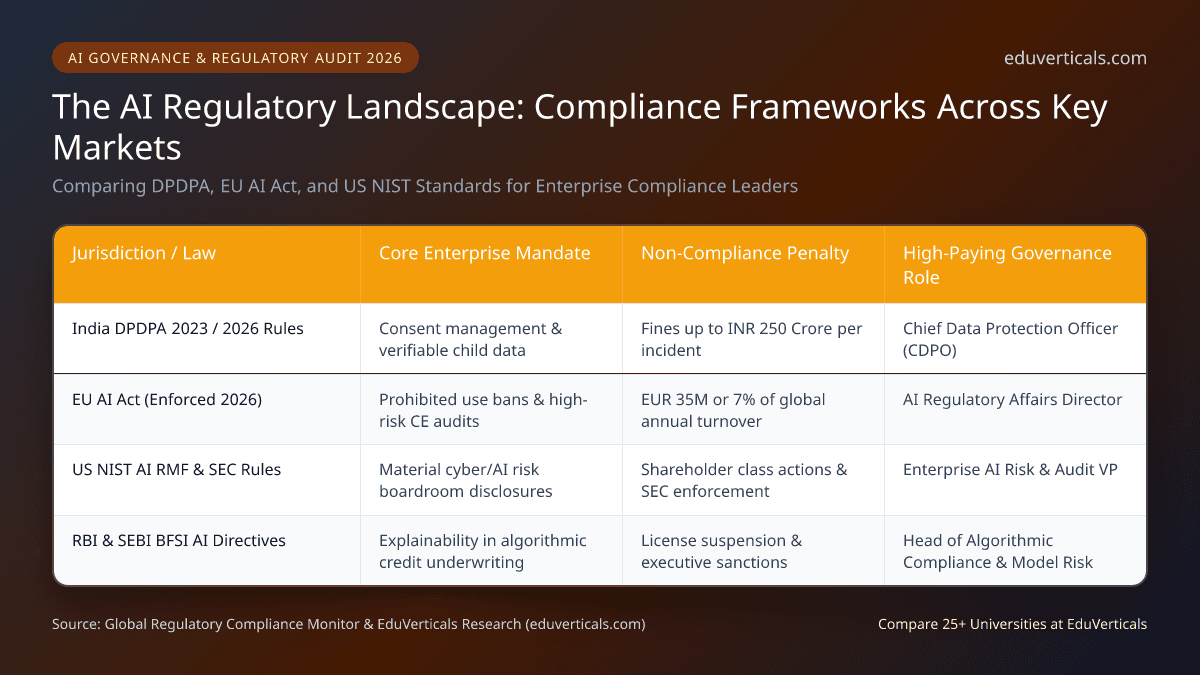
  • India’s DPDPA 2023/2026 Enforcement: Mandates verifiable parental consent for minors, strict data minimization principles, explicit consent architecture for every training data pipeline, and statutory penalties up to ₹250 Crore per breach under the newly operational Data Protection Board of India.
  • The European Union AI Act: Classifies enterprise AI systems into strict risk tiers. High-risk applications (including biometric identification, employment screening, and credit scoring) require comprehensive technical documentation, third-party CE-mark audits, and continuous human oversight under penalty of €35 million or 7% of worldwide turnover.
  • RBI and SEBI BFSI Directives: Indian financial regulators mandate that all algorithmic credit underwriting, fraud detection, and automated trading algorithms possess full mathematical explainability, prohibiting "black-box" decision models that cannot produce human-interpretable audit trails.
  • US SEC Cyber and AI Material Disclosures: Publicly traded multinationals must disclose material operational risks, data lineage dependencies, and hallucination vulnerabilities in quarterly filings under threat of federal securities litigation.
AI Regulatory Landscape Compliance Frameworks Across Key Markets 2026
Comparative Matrix of Enterprise AI Regulatory Frameworks, Non-Compliance Penalties, and Leadership Roles in 2026.

2. Inside the Enterprise Model Audit: What Risk Officers Actually Inspect

Modern algorithmic auditing has evolved into an exacting scientific and operational discipline. As explored in our strategic analysis of The Future of AI Business Leadership, enterprise audit committees scrutinize four foundational pillars:

  1. Data Lineage and Consent Provenance: Verifying the cryptographic chain of custody for every training token, ensuring that proprietary corporate data sets and user PII were acquired with legally enforceable consent.
  2. Algorithmic Bias and Disparate Impact Auditing: Subjecting automated hiring, promotion, and lending algorithms to rigorous statistical stress tests across demographic, gender, and regional categories.
  3. Adversarial Robustness and Jailbreak Defense: Testing system vulnerabilities against prompt injection, model poisoning, and unauthorized extraction of underlying training weights.
  4. Continuous Production Telemetry: Deploying automated monitors that detect model drift, hallucination frequency spikes, and semantic policy violations in real time.
Interactive Career Pulse

Select your career goal to tailor advice

Decision note · Verified comparison01 / 03

How prepared is your organization for mandatory algorithmic and data privacy audits?

Mentor RecommendationEarly Stage: Minimal Formal Documentation

Risk exposure is severe under DPDPA and RBI audits. Review our University Comparison Report to identify specialized business law and compliance curricula.

Tailored shortlist from our admission partners

3. The Executive Career Boom: High-Paying Roles in AI Risk & Governance

This regulatory wave has triggered an executive compensation boom. Roles like Chief Data Protection Officer (CDPO), Head of Algorithmic Risk, and Director of Enterprise AI Compliance command annual compensation packages ranging from ₹48 LPA to ₹95 LPA in Indian corporate hubs, with international postings in Singapore, London, and Dubai reaching $220,000+.

Technical specialists and corporate lawyers are actively upgrading their commercial capabilities by enrolling in the NMIMS CDOE Online MBA in Business Analytics & Corporate Governance, which delivers the interdisciplinary mastery of enterprise risk management, corporate finance, regulatory compliance, and digital strategy required to lead in boardrooms.

  • Turn Compliance into a Commercial Asset: Companies with certified governance frameworks win enterprise RFP contracts 40% faster by assuring clients of complete regulatory safety.
  • Explore Accredited University Portfolios: Inspect comprehensive curriculum comparisons on the EduVerticals Academic Catalog to identify leading management programs.
  • Model Your Long-Term ROI: Evaluate how an accredited executive degree impacts your five-year salary progression via .

Keep the details close

Common QuestionsThe full picture.

Explore key programme specifications, recognition terms, fee components, and career outcomes side by side before applying.

05 verified FAQs

India’s Data Protection Board can levy statutory financial penalties of up to ₹250 Crore per incident for significant data breaches, failure to implement reasonable security safeguards, or unauthorized processing of personal data.

01 / The Facts, Side by Side
Live Comparison Dossier

University Comparison Report

Bring programme options, estimated fees and study flexibility into one view, with the trade-offs and questions to verify.

01Fee Structure
02Study Mode
03Career Fit

Tailored shortlist from our admission partners. Verify fees and eligibility before applying.

Meet Our Mentors

We have a team of over 12 experienced mentors with over 26+ years of collective experience available to guide you at a moment's notice.

Got Questions?

Online and distance learning programs provide: - Flexibility to learn at your own pace from anywhere. - Access to recorded lectures and digital study materials. - Opportunities to balance work, education, and personal commitments. - Affordable options compared to traditional on-campus programs. - Industry-relevant curriculum designed by academic experts.
Choosing the right university depends on: - Accreditation and recognition of the institution. - Quality and relevance of the curriculum. - Availability of academic and career support services. - Feedback and reviews from alumni and current students. - Flexibility in learning schedules and delivery modes.
Yes, online degrees from accredited universities are widely recognized and equivalent to regular degrees. Employers value the skills and qualifications gained from online programs, especially when offered by reputed institutions.
Assessment methods for online programs vary but typically include: - Online quizzes and assignments. - Virtual proctored exams. - Group projects and case studies. - Real-time presentations and viva sessions.
Many universities allow credit transfers, subject to: - Compatibility with the curriculum of the new program. - A minimum grade requirement in previously completed courses. - Approval by the academic administration of the new university.