
logo

AI Dot-Com Bubble Warnings & Enterprise ROI: CFO Budget Scrutiny in 2026

AI Dot Com BubbleEnterprise AI ROICFO Budget ScrutinyCapital Allocation 2026AI Capex JustificationOnline MBA FinanceEduVerticals
EduVerticals EditorialsEduVerticals Editorials

Posted 1 day ago

AI Dot-Com Bubble Warnings & Enterprise ROI: CFO Budget Scrutiny in 2026
Executive Summary
Reading Brief
Executive Summary: Throughout 2026, a drumbeat of stark warnings from Wall Street investment banks, Dalal Street equity research desks, and corporate treasury committees drew uncomfortable parallels between generative AI capital expenditures and the dot-com bubble of 2000. With global tech giants allocating over $300 billion annually to data center construction and enterprise software licenses, Chief Financial Officers are asking a brutal, long-overdue question: where is the cash return? In Corporate India, the era of unvetted AI proof-of-concept budgets has evaporated. Finance and operational managers who cannot demonstrate hard payback schedules, cost-to-serve reductions, and measurable EBITDA expansion are seeing their projects terminated and their capital reallocated.

The late-2026 macroeconomic reality is unforgiving. Interest rates remain sticky, corporate debt refinancing costs have risen, and shareholders are demanding bottom-line cash generation over futuristic product demos. In major Indian conglomerates—from Tata Sons and Reliance to Infosys, Wipro, and HDFC Bank—IT budgets are undergoing forensic audits to strip out redundant generative software subscriptions and underutilized cloud GPU clusters.

This corporate belt-tightening does not represent the end of artificial intelligence; rather, it represents the maturation of enterprise AI from an R&D novelty into an audited operational asset. The professionals thriving in this environment are not the tech evangelists preaching vague transformative potential, but the commercially disciplined managers who can calculate the Internal Rate of Return (IRR) on a technology deployment down to the basis point.

1. Why the AI Capex Froth Collapsed: Anatomy of Failed Pilot Programs

Between 2023 and 2025, enterprise IT departments launched thousands of AI initiatives characterized by what corporate auditors term "pilot purgatory." Four structural flaws caused these experiments to fail financial scrutiny in 2026:
  • Confusing Adoption with Economic Value: Teams celebrated that 80% of employees used generative writing assistants weekly, yet overall departmental output, client billing velocity, and administrative headcount expenses remained entirely unchanged.
  • Unmodeled Inference Scaling Curves: Business cases were modeled on cheap initial development API tiers, only to suffer massive cost explosions when full customer transactional volume overwhelmed production GPU pipelines.
  • Integration Debt and Manual Verification: Because automated systems frequently produced subtle hallucinations, companies had to hire expensive external consultants to manually double-check automated outputs, effectively wiping out anticipated labor savings.
  • Shelfware License Sprawl: Enterprises accumulated overlapping subscriptions for coding assistants, document search engines, and marketing copy tools, generating zero operational cohesion while saddling IT P&Ls with recurring liabilities.
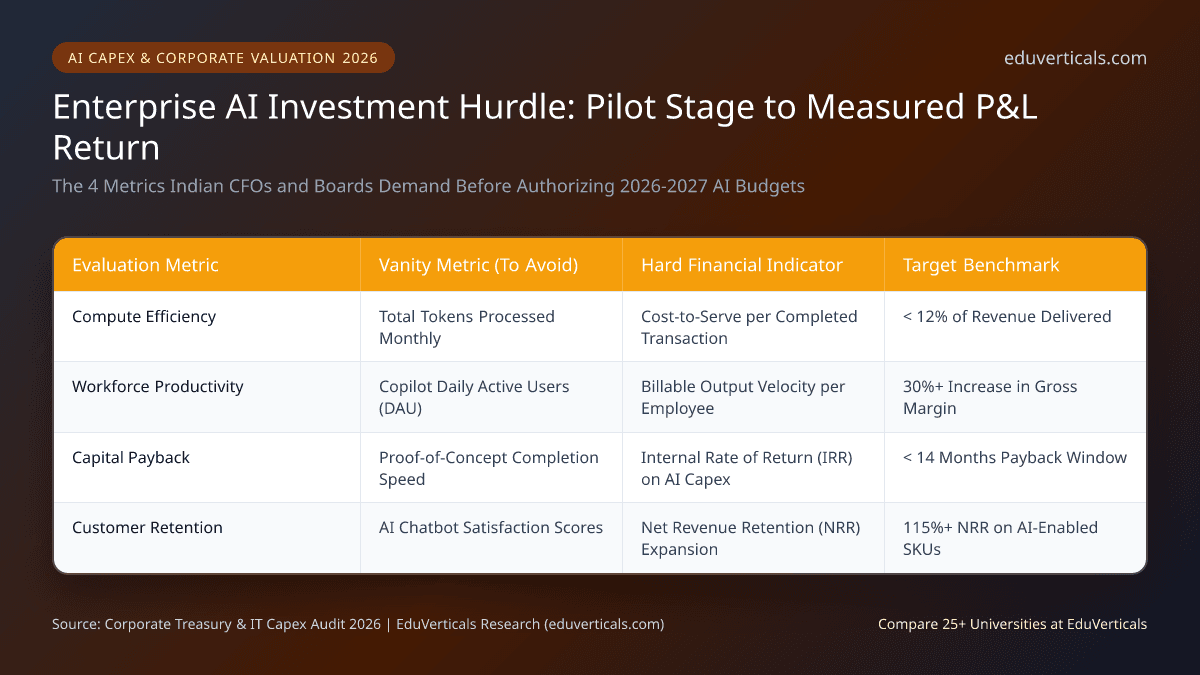
Enterprise AI Investment Hurdle Pilot Stage to Measured Return 2026
Enterprise AI Investment Hurdle Framework: From Pilot Experiments to Audited Bottom-Line P&L Returns in 2026.

2. The Hard Financial Metrics Modern CFOs Demand Before Signing Budgets

To secure funding in the 2026–2027 fiscal cycle, engineering and product leaders must abandon vanity metrics and present audited business cases rooted in classical corporate finance. As highlighted in our strategic analysis of The Future of AI Business Leadership, enterprise capital allocation is won through four rigorous quantitative hurdles:

  1. Contribution Margin per Transaction: Demonstrating that the compute, fine-tuning, and software licensing cost of each automated transaction consumes less than 12% of the incremental revenue delivered.
  2. Net Working Capital Efficiency: Proving that AI-driven supply chain forecasting or automated credit assessment releases cash locked in inventory cycles and accounts receivable.
  3. Strict Payback Windows Under 14 Months: Discounted cash flow models must project full capital recovery within five business quarters to offset technological obsolescence risk.
  4. Net Revenue Retention (NRR) Expansion: Showing that AI features actually increase existing customer spending and depress churn below historical enterprise software averages.
Interactive Career Pulse

Select your career goal to tailor advice

Decision note · Verified comparison01 / 03

How does your organization currently justify its enterprise AI expenditure?

Mentor RecommendationExperimental Innovation Budget

Beware imminent budget cuts as CFOs demand audited payback timelines. Review our University Comparison Report to add financial modeling and business analytics to your toolkit.

Tailored shortlist from our admission partners

3. Bridging Tech Architecture and Corporate Finance via an Online MBA

The CFO scrutiny sweep has created an unprecedented executive talent vacuum across India’s corporate landscape. Companies desperately need leaders who can bridge the chasm between cloud infrastructure engineering and corporate balance sheets. In Indian corporate hubs, professionals who master this intersection command compensation packages ranging from ₹38 LPA to ₹65 LPA in senior management and financial planning roles.

Working professionals are bridging this exact gap by enrolling in the Symbiosis Centre for Distance Learning (SCDL) Online Post Graduate Diploma in Financial Management, where they gain rigorous training in capital budgeting, financial statement analysis, and strategic cost management without taking a career hiatus.

  • Speak the CFO’s Language: Translate technical compute latency and model architecture into cost-of-capital, IRR, and EBITDA impact.
  • Explore Accredited University Portfolios: Inspect comprehensive curriculum breakdowns on the EduVerticals Academic Catalog to choose an institution aligned with your corporate goals.
  • Calculate Your Executive Payoff: Utilize the verified to project the financial return of upgrading your credentials over a five-year horizon.

Keep the details close

Common QuestionsThe full picture.

Explore key programme specifications, recognition terms, fee components, and career outcomes side by side before applying.

05 verified FAQs

CFOs are sounding alarms because enterprise spending on AI data centers, chips, and software licenses has skyrocketed, while verifiable productivity gains and bottom-line profit expansion remain modest across many non-tech sectors.

01 / The Facts, Side by Side
Live Comparison Dossier

University Comparison Report

Bring programme options, estimated fees and study flexibility into one view, with the trade-offs and questions to verify.

01Fee Structure
02Study Mode
03Career Fit

Tailored shortlist from our admission partners. Verify fees and eligibility before applying.

Meet Our Mentors

We have a team of over 12 experienced mentors with over 26+ years of collective experience available to guide you at a moment's notice.

Got Questions?

Online and distance learning programs provide: - Flexibility to learn at your own pace from anywhere. - Access to recorded lectures and digital study materials. - Opportunities to balance work, education, and personal commitments. - Affordable options compared to traditional on-campus programs. - Industry-relevant curriculum designed by academic experts.
Choosing the right university depends on: - Accreditation and recognition of the institution. - Quality and relevance of the curriculum. - Availability of academic and career support services. - Feedback and reviews from alumni and current students. - Flexibility in learning schedules and delivery modes.
Yes, online degrees from accredited universities are widely recognized and equivalent to regular degrees. Employers value the skills and qualifications gained from online programs, especially when offered by reputed institutions.
Assessment methods for online programs vary but typically include: - Online quizzes and assignments. - Virtual proctored exams. - Group projects and case studies. - Real-time presentations and viva sessions.
Many universities allow credit transfers, subject to: - Compatibility with the curriculum of the new program. - A minimum grade requirement in previously completed courses. - Approval by the academic administration of the new university.