
logo

Adobe Firefly & SaaS Moats: Defending Enterprise Workflows in 2026

Adobe Firefly 2026SaaS Moats AIEnterprise Workflow SoftwareCommoditized AI ModelsB2B SaaS RetentionOnline MBA StrategyEduVerticals
EduVerticals EditorialsEduVerticals Editorials

Posted 1 day ago

Adobe Firefly & SaaS Moats: Defending Enterprise Workflows in 2026
Executive Summary
Reading Brief
Executive Summary: By late 2026, the artificial intelligence landscape reached a watershed moment that many early AI startups failed to anticipate: foundation models have effectively commoditized. With open-weights models like Llama 3.3, Mistral Large, and DeepSeek matching or exceeding closed proprietary frontier benchmarks at a tiny fraction of the hosting cost, raw generative intelligence has become an abundant, low-margin utility. In this new economic reality, thin wrapper applications that merely resell foundation model APIs have suffered catastrophic 80%+ annual customer churn. Conversely, enterprise software giants—headlined by Adobe’s Firefly ecosystem—have demonstrated how to construct insurmountable software moats by embedding generative intelligence deep inside enterprise systems of record, multi-tool creative pipelines, and legally indemnified commercial workflows.

At the Adobe MAX 2026 conference, enterprise software strategists observed a masterclass in modern defensibility. While venture capitalists spent billions backing speculative foundation model labs, Adobe focused relentlessly on a single business moat: workflow integration and switching friction. Creative directors and global marketing agencies do not use Adobe software because its underlying diffusion models generate prettier pixels in isolation; they use Adobe because Firefly outputs are automatically layered into Photoshop .psd formats, tagged with enterprise digital asset management (DAM) metadata, synchronized with Illustrator vector nodes, and covered by a comprehensive multi-million-dollar intellectual property indemnification guarantee.

In India’s expanding enterprise software corridors—spanning SaaS pioneers in Chennai, Bengaluru, and Pune—founders, Chief Product Officers (CPOs), and Strategy Directors are studying Adobe’s playbook with intense urgency. As open-source models make algorithmic intelligence ubiquitous, Indian SaaS companies must transition from selling generic AI features to controlling sticky, mission-critical business workflows.

1. Deconstructing the Collapse of the "AI Wrapper" Startup

Between 2023 and 2025, venture capital funded hundreds of startups that built consumer-facing interfaces atop raw foundation models. By 2026, these businesses encountered structural economic collapse due to four fundamental vulnerabilities:
  • Zero Switching Friction: When an application merely routes a prompt to a third-party API, a competitor can clone the entire user interface and feature set over a weekend, triggering aggressive price wars down to cost.
  • API Arbitrage Squeeze: Foundation model providers continuously captured the majority of gross margins, leaving wrapper apps with 15% to 25% gross margins that could not support enterprise sales forces or customer acquisition costs.
  • Feature Absorption by Platforms: Operating systems and platform giants (Microsoft, Google, Apple) systematically integrated text editing, image generation, and summarization directly into default productivity suites, destroying stand-alone utility apps.
  • Enterprise Legal Exposure: Unvetted open-source tools exposed corporate clients to copyright infringement lawsuits, preventing Fortune 500 legal teams from authorizing enterprise-wide contract renewals.
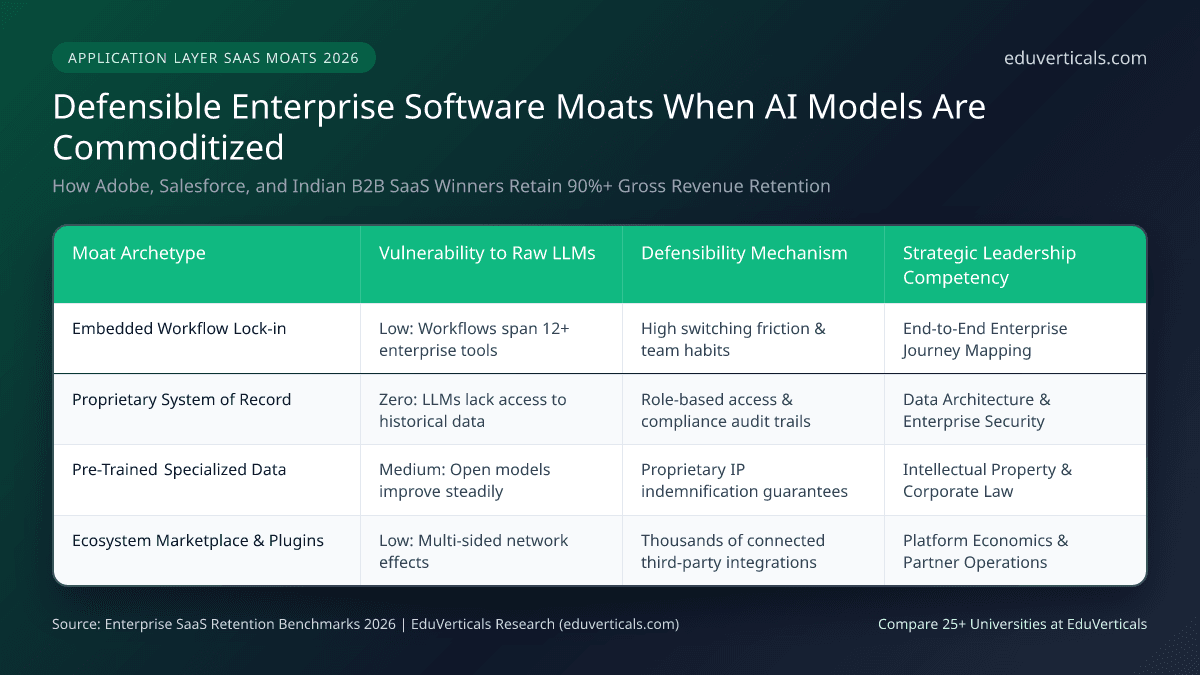
Defensible Enterprise Software Moats When AI Models Commoditized 2026
Enterprise Software Defensibility Framework: Comparing SaaS Moat Archetypes When Foundation Models Commoditize.

2. The Four Pillars of Modern Enterprise SaaS Defensibility

Sustainable enterprise software businesses in 2026 are built upon structural moats that raw foundation models cannot replicate. As analyzed in our definitive study on The Future of AI Business Leadership, enterprise defensibility is anchored in four strategic capabilities:

  1. Proprietary System of Record: Owning the historical database of customer contracts, financial transactions, and asset metadata. Models are transient; audited historical data is permanent.
  2. Multi-Stakeholder Workflow Entrenchment: Embedding software across ten different corporate roles—from compliance reviewers and copywriters to creative directors and external agency partners—creating massive organizational inertia against switching.
  3. Enterprise IP and Legal Indemnification: Providing corporate clients with contractually binding financial guarantees that all generated content is trained exclusively on licensed, clean data sets.
  4. Ecosystem Network Effects: Cultivating two-sided marketplaces where thousands of third-party developers, agency partners, and plugin creators build proprietary extensions on your API.
Interactive Career Pulse

Select your career goal to tailor advice

Decision note · Verified comparison01 / 03

How defensible is your software product against commoditized foundation models?

Mentor RecommendationHigh Risk: Thin Wrapper on Third-Party APIs

Pivot rapidly toward embedding proprietary data loops and multi-step organizational workflows. Consult our University Comparison Report for strategic transformation programs.

Tailored shortlist from our admission partners

3. The Career Dividend: From Feature Developer to Strategic Corporate Leader

This strategic reality has redefined executive recruitment across Indian technology firms. Companies are aggressively headhunting leaders who can construct durable product moats, negotiate complex B2B enterprise software contracts, and protect Net Revenue Retention (NRR) above 115%. Strategic Product Directors and Chief Growth Officers command compensation packages ranging from ₹45 LPA to ₹90 LPA in Bengaluru, Chennai, and Gurugram.

To make this executive transition, senior technical managers are enrolling in the Manipal University Jaipur (MUJ) Online MBA in Strategic Management & Analytics, where they acquire the formal training in competitive strategy, platform economics, microeconomic pricing, and enterprise sales cycles needed to lead market-dominating software enterprises.

  • Master Strategic Competitive Positioning: Learn to analyze market structures, identify defensible moats, and protect enterprise software pricing power.
  • Explore Accredited University Portfolios: Review verified UGC-DEB recognized degree options on the EduVerticals Academic Catalog to upgrade your leadership credentials.
  • Explore Specialized Degree Options: Review competitive specialization offerings on the EduVerticals Course Catalog to find programs that match your exact career goals.
  • Calculate Your Executive Payoff: Utilize verified to project the financial return of upgrading your credentials over a five-year horizon.

Keep the details close

Common QuestionsThe full picture.

Explore key programme specifications, recognition terms, fee components, and career outcomes side by side before applying.

05 verified FAQs

An AI wrapper is a software application that adds a thin user interface on top of a third-party foundation model API without possessing proprietary data, deep workflow integrations, or unique business logic, making it easily replicated and vulnerable to extreme customer churn.

01 / The Facts, Side by Side
Live Comparison Dossier

University Comparison Report

Bring programme options, estimated fees and study flexibility into one view, with the trade-offs and questions to verify.

01Fee Structure
02Study Mode
03Career Fit

Tailored shortlist from our admission partners. Verify fees and eligibility before applying.

Meet Our Mentors

We have a team of over 12 experienced mentors with over 26+ years of collective experience available to guide you at a moment's notice.

Got Questions?

Online and distance learning programs provide: - Flexibility to learn at your own pace from anywhere. - Access to recorded lectures and digital study materials. - Opportunities to balance work, education, and personal commitments. - Affordable options compared to traditional on-campus programs. - Industry-relevant curriculum designed by academic experts.
Choosing the right university depends on: - Accreditation and recognition of the institution. - Quality and relevance of the curriculum. - Availability of academic and career support services. - Feedback and reviews from alumni and current students. - Flexibility in learning schedules and delivery modes.
Yes, online degrees from accredited universities are widely recognized and equivalent to regular degrees. Employers value the skills and qualifications gained from online programs, especially when offered by reputed institutions.
Assessment methods for online programs vary but typically include: - Online quizzes and assignments. - Virtual proctored exams. - Group projects and case studies. - Real-time presentations and viva sessions.
Many universities allow credit transfers, subject to: - Compatibility with the curriculum of the new program. - A minimum grade requirement in previously completed courses. - Approval by the academic administration of the new university.