
logo

Academic Bank of Credits (ABC ID) & NEP 2020: How Credit Transfer Works in Online MBA Programs

Academic Bank of CreditsABC ID Online MBANEP 2020 Higher EducationCredit Transfer Online MBADigiLocker ABC IDMultiple Entry Exit MBAEduVerticals
EduVerticals EditorialsEduVerticals Editorials

Posted 2 hours ago

Academic Bank of Credits (ABC ID) & NEP 2020: How Credit Transfer Works in Online MBA Programs
Executive Summary: The Academic Bank of Credits (ABC ID), established under India’s National Education Policy (NEP 2020) and the National Credit Framework (NCrF), functions like a "Demat account for your university grades." For Online MBA students in 2026, your 12-digit ABC ID is mandatory for UGC-DEB admission, stores your 80–90 postgraduate credits for up to 7 years, enables multiple entry-exit flexibility (such as exiting with a PG Diploma after Year 1 at participating universities), and makes corporate background verification instant.

If you have started an application for any Online MBA in 2026—whether at VIT, NMIMS, Manipal, or Amity—you have noticed a mandatory field on page one of the admission form: "Enter Your 12-Digit ABC ID (Academic Bank of Credits) & UGC-DEB ID."

While we explored the broad shift toward Skill-Based Education vs Traditional Degrees under NEP 2020 in an earlier piece, this practical 2026 guide explains exactly how the Academic Bank of Credits works for Online MBA students, how credit points are calculated, and how to create your ABC ID in 3 minutes.

1. What Exactly Is the Academic Bank of Credits (ABC ID)?

Think of the Academic Bank of Credits (`abc.gov.in`) as NSDL/CDSL for higher education. Instead of your marksheets sitting only on a university’s private server or in a paper folder, every accredited Higher Educational Institution (HEI) in India is now required to deposit the academic credits you earn each semester directly into your Aadhaar-authenticated ABC account on DigiLocker.
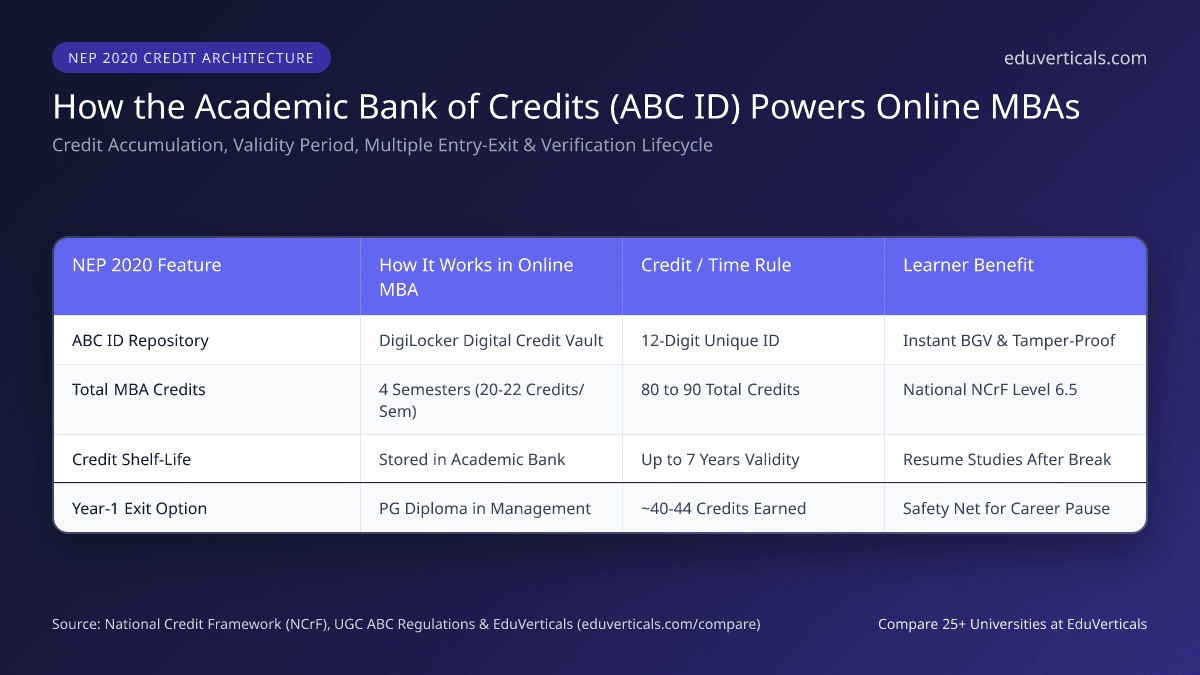
  • How 1 Credit Is Defined (NCrF Standard): Under the National Credit Framework, 1 credit typically represents 15 hours of direct teaching/instruction plus 15 hours of self-study/assignments (30 notional learning hours).
  • Typical Online MBA Credit Load: Across EduVerticals partner universities, a 2-year Online MBA comprises 80 to 102 credit points (averaging 20–24 credits per semester across 5–6 subjects). You can compare exact credit points for every university on EduVerticals University Compare.
Academic Bank of Credits ABC ID NEP 2020 Online MBA Guide
2026 NEP 2020 & Academic Bank of Credits (ABC ID) Architecture for Online MBA Programmes in India.

2. Three Massive Benefits of ABC ID for Working Professionals

  1. Multiple Entry and Exit Safety Net (Up to 7-Year Credit Validity): Suppose a medical emergency, maternity leave, or international relocation forces you to pause your Online MBA after completing Semester 2 (Year 1, ~40–45 credits). Under NEP 2020 ordinances adopted by leading universities, your earned credits remain safely banked for up to 7 years—allowing you either to exit with a Postgraduate Diploma in Management (PGDM/PGD) or to re-enter later to complete Semesters 3 and 4!
  2. SWAYAM & MOOC Credit Integration (Up to 40% Rule): UGC regulations allow universities to permit up to 40% of a programme’s non-core credits in a semester to be earned via approved SWAYAM national MOOC courses, subject to the university’s academic council approval.
  3. Instant, Fraud-Proof Employer Background Verification (BGV): When you switch jobs after your Online MBA, HR verification agencies no longer need to send physical letters to university registrars and wait 45 days. Your digitally signed ABC transcript and NAD degree certificate verify in seconds.
  1. Step 1: Open the DigiLocker app or visit `abc.gov.in` and click "My Account -> Student".
  2. Step 2: Sign in with your Aadhaar-linked mobile number and OTP.
  3. Step 3: Select your admitting University from the institution dropdown to generate your 12-digit numeric ABC ID.
  4. Step 4: Visit `deb.ugc.ac.in`, enter your 12-digit ABC ID, and generate your mandatory UGC-DEB Student ID for Online MBA admission.
Compare Credit Points & Accreditations Across 25+ Universities: See exact credit structures, semester counts, and NAAC grades side-by-side on EduVerticals Compare or generate your custom report on .
Frequently Asked Questions

Common Questions Answered

Yes. The University Grants Commission (UGC) has made both the 12-digit Academic Bank of Credits (ABC) ID and the linked UGC-DEB ID compulsory for all students enrolling in Open & Distance Learning (ODL) and Online programmes across India.

01 / The Facts, Side by Side

University Comparison Report

Bring programme options, estimated fees and study flexibility into one view, with the trade-offs and questions to verify.

Tailored shortlist from our admission partners. Verify fees and eligibility before applying.

Meet Our Mentors

We have a team of over 12 experienced mentors with over 26+ years of collective experience available to guide you at a moment's notice.

Got Questions?

Online and distance learning programs provide: - Flexibility to learn at your own pace from anywhere. - Access to recorded lectures and digital study materials. - Opportunities to balance work, education, and personal commitments. - Affordable options compared to traditional on-campus programs. - Industry-relevant curriculum designed by academic experts.
Choosing the right university depends on: - Accreditation and recognition of the institution. - Quality and relevance of the curriculum. - Availability of academic and career support services. - Feedback and reviews from alumni and current students. - Flexibility in learning schedules and delivery modes.
Yes, online degrees from accredited universities are widely recognized and equivalent to regular degrees. Employers value the skills and qualifications gained from online programs, especially when offered by reputed institutions.
Assessment methods for online programs vary but typically include: - Online quizzes and assignments. - Virtual proctored exams. - Group projects and case studies. - Real-time presentations and viva sessions.
Many universities allow credit transfers, subject to: - Compatibility with the curriculum of the new program. - A minimum grade requirement in previously completed courses. - Approval by the academic administration of the new university.