 EduVerticals Editorials
Posted 4 months ago
For decades, Indian students followed a simple formula:
In 2026, that formula is no longer enough.
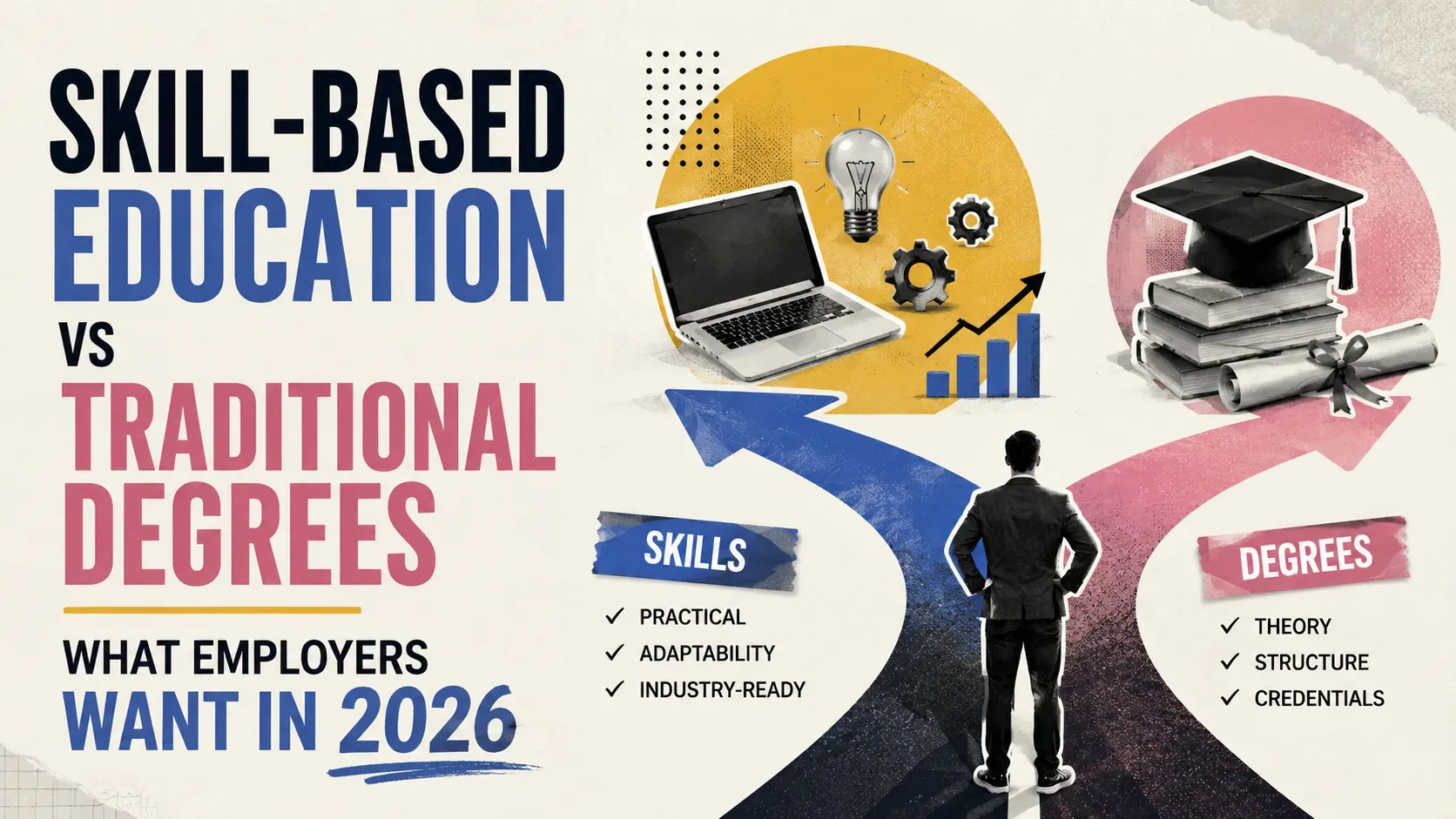
Employers today are hiring in a completely different environment shaped by artificial intelligence, automation, digital transformation, and rapidly evolving business needs. While degrees continue to hold value, companies are increasingly looking beyond academic qualifications and focusing on practical skills, adaptability, and real-world problem-solving abilities.
The debate is no longer whether education matters.
The real question is:
Do employers value skills more than degrees in 2026?
The answer is more nuanced than many students realize.
Skill-based education focuses on developing practical competencies rather than simply acquiring theoretical knowledge.
Instead of memorizing concepts for examinations, students learn how to apply knowledge in real-world situations.
Examples include:
- Data Analytics projects
- Digital Marketing campaigns
- Software development portfolios
- Industry certifications
- Business simulations
- Internships and apprenticeships
- AI and automation tools
This shift aligns closely with the goals of the National Education Policy (NEP) 2020, which encourages experiential learning, multidisciplinary education, and stronger industry-academia collaboration. According to recent studies examining the impact of NEP implementation, employability and skill development have become central priorities in higher education reform.
The biggest driver behind this change is technology.
A recent PwC analysis of more than one billion job advertisements worldwide found that AI is rapidly transforming entry-level jobs. Employers increasingly expect junior professionals to possess skills that were previously associated with experienced employees, including leadership, communication, stakeholder management, and data-driven decision-making.
At the same time, a Cognizant-Pearson study found that artificial intelligence is already performing approximately 37% of entry-level work in India, exceeding the global average. As routine tasks become automated, employers are placing greater emphasis on human skills that technology cannot easily replace.
The result is clear:
Companies are not simply hiring degree holders.
They are hiring problem-solvers.
The latest India Skills Report 2026 shows India's employability rising to 56.35%, reflecting a growing shift toward a skill-first economy driven by AI adoption, digital fluency, and workforce readiness.
At the same time, industry reports continue to highlight a significant skills gap between what universities teach and what employers require. Studies suggest that organisations across sectors are struggling to find candidates with the right mix of technical and professional competencies.
This explains why many graduates continue to face challenges in securing employment despite holding recognised degrees.
Absolutely not.
The idea that degrees are becoming irrelevant is a misconception.
Degrees continue to serve several important purposes:
Foundation of Knowledge
A degree provides structured learning and conceptual understanding that many professional roles still require.
Credibility
Employers often use degrees as an initial screening mechanism when evaluating candidates.
Professional Requirements
Fields such as medicine, law, engineering, education, and accounting continue to require formal qualifications.
Career Progression
Many leadership and management positions still prefer or require bachelor's and master's degrees.
The difference is that a degree alone is no longer sufficient.
Today's employers are looking for a combination of qualifications and practical skills.
The most sought-after capabilities include:
Digital Literacy
Understanding digital tools has become essential across industries.
Artificial Intelligence Skills
Employees who know how to work with AI systems and automation tools have a competitive advantage.
Communication Skills
Strong written and verbal communication remain among the most valued professional skills.
Data Analysis
The ability to interpret and use data is becoming important far beyond technical roles.
Problem Solving
Employers increasingly value individuals who can identify challenges and create practical solutions.
Adaptability
Rapid technological change means continuous learning has become a core workplace requirement.
Research from global hiring studies also indicates that companies are becoming more flexible regarding educational backgrounds when candidates can demonstrate relevant skills and experience.
The future of education is unlikely to be a battle between skills and degrees.
Instead, it will be a combination of both.
Universities are increasingly integrating:
- Industry certifications
- Project-based learning
- Experiential education
- Internships
- Apprenticeships
- AI-focused coursework
- Career-oriented training
This blended model aims to produce graduates who are academically qualified and workplace ready.
If you're currently pursuing a degree, focus on building complementary skills alongside your academic education.
Consider:
- Learning AI tools relevant to your field
- Building a portfolio of projects
- Completing industry-recognised certifications
- Participating in internships
- Developing communication and leadership abilities
- Staying updated with emerging technologies
Students who combine academic credentials with practical expertise will be significantly better positioned in the job market.
The question in 2026 is no longer "skills or degrees."
The real question is whether students can combine both effectively.
Degrees continue to provide credibility, structure, and foundational knowledge. Skills provide employability, adaptability, and workplace relevance.
Employers are increasingly seeking candidates who possess both.
In a world shaped by artificial intelligence and rapid technological change, the most successful professionals will not be those with the highest qualifications alone, but those who can consistently demonstrate what they know and how effectively they can apply it.


We have a team of over 12 experienced mentors with over 26+ years of collective experience available to guide you at a moment's notice.