 EduVerticals Editorials
Posted 1 day ago

Executive SummaryReading BriefExecutive Summary: The Supreme Court of India’s definitive review of the ₹8,415 Crore Yes Bank Additional Tier-1 (AT-1) bond write-down represents a defining jurisprudence benchmark for Indian banking regulation and capital markets. Arising from the Reserve Bank of India’s (RBI) March 2020 emergency reconstruction scheme, this landmark dispute underscores the severe loss-absorption mechanics embedded in Basel III hybrid capital instruments. For professionals across the banking, financial services, and insurance (BFSI) spectrum, this saga has triggered unprecedented demand for executives trained in credit underwriting, treasury risk management, and regulatory compliance.
In the modern annals of Indian financial markets, few episodes have created as much shock and regulatory debate as the complete write-down of ₹8,415 Crore worth of Additional Tier-1 bonds issued by Yes Bank. When the Reserve Bank of India intervened in March 2020 to rescue the beleaguered private lender—orchestrating an equity recapitalization led by State Bank of India—it enforced the contractual loss-absorption clause, writing the entire stock of perpetual subordinated AT-1 debt down to zero.
Six years of high-stakes litigation across the Bombay High Court and the Supreme Court of India culminated in late 2026 with profound implications for debt capital markets, retail wealth advisory norms, and bank balance sheet structuring. The core lesson is unmistakable: in modern regulated finance, understanding capital adequacy covenants is a non-negotiable professional capability.
Following the 2008 global financial meltdown, the Basel Committee on Banking Supervision developed the Basel III framework to ensure that commercial banks maintain adequate capital buffers to absorb losses without requiring public taxpayer bailouts. The regulatory capital structure was divided into clear tiers:
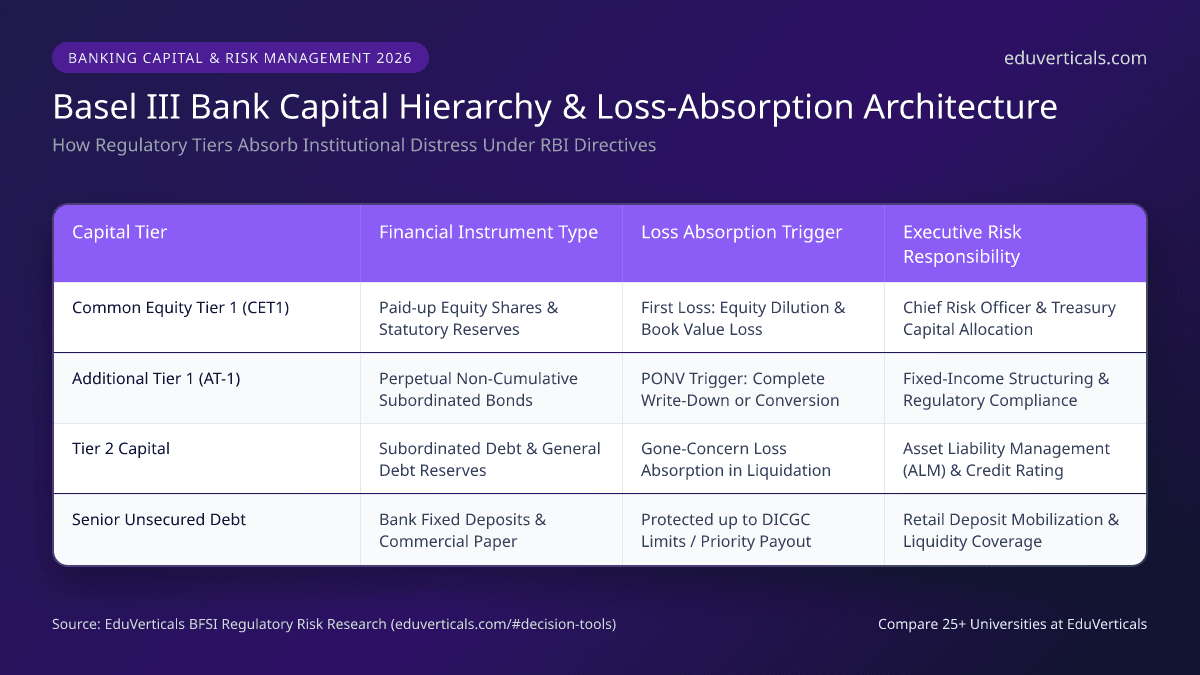
The intense human and institutional drama surrounding the Yes Bank AT-1 saga stemmed from a severe failure in wealth management distribution. Numerous retail investors, charitable trusts, and superannuation funds alleged that wealth managers and relationship bankers marketed these risky perpetual subordinated debt instruments as "super fixed deposits with higher interest rates," glossing over the catastrophic PONV write-down clause.
This controversy prompted the Securities and Exchange Board of India (SEBI) and the RBI to introduce stringent new guidelines: barring retail distribution of AT-1 bonds, imposing high minimum ticket sizes of ₹1 Crore, and mandating transparent risk profiling. As a direct consequence, private banks and wealth management institutions are radically overhauling their compliance and advisory teams.
Select your career goal to tailor advice
Master Basel III capital regulations, liquidity coverage ratios, and fixed-income portfolio modeling for commercial banks.
The fallout from the AT-1 verdict highlights an acute talent deficit in Indian banking: a shortage of professionals who understand the intricate intersection of credit risk, financial regulation, and capital structuring. Commercial banks, NBFCs, and Global Capability Centers (GCCs) in Mumbai, Bengaluru, and Hyderabad are aggressively expanding their Asset Liability Management (ALM), enterprise risk management, and regulatory reporting divisions.
Professionals who possess formal training in banking finance—mastering concepts such as Value-at-Risk (VaR), Liquidity Coverage Ratio (LCR), Net Stable Funding Ratio (NSFR), and Ind AS 109 expected credit loss modeling—are commanding 35% to 50% salary premiums during lateral hiring cycles.
For branch managers, credit analysts, and finance professionals seeking to break into senior corporate banking and treasury roles, an accredited Master of Business Administration in Finance provides the essential analytical foundation. Renowned institutions such as NMIMS CDOE and Symbiosis Centre for Distance and Online Learning (SSODL) offer specialized online curricula in Banking & Financial Services.
These UGC-DEB recognized programs allow working professionals to master corporate finance, debt syndication, and risk modeling on weekends without leaving their banking desks. Explore university accreditations on the Academic Catalog and use to map your personal career growth. Request a tailored shortlist from our admission partners to choose the ideal finance program.
Keep the details close
Explore key programme specifications, recognition terms, fee components, and career outcomes side by side before applying.
AT-1 bonds are perpetual, unsecured, subordinated debt instruments issued by banks to meet Basel III capital adequacy norms. They carry high yields but contain contractual clauses allowing full write-down or equity conversion if the bank faces financial collapse.
Bring programme options, estimated fees and study flexibility into one view, with the trade-offs and questions to verify.
Tailored shortlist from our admission partners. Verify fees and eligibility before applying.


We have a team of over 12 experienced mentors with over 26+ years of collective experience available to guide you at a moment's notice.