 EduVerticals Editorials
Posted 1 day ago

Executive SummaryReading BriefExecutive Summary: The nationwide United States Federal Aviation Administration (FAA) routing tech failure—grounding over 6,000 domestic and international flights within six hours—demonstrates the catastrophic vulnerability of single-point-of-failure (SPOF) legacy architectures in global logistics. Far beyond passenger delays, the outage stranded thousands of tons of time-sensitive belly cargo, triggered pharmaceutical cold-chain write-offs, and disrupted just-in-time automotive assembly lines worldwide. In an increasingly interconnected global economy, enterprises are aggressively recruiting Operations Management MBAs to conduct resilience audits, design multi-hub redundancy networks, and lead crisis supply-chain operations.
In November 2026, the global transport ecosystem received an alarming wake-up call. A corrupted database synchronization file in the FAA’s core Notice to Air Missions (NOTAM) and flight-routing architecture triggered an immediate national ground stop. For hours, aircraft sat idle on tarmac aprons from New York to Los Angeles, international flights were diverted, and logistics hubs were plunged into chaos.
While mainstream media focused on stranded airport holiday travelers, the real economic earthquake took place inside corporate supply chains. Modern high-value commerce—from life-saving biological pharmaceuticals and semiconductor wafers to critical aerospace replacement parts—relies almost entirely on the predictive precision of commercial passenger aircraft belly cargo.
Aviation operations represent the ultimate expression of tightly coupled network theory. Unlike maritime shipping or trucking, where a localized delay can often be buffered by regional warehousing, an airline network operates with zero margin for error. The cascading failure unfolded across four distinct layers:
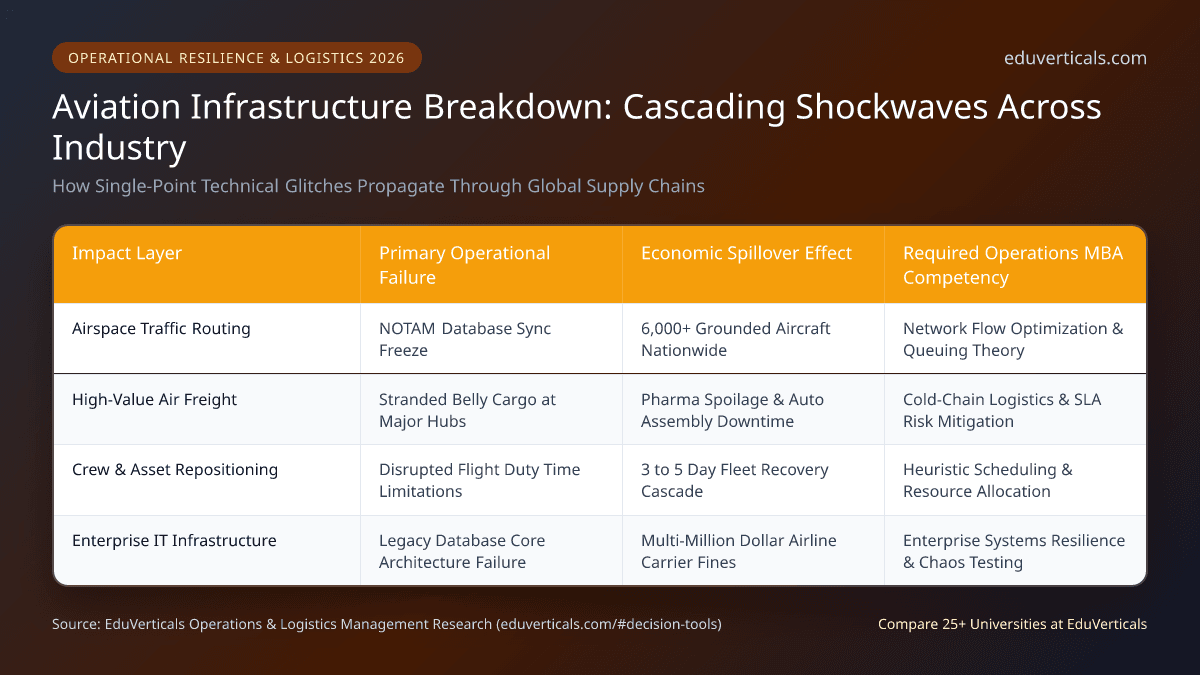
The FAA crisis exposed a fundamental weakness found in thousands of legacy corporations: vital multi-billion-dollar enterprise operations running on decades-old monolithic software codebases maintained by fragmented vendor contracts. Following this disaster, corporate boards worldwide are commissioning comprehensive Single-Point-of-Failure audits.
Enterprise resilience is no longer treated as a routine back-office IT checklist; it is an existential business continuity mandate. Operations directors are tasked with identifying fragile vendor monopolies, implementing multi-cloud redundancy, and designing offline-capable manual fallback protocols that ensure uninterrupted service delivery during catastrophic digital infrastructure outages.
Select your career goal to tailor advice
Master quantitative routing, cross-dock logistics, and intermodal transport modeling for global supply chains.
This operational lesson carries immense relevance for India’s booming transport and logistics sector. With domestic carriers—led by IndiGo and Air India—expanding combined order books beyond 1,100 modern aircraft, and the central government investing over ₹12 Lakh Crore in Dedicated Freight Corridors (DFC), airports, and multimodal logistics parks, operational execution is India’s greatest business bottleneck.
E-commerce giants, pharmaceutical manufacturers, and third-party logistics (3PL) conglomerates are actively seeking managers who understand queuing theory, linear programming, warehouse automation, and route optimization. An engineering degree provides technical baseline competence, but orchestrating enterprise logistics networks requires formal postgraduate management expertise.
Working professionals in logistics, airline operations, manufacturing, and IT infrastructure can bridge into senior leadership by earning an accredited Master of Business Administration in Operations and Supply Chain Management. Programs such as the VIT Online MBA or the technology-driven operations tracks from Manipal University Jaipur deliver deep analytical training in lean operations, risk management, and quantitative forecasting.
These UGC-DEB recognized programs allow working executives to acquire vital credentials on weekends without sacrificing their corporate employment. Explore specialized operations degrees on the Academic Catalog and compare career outcomes on . Receive a tailored shortlist from our admission partners to match your technical background with top-ranked online management programs.
Keep the details close
Explore key programme specifications, recognition terms, fee components, and career outcomes side by side before applying.
The systemwide ground stop was triggered by a corrupted database synchronization file within the FAA’s core Notice to Air Missions (NOTAM) and flight routing database, exposing catastrophic architectural vulnerabilities in legacy air traffic control infrastructure.
Bring programme options, estimated fees and study flexibility into one view, with the trade-offs and questions to verify.
Tailored shortlist from our admission partners. Verify fees and eligibility before applying.


We have a team of over 12 experienced mentors with over 26+ years of collective experience available to guide you at a moment's notice.