 Aditi Chouri
 Posted 11 months ago
In today’s competitive job market, education is more than just a degree it’s an investment. And like any investment, the real question is: what’s the return?
An Online MBA (Master of Business Administration) is one of the most sought-after qualifications for working professionals today. But with tuition fees ranging from ₹1.5 to ₹10 lakhs in India (and even higher globally), many wonder is the ROI (Return on Investment) of an Online MBA truly worth it?
Let’s unpack what real ROI means when it comes to an Online MBA beyond just the paycheck.
Traditionally, ROI is measured in rupees or dollars — the difference between what you spend on your MBA and what you earn afterward. But the real ROI of an Online MBA goes beyond financial numbers. It’s about:
1. Career advancement opportunities
2. Enhanced leadership and management skills
3. Networking and industry exposure
4. Personal growth and flexibility
Let’s look deeper into these layers of return:
When most professionals think of ROI, they think of salary hikes. And yes, data supports that.
According to a 2024 LinkedIn Workplace Learning Report, professionals with an MBA earn 35–45% higher salaries on average than those without one. But here’s the interesting part, Online MBA graduates are now catching up fast.
For instance:
NMIMS Online MBA graduates have reported an average salary hike of 40% within two years of completion.
Sikkim Manipal University and Amity Online MBA students often see promotions and job changes within 12–18 months.
Globally, Indiana University’s Kelley Direct Online MBA reported a salary growth of over 30% for its alumni post-program.
What drives this financial return is not just the degree but the ability to apply learning in real-time. Online MBAs allow you to work and study simultaneously, which means your classroom lessons directly impact your current job performance and often, your pay.
Example:
A marketing manager pursuing an Online MBA in Business Analytics might start applying data-driven strategies in her company during the course. Her improved performance leads to quicker promotions even before she graduates. That’s immediate ROI.
One major reason why the ROI of an Online MBA is stronger than traditional MBAs is the zero opportunity cost.
In a full-time MBA, you typically quit your job for 1–2 years, losing not just your income but also your career momentum. On the other hand, an Online MBA lets you:
1. Keep your job (and salary)
2. Gain new skills
3. Apply your learning instantly
4. Graduate without career breaks
This combination significantly improves your real-world ROI because you’re earning while learning.
Example:
Rohit, a 29-year-old IT professional, enrolled in NMIMS Global Online MBA while working full-time. He didn’t pause his ₹10 LPA job instead, he finished the program in two years, got promoted internally, and was earning ₹15 LPA by graduation. His ROI? Almost immediate.
Money isn’t the only metric that matters. The skills you gain from an Online MBA often become the biggest long-term return.
Today’s top companies look for professionals who can think strategically, lead teams, and make data-driven decisions. Online MBA programs are built around those exact capabilities.
You gain exposure to:
1. Business analytics and financial modeling
2. Strategic marketing and leadership
3. Global business practices
4. Digital transformation and innovation
These are not just academic topics, they’re practical tools that improve your problem-solving and decision-making abilities.
Example:
Many professionals pursuing Online MBAs report that their understanding of business models helps them pitch new ideas, lead departments, or even start their own ventures. That’s a long-term ROI that compounds over your career.
While traditional MBAs are known for their campus networking, Online MBAs have evolved tremendously in this space. Virtual discussions, live classes, and alumni events now connect students across industries and countries.
1. Networking in an Online MBA often means:
2. Collaborating with working professionals from diverse fields
3. Learning from industry experts during webinars
4. Building LinkedIn connections that lead to new opportunities
Example:
An NMIMS Online MBA student from Pune recently shared how she connected with a peer working in Dubai through the university’s virtual networking event. That connection later helped her secure an international job offer.
That’s ROI you can’t quantify but it’s real.
Unlike traditional MBAs, the flexibility of an Online MBA allows learners to shape their education around their lives.
This flexibility ensures that:
1. You don’t have to relocate or pause family commitments.
2. You can access lectures 24/7, study at your own pace, and revisit content anytime.
3. You can balance work, learning, and personal life — all together.
That level of convenience and accessibility means you get maximum learning with minimal disruption an ROI in itself for working professionals.
An often-overlooked aspect of ROI is personal transformation. Online MBAs teach you discipline, time management, and resilience. Balancing a demanding job with coursework pushes you to perform at your best.
Graduates often mention feeling more confident, better at decision-making, and ready to take on leadership roles.
Example:
Priya, a project coordinator who pursued an Online MBA in HR from Amity, said “It wasn’t just about the degree. I learned to prioritize, lead, and communicate better. That’s something I apply every single day at work.”
This “growth mindset” though intangible becomes your lifelong ROI.
In a world where automation and AI are reshaping jobs, the adaptability that comes with an MBA is invaluable. An Online MBA keeps your career future-ready ensuring you stay relevant even as industries evolve.
Employers increasingly value continuous learning. Professionals who invest in flexible, digital education stand out as proactive and forward-thinking qualities every company looks for.
If you measure ROI purely in rupees, you’ll miss the full picture. The real ROI of an Online MBA includes:
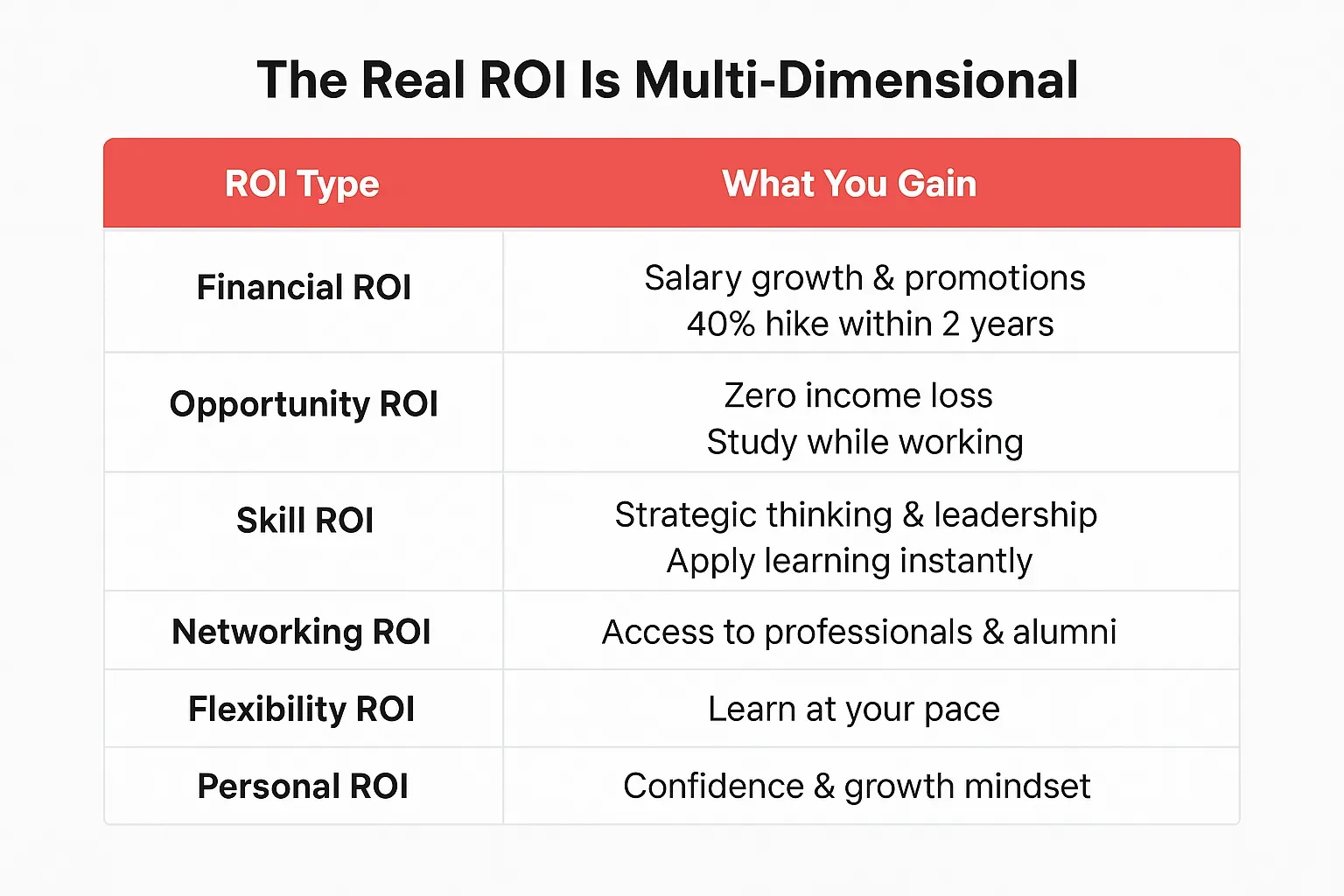
When you combine all these, the overall return easily outweighs the cost — both financially and personally.
An Online MBA is not just a shortcut to a better salary, it’s a strategic investment in your lifelong career growth.
The true ROI lies in how effectively you apply what you learn, expand your network, and position yourself for opportunities that didn’t exist before.
So, before you ask “Is an Online MBA worth it?”, maybe ask instead,
“How can I make it worth it for me?”


We have a team of over 12 experienced mentors with over 26+ years of collective experience available to guide you at a moment's notice.