 EduVerticals Editorials
Posted 1 day ago

Executive SummaryReading BriefExecutive Summary: The intricate corporate governance structure linking philanthropic promoter trusts to multi-billion-dollar operating enterprises represents the definitive institutional case study of Indian capitalism. In late 2026, as Indian conglomerates face heightened scrutiny from domestic regulators and global institutional capital, the boundary between trustee fiduciary oversight and operating board executive autonomy has become Corporate India’s most critical leadership frontier. Navigating this ecosystem demands senior executives who master multi-entity corporate finance, SEBI Listing Obligations and Disclosure Requirements (LODR), and long-term capital stewardship.
When modern business historians analyze the longevity of Indian industrial powerhouses, attention inevitably settles on the unique holding structure of Bombay House. Approximately 66% of the equity capital of Tata Sons—the principal holding company of the $165+ billion conglomerate—is held by philanthropic trusts endowed by the founding family, predominantly the Sir Dorabji Tata Trust and the Sir Ratan Tata Trust. This structure insulates operating companies like TCS, Tata Motors, Tata Steel, and Air India from short-term quarterly market myopias, enabling generational bets on domestic infrastructure, green hydrogen, aerospace, and semiconductor manufacturing.
Yet this institutional arrangement also creates a profoundly complex governance dynamic. How do trustee-directors exercise their fiduciary responsibilities to protect the corpus of charitable trusts without infringing upon the day-to-day managerial prerogatives of listed corporate boards? In 2026, corporate governance is no longer a theoretical compliance checklist; it is an active boardroom battleground where billions of dollars in capital allocation, leadership succession, and regulatory approvals hang in the balance.
As conglomerates expand into capital-intensive, frontier technologies, three structural friction points emerge between promoter trusts, central holding entities, and listed operating boards:
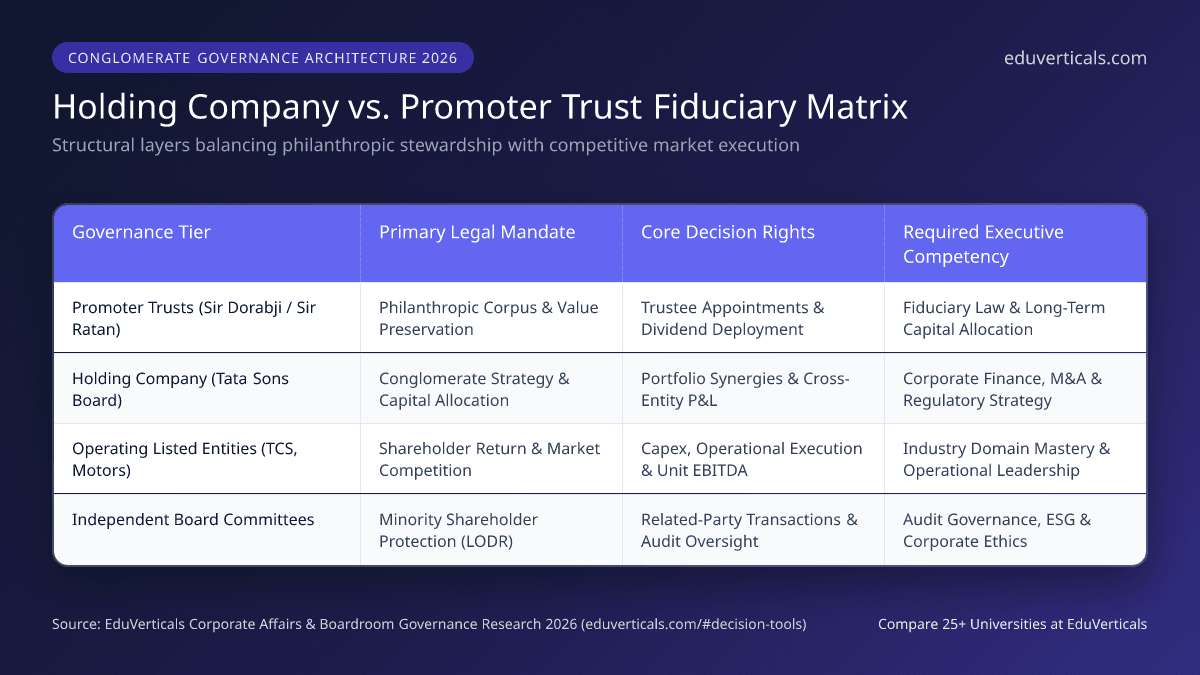
The regulatory climate of 2026 has permanently dismantled the era of passive, ceremonial boardrooms. Institutional proxy advisory firms (such as IiAS and InGovern) and sovereign wealth funds now demand granular accountability for every capital allocation decision. When a holding entity injects equity into an unlisted subsidiary or orchestrates a debt-funded acquisition, board members must justify the cost of capital against stringent hurdle rates.
Furthermore, the emergence of ESG-linked lending and global carbon taxation mechanisms (including the EU’s Carbon Border Adjustment Mechanism) means that holding company boards are held liable not merely for financial balance sheets, but for the carbon footprint, supply-chain labor integrity, and ethical conduct of every subsidiary across the globe. Strategic leaders must therefore possess a holistic command of corporate law, financial engineering, and cross-border governance.
Select your career goal to tailor advice
Focus on advanced corporate law, regulatory compliance, and minority shareholder rights through executive management tracks.
For ambitious mid-career professionals—whether corporate counsels, finance controllers, strategy directors, or enterprise risk heads—the glass ceiling is rarely technical. It is the ability to think like a fiduciary board member. Boardrooms do not need more spreadsheet modelers; they require trusted advisors who can synthesize complex legal mandates, manage promoter relationships, and evaluate risk-adjusted return on invested capital (ROIC).
To bridge this capability gap, experienced professionals increasingly pursue accredited management credentials without stepping away from active corporate duties. Exploring top-tier programmes on the EduVerticals Academic Catalog enables corporate leaders to evaluate NIRF-ranked and NAAC A++ accredited executive and online programmes tailored to enterprise finance, strategy, and governance.
Editorial BriefReading BriefPlan Your Executive Career Trajectory: Discover how a recognized postgraduate credential equips you for senior governance, strategy, and corporate affairs roles. Access our tailored shortlist from our admission partners and compare accredited programmes on .
Keep the details close
Explore key programme specifications, recognition terms, fee components, and career outcomes side by side before applying.
Tata Trusts—principally the Sir Dorabji Tata Trust and Sir Ratan Tata Trust—hold approximately 66% of the equity share capital of Tata Sons Private Limited, which functions as the principal investment holding company for all operating Tata operating enterprises.
Bring programme options, estimated fees and study flexibility into one view, with the trade-offs and questions to verify.
Tailored shortlist from our admission partners. Verify fees and eligibility before applying.


We have a team of over 12 experienced mentors with over 26+ years of collective experience available to guide you at a moment's notice.