 EduVerticals Editorials
Posted 1 day ago

Executive SummaryReading BriefExecutive Summary: Tata Motors’ high-stakes corporate demerger—splitting the automotive behemoth into two separately listed powerhouses for Commercial Vehicles (CV) and Passenger Vehicles (PV including electric mobility and JLR)—enters its execution endgame against severe industry headwinds. With Federation of Automobile Dealers Associations (FADA) reports highlighting unprecedented 65-to-75-day dealer inventories and EV price cuts pressuring gross margins, corporate turnaround strategy has shifted from boardroom rhetoric to granular operational execution. This restructuring underscores why automotive enterprises are intensely recruiting managers skilled in working capital optimization, supply-chain resilience, and unit-economics financial modeling.
The late 2026 demerger of Tata Motors marks one of the most consequential corporate reorganizations in modern Indian industrial history. By separating the cyclical, capital-intensive Commercial Vehicles division from the dynamic, consumer-facing Passenger Vehicles and Electric Mobility business, the Tata Group aims to unlock pure-play valuation multiples and sharpen strategic focus.
However, this corporate surgery coincides with an acute operational challenge: an auto dealership inventory glut. Across India, franchised passenger vehicle dealerships entered late 2026 carrying over ₹75,000 Crore in unsold vehicles on their floor plans. Coupled with slowing electric vehicle retail adoption ahead of new battery technology rollouts, passenger car manufacturers face intense margin compression.
Historically, conglomerate holding structures led to significant valuation discounts for Tata Motors. Public investors interested in passenger car market share gains and Jaguar Land Rover (JLR) luxury margins were hesitant to take on exposure to volatile domestic truck sales, which are directly tethered to infrastructure outlays and interest rate cycles.
The demerger creates two distinct corporate entities: a resilient CV powerhouse focused on heavy haulage, zero-emission hydrogen transport, and fleet digitization; and an agile PV/EV corporation prioritizing design differentiation, software-defined vehicle architectures, and battery-pack localization. But restructuring on paper does not solve factory-floor realities.
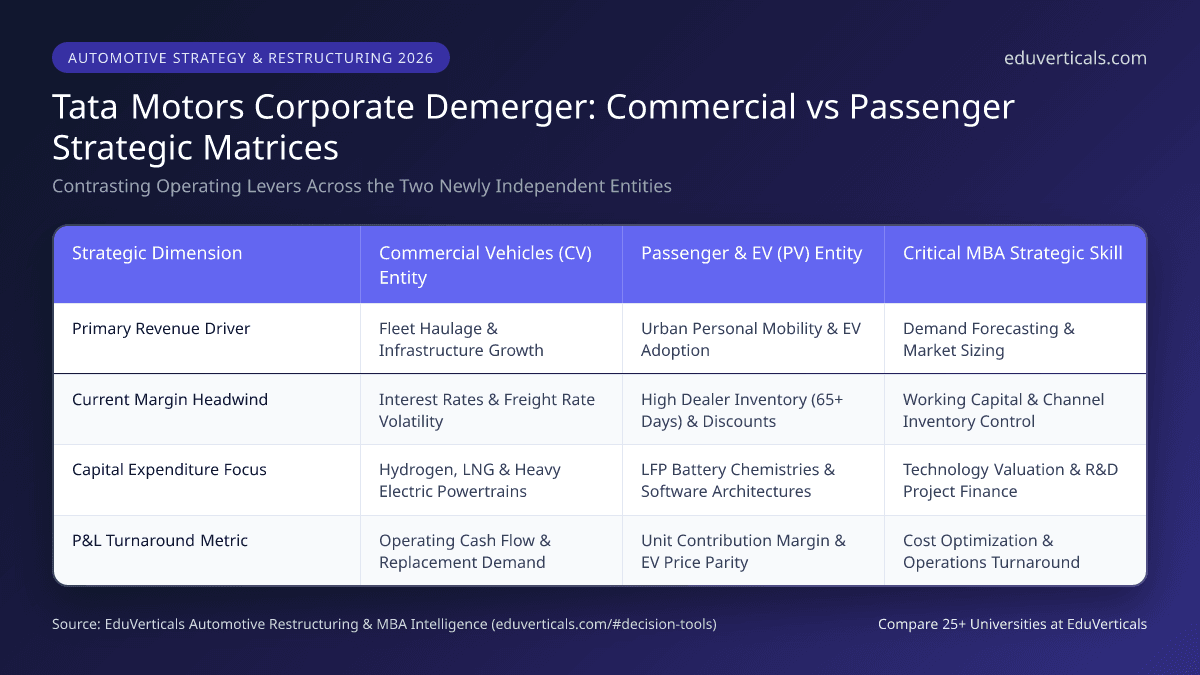
The most pressing operational bottleneck facing automotive leadership is dealership channel health. When auto manufacturers push excess factory wholesale volume onto regional dealerships to report glowing quarterly numbers, dealer working capital becomes paralyzed by floor-plan financing interest.
Select your career goal to tailor advice
Master quantitative supply-chain modeling and working capital control to resolve manufacturing and dealership pipeline bottlenecks.
While Tata Motors established an undisputed first-mover advantage in Indian electric passenger vehicles—commanding over 65% market share with the Nexon.ev, Tiago.ev, and Punch.ev—the next phase of growth requires moving beyond affluent early adopters to mass-market value buyers.
Mainstream consumers evaluate total cost of ownership (TCO) with extreme rigor. Until vehicle battery pack costs decline below $80 per kilowatt-hour through domestic cell manufacturing under the Advanced Chemistry Cell (ACC) PLI scheme, electric vehicles face unit-economics friction against compressed natural gas (CNG) and hybrid powertrains. Navigating this transition demands product strategists who can engineer cost reduction across vehicle platforms while maintaining robust gross margins.
The automotive industry’s transformation demonstrates why technical engineering literacy alone is no longer enough to build an executive career in manufacturing. Automotive enterprises are aggressively promoting professionals who possess an accredited Master of Business Administration to lead cross-functional transformation programs.
Programmes such as the VIT Online MBA with specializations in Operations, or management tracks from Manipal University Jaipur, equip automotive professionals with the analytical frameworks needed to manage global supply chains, negotiate tier-1 supplier contracts, and conduct corporate turnaround evaluations.
Evaluate accredited industrial and operations management degrees on the Academic Catalog and model your postgraduate salary advancement using . Connect with our admission partners for a tailored shortlist matching your engineering and corporate experience.
Keep the details close
Explore key programme specifications, recognition terms, fee components, and career outcomes side by side before applying.
The demerger separates Commercial Vehicles from Passenger Vehicles (including EVs and JLR) into two independent listed entities, enabling each business to pursue distinct capital allocation strategies, raise tailored equity, and eliminate the holding company conglomerate discount.
Bring programme options, estimated fees and study flexibility into one view, with the trade-offs and questions to verify.
Tailored shortlist from our admission partners. Verify fees and eligibility before applying.


We have a team of over 12 experienced mentors with over 26+ years of collective experience available to guide you at a moment's notice.