 EduVerticals Editorials
Posted 1 day ago

Executive SummaryReading BriefExecutive Summary: In November 2026, the Department of Telecommunications (DoT) and IN-SPACe finalized national security compliance frameworks for commercial Low Earth Orbit (LEO) satellite broadband constellations operating over Indian airspace. Central to the regulatory battle is India’s sovereign telecom requirement: all satellite traffic traversing Indian sovereign territory must terminate at licensed domestic earth-station gateways equipped with automated lawful interception mechanisms and an emergency government-controlled "kill switch." The resulting clash between global satellite operators (Starlink, Amazon Kuiper) and domestic telecom consortiums (Jio Space, Bharti Eutelsat OneWeb) has transformed telecom policy from an esoteric legal specialty into Corporate India’s most lucrative B2G (Business-to-Government) and infrastructure leadership domain.
Satellite broadband is no longer a fringe technology reserved for remote scientific outposts and luxury maritime yachts. In 2026, Low Earth Orbit constellations circling 500 to 1,200 kilometers above the planet represent the backbone of next-generation critical infrastructure—powering automated railway signaling, offshore oil platform telemetry, high-frequency banking redundancy, and military border surveillance across the Himalayas.
However, transmitting gigabits of encrypted data directly from orbital space to portable phased-array user terminals introduces unprecedented national security complexities. Unlike terrestrial fiber networks where data cables physically enter national boundaries at audited coastal landing stations, satellite signals cross sovereign borders intangibly. India’s telecom regulators have made it clear: access to 1.4 billion digital consumers requires absolute subservience to sovereign data localization, real-time security monitoring, and regulatory oversight.
Under the Telecommunications Act 2023 and the refined 2026 IN-SPACe operational directives, commercial satellite broadband licensees must fulfill four non-negotiable security conditions prior to commercial spectrum assignment:
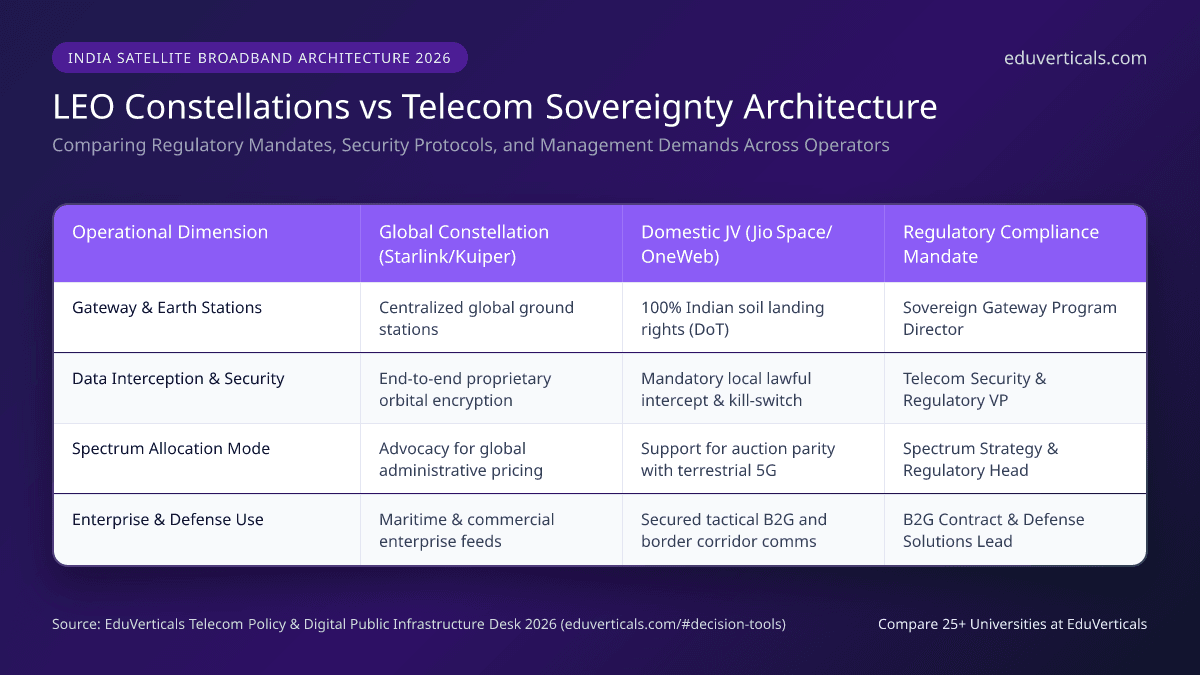
The regulatory debate over satellite spectrum allocation in late 2026 highlighted a philosophical divide in corporate strategy. Global satellite providers argued that orbital frequencies are a shared international resource governed by International Telecommunication Union (ITU) treaties, advocating for administrative assignment based on formulaic license fees. Conversely, established domestic telecom giants argued that allowing satellite operators to bypass competitive auctions creates an uneven playing field against operators who spent tens of thousands of crores acquiring terrestrial 5G frequencies.
While the government’s decision to adopt administrative allocation with stringent performance covenants settled the legal debate, it elevated the strategic importance of telecom regulatory managers. Enterprise organizations now require leaders who can calculate spectrum utilization levies, negotiate capacity leasing agreements with IN-SPACe, and ensure compliance with TRAI quality-of-service benchmarks.
Select your career goal to tailor advice
Focus on public policy analysis, telecom law, and government stakeholder management to step into Director of Regulatory Affairs roles. Explore specialized options on EduVerticals.
As telecommunications, cloud hosting, and space logistics converge, the corporate profile of a successful telecom executive has shifted dramatically. A decade ago, telecom managers focused primarily on retail prepaid distribution, tower tenancy ratios, and subscriber churn. In 2026, the high-margin enterprise growth engine is centered on Business-to-Government (B2G) contracts, public-private infrastructure partnerships, and sovereign security compliance.
A single B2G satellite connectivity contract with Indian Railways, the Ministry of Defense, or the National Disaster Management Authority (NDMA) can exceed ₹1,500 Crore in multi-year value. Yet securing and managing these contracts requires a rare combination of technical system literacy, administrative procedure fluency, and rigorous financial risk modeling.
Engineers and project managers who lack formal training in business law, corporate strategy, and public finance frequently find themselves outmatched during high-stakes government negotiations. Acquiring structured business acumen has become the indispensable differentiator for telecom professionals aiming for CXO and Vice President appointments.
For working professionals managing active network rollouts or satellite ground station installations, attending full-time campus programmes is impractical. A flexible, UGC-DEB entitled Online MBA from premier institutions such as Symbiosis SSODL or VIT Online provides the ideal framework to build strategic and financial competencies without stalling career momentum.
These programmes deliver comprehensive training in Corporate Governance, Infrastructure Finance, Advanced Strategic Management, and Data Privacy Law. Working executives learn how to evaluate debt covenants, structure public-private partnership (PPP) concessions, and lead cross-functional legal and technical teams during government audits.
To review recognized programmes, curriculum specializations, and compare university accreditations, visit the EduVerticals Academic Catalog or evaluate your executive promotion readiness using .
Editorial BriefReading BriefLead the Sovereign Telecom Revolution: Discover how top working professionals are stepping into B2G and digital infrastructure leadership on EduVerticals Course Catalog.
Keep the details close
Explore key programme specifications, recognition terms, fee components, and career outcomes side by side before applying.
It is a mandatory regulatory protocol under Indian telecom security guidelines requiring satellite operators to maintain technical capabilities allowing authorized Indian authorities to disable satellite internet beams over specific geographical zones during national security emergencies.
Bring programme options, estimated fees and study flexibility into one view, with the trade-offs and questions to verify.
Tailored shortlist from our admission partners. Verify fees and eligibility before applying.


We have a team of over 12 experienced mentors with over 26+ years of collective experience available to guide you at a moment's notice.