
logo

Sovereign Cloud & DPDPA: Data Localization Architecture & Tech Compliance (2027)

Sovereign Cloud IndiaDPDPA Data LocalizationCloud Architecture 2027Privacy By DesignBFSI Tech ComplianceRegulatory Tech MBAEduVerticals
EduVerticals EditorialsEduVerticals Editorials

Posted 1 day ago

Sovereign Cloud & DPDPA: Data Localization Architecture & Tech Compliance (2027)
Executive Summary
Reading Brief
Executive Summary: With the comprehensive operational enforcement of India’s Digital Personal Data Protection Act (DPDPA 2023) and tightened regulatory mandates from the Reserve Bank of India (RBI) and Securities and Exchange Board of India (SEBI), enterprise cloud architecture in India has entered a transformative era. Multinationals, Global Capability Centers (GCCs), and domestic fintech giants can no longer treat cloud infrastructure as a borderless global fabric. Statutory penalties of up to ₹250 Crore per data infraction, coupled with mandatory cross-border data transfer restrictions, are compelling Chief Technology Officers and Enterprise Architects to design sovereign cloud enclaves within Indian borders (Mumbai, Hyderabad, Chennai, and Noida). Mastering this transition requires technology leaders to bridge low-level data residency engineering with executive corporate governance, regulatory compliance, and risk capital budgeting.

For two decades, the architectural philosophy of the modern internet was rooted in global centralization. Application databases, analytics data lakes, and event queues were distributed across public cloud regions (such as AWS us-east-1 in Virginia or GCP europe-west1 in Belgium) to maximize economies of scale and simplify global deployment pipelines. A user transaction originating in Mumbai routinely pinged an authorization server in Frankfurt and cached customer analytics in North America.

India’s DPDPA framework permanently dismantles this borderless convenience. The law establishes strict fiduciary obligations over digital personal data, mandates explicit and granular consent tracking, enforces the "right to erasure," and severely penalizes cross-border data routing that fails to comply with notified governmental exemptions. For BFSI institutions, healthcare providers, and consumer digital platforms, data localization is no longer an optional compliance checkbox—it is a core engineering requirement for corporate survival.

1. The Engineering Realities of DPDPA Sovereign Architecture

Complying with DPDPA mandates involves far more than simply provisioning an isolated AWS Mumbai or Azure Pune virtual private cloud. Enterprise architects must completely re-engineer the data lifecycle from ingestion to archival:
  • Cryptographic In-Country Boundary Isolation: Ensuring that primary customer relational databases (PostgreSQL, Oracle) and distributed message streams (Kafka, RabbitMQ) reside strictly on bare-metal servers or cloud partitions physically located within the sovereign territory of India.
  • Consent Lifecycle Orchestration: Building dynamic consent management platforms that capture, version, and cryptographically log user permission states for every single data processing purpose (marketing, billing, analytics). When a user withdraws consent, downstream systems must automatically purge their PII within statutory timelines.
  • Dual-Core Global vs Local Architecture: Multinational enterprises must decouple core application logic from customer personal data, deploying localized microservices within Indian sovereign clouds while synchronizing only anonymized or synthetic telemetry back to global corporate headquarters.
  • Sovereign Cloud Provider Diversity: Tapping both global hyperscalers (AWS, Azure, Google Cloud India) and domestic sovereign cloud operators (Yotta Data Services, CtrlS, Sify) to prevent single-provider vendor lock-in and comply with government procurement guidelines.
Sovereign Cloud DPDPA Data Localization Architecture 2027
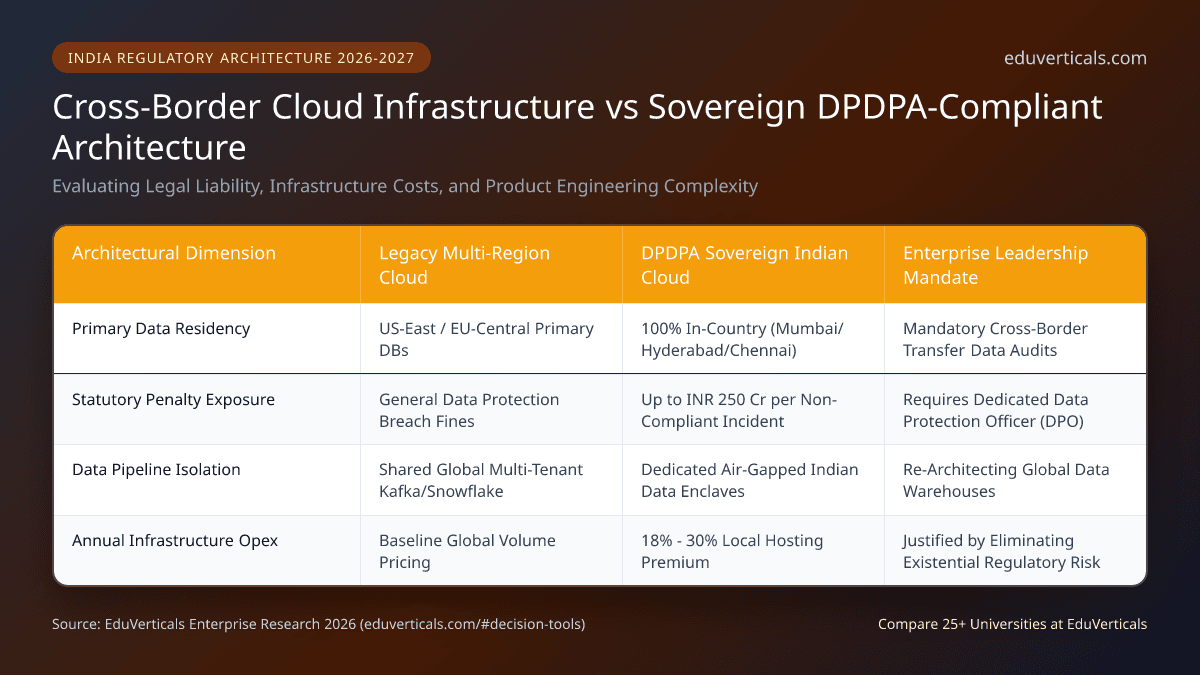
Comparison of legacy multi-region cloud architecture versus sovereign DPDPA-compliant infrastructure in India.

2. Financial Modeling: Quantifying Compliance Opex vs Non-Compliance Fines

Chief Information Officers and Chief Financial Officers face significant capital decisions when executing sovereign cloud migrations. Hosting data entirely within domestic data centers often carries an 18% to 30% cost premium compared to global bulk multi-region cloud pricing.

  1. The Statutory Penalty Trade-Off: Under the DPDPA, failure to deploy reasonable security safeguards to prevent a personal data breach carries fines of up to ₹250 Crore per incident. A single unauthorized exfiltration of customer records can wipe out an entire fiscal year of corporate net profit.
  2. Operational Interruption Costs: Regulatory enforcement actions by the RBI or Data Protection Board of India can result in immediate executive cease-and-desist orders, halting new customer onboarding for months (as observed in historical supervisory bans on major credit card issuers).
  3. Brand Equity & Enterprise Valuation: Institutional private equity and sovereign wealth funds conducting M&A due diligence in 2026 apply steep valuation discounts (often 15%–25%) to Indian technology startups that exhibit ambiguous data residency documentation.
  4. Continuous Automated Audit Trails: Investing in automated data classification, synthetic data generation, and real-time egress monitoring systems that generate compliance reports for statutory auditors at the touch of a button.
Interactive Career Pulse

Select your career goal to tailor advice

Decision note · Verified comparison01 / 03

What is your primary career trajectory in regulatory cloud and tech governance?

Mentor RecommendationAdvancing from Cloud Architect to Enterprise Architect

Master privacy-by-design frameworks and sovereign cloud modeling. Check EduVerticals University Compare for top executive tracks.

Tailored shortlist from our admission partners

The days when an Enterprise Architect could focus purely on network throughput, microservice decoupling, and database indexing are long gone. Today’s senior technical leaders sit at the intersection of constitutional privacy law, corporate finance, international trade treaties, and software engineering.

Technology professionals who aspire to Chief Technology Officer (CTO) or Chief Information Officer (CIO) appointments must possess the executive vocabulary required to defend multi-crore infrastructure migration budgets before board audit committees and statutory regulators. Enrolling in an accredited Online MBA in Technology & Business Analytics from premier institutions such as Symbiosis Centre for Distance Learning or reviewing executive pathways in our Course Catalog equips senior architects with the strategic, legal, and financial acumen necessary to navigate India’s rapidly evolving regulatory landscape.

Editorial Brief
Reading Brief
Prepare for Board-Level Tech Governance: Discover how an accredited postgraduate business qualification accelerates your elevation to executive enterprise leadership on .

Keep the details close

Common QuestionsThe full picture.

Explore key programme specifications, recognition terms, fee components, and career outcomes side by side before applying.

05 verified FAQs

A Sovereign Cloud is cloud infrastructure physically located within national borders that complies strictly with local data privacy, security, and jurisdictional laws. India mandates it to protect citizen data privacy under the DPDPA and safeguard critical digital infrastructure from foreign legal overreach.

01 / The Facts, Side by Side
Live Comparison Dossier

University Comparison Report

Bring programme options, estimated fees and study flexibility into one view, with the trade-offs and questions to verify.

01Fee Structure
02Study Mode
03Career Fit

Tailored shortlist from our admission partners. Verify fees and eligibility before applying.

Meet Our Mentors

We have a team of over 12 experienced mentors with over 26+ years of collective experience available to guide you at a moment's notice.

Got Questions?

Online and distance learning programs provide: - Flexibility to learn at your own pace from anywhere. - Access to recorded lectures and digital study materials. - Opportunities to balance work, education, and personal commitments. - Affordable options compared to traditional on-campus programs. - Industry-relevant curriculum designed by academic experts.
Choosing the right university depends on: - Accreditation and recognition of the institution. - Quality and relevance of the curriculum. - Availability of academic and career support services. - Feedback and reviews from alumni and current students. - Flexibility in learning schedules and delivery modes.
Yes, online degrees from accredited universities are widely recognized and equivalent to regular degrees. Employers value the skills and qualifications gained from online programs, especially when offered by reputed institutions.
Assessment methods for online programs vary but typically include: - Online quizzes and assignments. - Virtual proctored exams. - Group projects and case studies. - Real-time presentations and viva sessions.
Many universities allow credit transfers, subject to: - Compatibility with the curriculum of the new program. - A minimum grade requirement in previously completed courses. - Approval by the academic administration of the new university.