
logo

Return-to-Office Mandates vs Flexible Hybrid Output: The 2027 Leadership Playbook for Retaining Senior Talent

Return to Office Mandate 2027Hybrid Work Output MetricsSenior Talent Retention IndiaRTO Backlash GCCsPeople Ops LeadershipTotal Rewards RedesignExecutive Leadership MBAEduVerticals
EduVerticals EditorialsEduVerticals Editorials

Posted 1 day ago

Return-to-Office Mandates vs Flexible Hybrid Output: The 2027 Leadership Playbook for Retaining Senior Talent
Executive Summary
Reading Brief
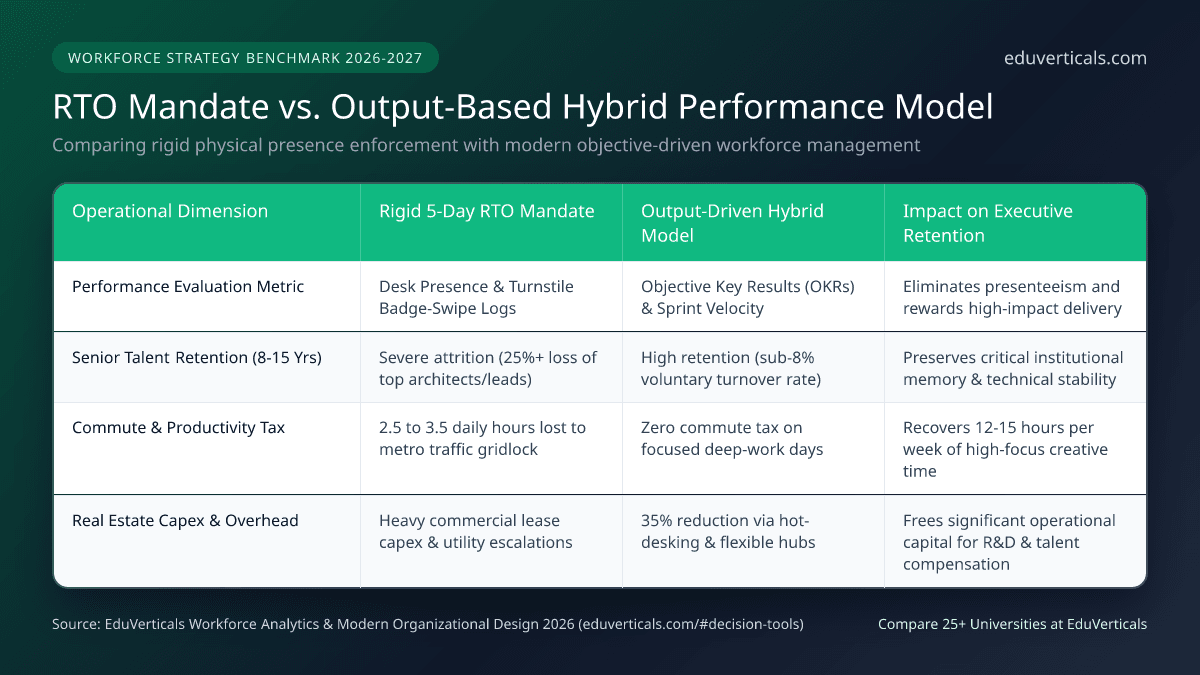
Executive Summary: The corporate confrontation over Return-to-Office (RTO) mandates has reached boiling point across Indian metro corridors and multinational Global Capability Centers. Throughout 2025 and 2026, several legacy IT giants and Wall Street investment banks enforced rigid five-day physical presence policies backed by automated turnstile badge-swipe surveillance. However, human capital data heading into 2027 reveals severe unintended consequences: a 25% spike in voluntary attrition among senior technical leads, architects, and women managers with 8 to 15 years of experience. Forward-thinking leaders are abandoning desk-presence tracking in favor of an output-driven hybrid management playbook.

Across Bengaluru’s Outer Ring Road, Mumbai’s Western Express Highway, Hyderabad’s HITEC City, and Gurugram’s Cyber City, daily urban commuting has become an exhausting ordeal. Mid-career professionals frequently endure 2.5 to 3.5 hours of grueling traffic gridlock each day merely to sit in corporate cubicles and participate in video calls with colleagues stationed across different time zones.

When corporate leadership arbitrarily mandates 100% physical attendance without demonstrable productivity justification, the policy is widely interpreted as a lack of trust and managerial incompetence. The most talented, autonomous professionals—who possess strong market demand—simply vote with their feet, migrating to progressive GCCs and agile digital enterprises that evaluate performance based on deliverables rather than physical seat occupancy.

1. The Three Fallacies of Physical Desk-Presence Surveillance

Rigid RTO mandates frequently fail because they are built upon fundamentally flawed organizational assumptions:
  1. The Fallacy of Co-Location Collaboration: In globalized organizations, team members rarely sit in the same physical office. A team lead in Bengaluru collaborates with product managers in San Francisco, data scientists in Tel Aviv, and QA engineers in Krakow. Mandating physical attendance in an Indian facility does not alter the inherently distributed nature of modern digital workflows.
  2. The Presenteeism Trap: When physical presence is actively monitored via badge-swipe audits, employees quickly adapt by optimizing for optical visibility rather than actual output. They arrive early, pace the floor, engage in performative social banter, and leave promptly once compliance minimums are logged.
  3. Disproportionate Impact on Senior Diversity: Rigid five-day office mandates disproportionately trigger exits among experienced female leaders and mid-career managers balancing elder care and young families, unraveling years of corporate diversity, equity, and inclusion (DEI) investments.
Return to Office vs Hybrid Work Output Playbook 2027
RTO Mandates vs. Output-Driven Hybrid Models: Evaluating Desk Presence vs. Objective Key Results (OKRs).

2. The Output-Driven Hybrid Playbook for 2027 Leaders

Transitioning from an attendance-based surveillance culture to a high-accountability hybrid framework requires a fundamental redesign of managerial systems. Progressive enterprises structure their operations around three core practices:

  • Asynchronous Documentation Over Real-Time Meetings: Teams document architectural decisions, sprint backlogs, and strategy memos in centralized repositories, minimizing the necessity for continuous synchronous meetings.
  • Granular Objective Key Results (OKRs): Individual and team performance is assessed through transparent, quantifiable deliverables, code velocity, customer satisfaction scores, and revenue milestones rather than hours spent at a desk.
  • Purpose-Driven In-Person Gathering: Physical office time is reserved exclusively for high-value collaborative activities: quarterly strategic planning, complex design workshops, and team mentorship, rather than isolated individual typing.
Interactive Career Pulse

Select your career goal to tailor advice

Decision note · Verified comparison01 / 03

What is the biggest operational hurdle your team faces under hybrid/RTO models?

Mentor RecommendationFair Output Measurement & OKRs

Build objective performance matrices that evaluate real impact rather than optical desk hours.

Tailored shortlist from our admission partners

3. Career Elevation: Mastering Modern Organizational Leadership

The corporate clash over return-to-office policies underscores a vital career reality: organizations desperately need modern, enlightened managers who know how to lead distributed, high-performance teams. Old-school command-and-control supervisors are being phased out in favor of empathetic, metric-driven People Operations directors.

Developing this advanced managerial capability requires formal education in organizational design, behavioral economics, and strategic human capital management. Working professionals are transforming their leadership profiles through UGC-DEB entitled Online MBA programmes. Explore accredited options on the EduVerticals Academic Catalog and compare leadership tracks from premier institutions such as Symbiosis (SSODL) and Manipal University Jaipur.

  • Lead High-Trust Distributed Teams: Learn psychological safety frameworks and asynchronous communication architectures that foster accountability across distributed workforces.
  • Optimize Real Estate & Operational Capex: Develop the financial literacy to model how flexible hot-desking and hub-and-spoke office networks reduce corporate fixed costs.
  • Master Total Rewards & Policy Design: Structure equitable hybrid work agreements that satisfy enterprise regulatory requirements while maximizing senior talent retention.
  • Gain Institutional Boardroom Standing: An accredited MBA credential validates your competence to lead enterprise-wide organizational transformations at the VP and CXO levels.
Editorial Brief
Reading Brief
Equip Yourself for Future-Ready Leadership: Discover how specialized executive management degrees empower you to lead modern, high-performance distributed workforces. Receive a tailored shortlist from our admission partners on .

Keep the details close

Common QuestionsThe full picture.

Explore key programme specifications, recognition terms, fee components, and career outcomes side by side before applying.

05 verified FAQs

Severe urban traffic congestion in cities like Bengaluru, Mumbai, and NCR imposes a 2 to 3 hour daily commute penalty, leading to severe burnout, disengagement, and voluntary attrition among senior talent who can easily find flexible hybrid roles.

01 / The Facts, Side by Side
Live Comparison Dossier

University Comparison Report

Bring programme options, estimated fees and study flexibility into one view, with the trade-offs and questions to verify.

01Fee Structure
02Study Mode
03Career Fit

Tailored shortlist from our admission partners. Verify fees and eligibility before applying.

Meet Our Mentors

We have a team of over 12 experienced mentors with over 26+ years of collective experience available to guide you at a moment's notice.

Got Questions?

Online and distance learning programs provide: - Flexibility to learn at your own pace from anywhere. - Access to recorded lectures and digital study materials. - Opportunities to balance work, education, and personal commitments. - Affordable options compared to traditional on-campus programs. - Industry-relevant curriculum designed by academic experts.
Choosing the right university depends on: - Accreditation and recognition of the institution. - Quality and relevance of the curriculum. - Availability of academic and career support services. - Feedback and reviews from alumni and current students. - Flexibility in learning schedules and delivery modes.
Yes, online degrees from accredited universities are widely recognized and equivalent to regular degrees. Employers value the skills and qualifications gained from online programs, especially when offered by reputed institutions.
Assessment methods for online programs vary but typically include: - Online quizzes and assignments. - Virtual proctored exams. - Group projects and case studies. - Real-time presentations and viva sessions.
Many universities allow credit transfers, subject to: - Compatibility with the curriculum of the new program. - A minimum grade requirement in previously completed courses. - Approval by the academic administration of the new university.