 EduVerticals Editorials
Posted 1 day ago

Executive SummaryReading BriefExecutive Summary: The Reserve Bank of India’s Scale-Based Regulation (SBR) framework represents the most consequential regulatory overhaul of the non-banking financial sector in decades. By categorizing systemically significant entities—including Core Investment Companies (CICs) of massive conglomerates like Tata Sons—into the NBFC Upper Layer (NBFC-UL), the central bank mandated public stock exchange listings within three years of identification. In late 2026, this regulatory deadline has catalyzed complex balance-sheet restructuring, debt paydowns, and unprecedented demand for strategic corporate treasury professionals.
When the Reserve Bank of India introduced the four-tiered Scale-Based Regulation framework, its objective was unambiguous: eliminate the regulatory arbitrage that previously allowed large shadow banks and conglomerate holding entities to operate with bank-like systemic leverage while avoiding public market transparency. The Upper Layer designation applies a score-based assessment encompassing asset size, turnover, interconnectedness with the banking system, and complexity of group structures.
For industrial conglomerates whose central investment vehicles were classified under NBFC-UL, the mandate triggered a profound strategic dilemma. Going public through an Initial Public Offering (IPO) exposes holding companies to intense market scrutiny, potential conglomerate valuation discounts of 30% to 50%, and aggressive public disclosure requirements. Conversely, avoiding a public listing necessitates drastic balance-sheet engineering: repaying borrowings, shrinking debt-to-equity ratios, and restructuring asset holdings to seek regulatory deregistration as an upper-layer entity.
The regulatory requirements governing NBFC-UL entities introduce rigorous prudential standards that mirror commercial banking supervision:
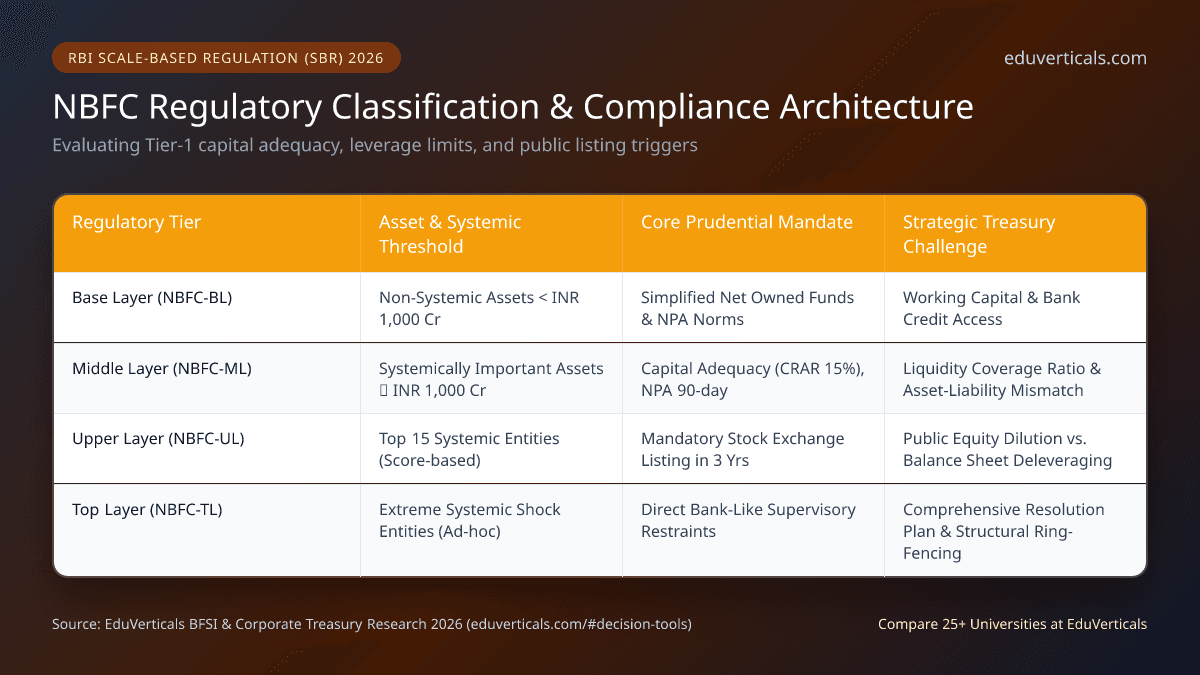
Faced with mandatory listing timelines, Corporate India’s largest conglomerates initiated historic financial maneuvers throughout 2025 and 2026. Rather than diluting promoter control and subjecting holding vehicles to market volatility, several groups chose aggressive deleveraging. By monetizing non-core assets, executing secondary stake sales in established operating subsidiaries (such as TCS), and deploying surplus cash to extinguish external debt, holding companies sought to shed their financial intermediary status and petition the central bank for recategorization.
However, this deleveraging strategy requires sophisticated corporate finance orchestration. Debt retirement must be balanced against multi-billion-dollar capex commitments in high-growth industrial verticals. A single misstep in working capital planning or tax liability structuring can impair credit ratings and escalate borrowing costs across the entire group.
Select your career goal to tailor advice
Target risk modeling, asset-liability management (ALM), and prudential compliance roles.
The ripple effect of RBI’s tightening supervisory regime is a massive talent crunch across Indian BFSI and conglomerate treasury desks. Corporations are aggressively hiring executives who can bridge the gap between statutory banking regulations and executive corporate strategy. CFOs are paying top-tier premiums for professionals who can model systemic capital requirements while preserving shareholder returns.
Traditional accountancy or generalist experience is no longer sufficient; senior leaders must master modern financial instruments, algorithmic liquidity management, and banking law. Professionals seeking to capitalize on this surge are turning to specialized executive management degrees. Review accredited programmes on the EduVerticals Course Catalog to compare flexible finance and banking curricula from leading institutions like Symbiosis Centre for Distance Learning (SSODL) and Vellore Institute of Technology (VIT Online).
Editorial BriefReading BriefAssess Your BFSI Leadership Readiness: Explore how accredited executive programmes in Finance and Risk Management can elevate your career into senior treasury leadership. Request a tailored shortlist from our admission partners on .
Keep the details close
Explore key programme specifications, recognition terms, fee components, and career outcomes side by side before applying.
RBI uses a parametric scoring matrix based on asset size (typically exceeding ₹1,000 Crore), interconnectedness with the financial system, complexity of operations, and systemic footprint to designate the top 15 systemically critical NBFCs as Upper Layer entities.
Bring programme options, estimated fees and study flexibility into one view, with the trade-offs and questions to verify.
Tailored shortlist from our admission partners. Verify fees and eligibility before applying.


We have a team of over 12 experienced mentors with over 26+ years of collective experience available to guide you at a moment's notice.