 EduVerticals Editorials
Posted 1 day ago

Executive SummaryReading BriefExecutive Summary: India’s quick commerce revolution—dominated by Blinkit, Swiggy Instamart, Zepto, and aggressive retail conglomerates—has entered a decisive new phase in late 2026: the scrutiny of public equity markets and IPO filings. The initial era of venture-funded expansion, where platforms competed purely on 10-minute speed regardless of unit-level cash burn, has been eclipsed by strict capital discipline. Public institutional investors demand audited dark store contribution margin profitability (CM2 of +4% to +8%). Achieving these margins requires a massive transformation of retail operations: increasing Average Order Value (AOV) from ₹400 to over ₹800 through high-margin consumer electronics, beauty, and festive retail assortments, while mathematically optimizing dark store picker velocity, micro-slotting density, and inventory turnover. This structural shift has created intense demand for retail supply chain leaders who can manage complex distributed micro-hub networks.
With quick commerce expanding from metropolitan centers into more than 40 Tier-2 cities—including Jaipur, Lucknow, Chandigarh, and Coimbatore—the operational complexity of running 3,000+ localized dark stores has reached unprecedented scale. A dark store is not merely a mini-warehouse; it is a high-velocity, algorithmically managed fulfillment node handling 10,000+ distinct stock-keeping units (SKUs) in less than 3,500 square feet of leased urban real estate. A single percentage point increase in inventory shrinkage, a miscalculated cold-chain forecast for dairy products, or suboptimal picker routing can destroy the unit profitability of an entire city cluster.
Consequently, quick commerce operators and organized retail giants (Reliance Retail, Tata Neu, D-Mart) are aggressively revamping their management tiers. They are replacing ad-hoc field coordinators with professionally trained Category P&L Managers, City Operations Directors, and Supply Chain Analytics Heads who understand the mathematical interplay between warehouse slotting, gross margin return on investment (GMROI), and working capital velocity.
Achieving sustainable contribution margins in 10-minute delivery requires meticulous optimization of every line item on the micro-hub income statement.
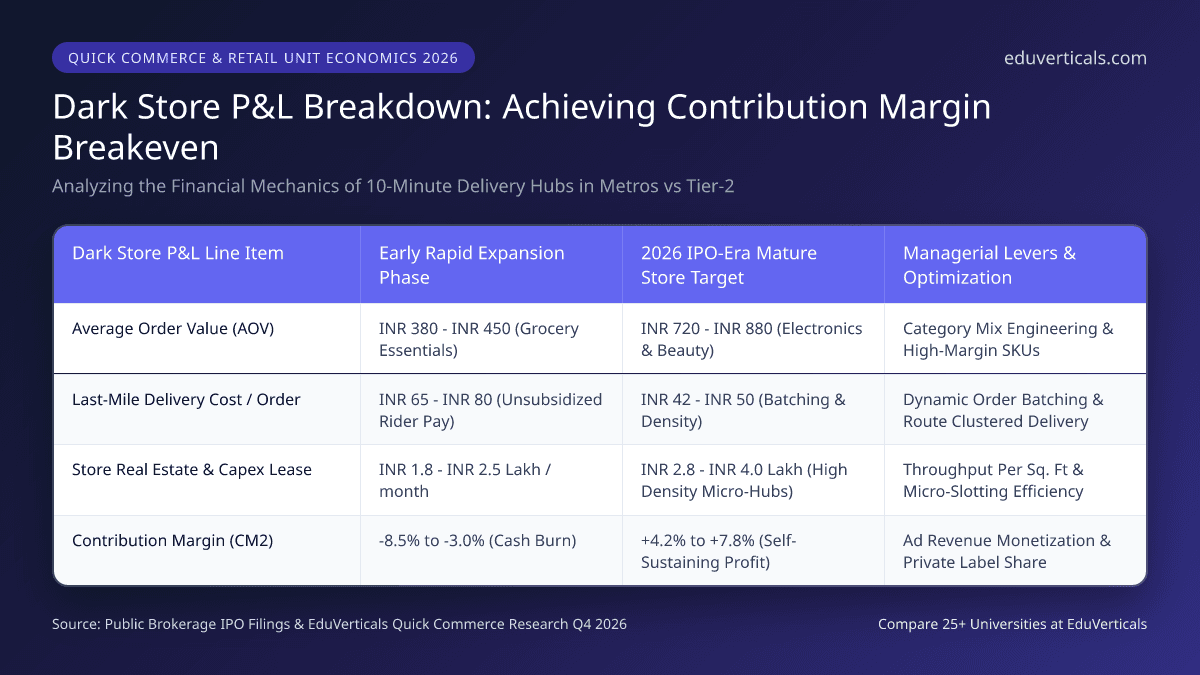
The leadership requirements of modern retail logistics have evolved rapidly. In legacy retail distribution, inventory moved in predictable pallets from central warehouses to hypermarkets on weekly schedules. In quick commerce, inventory turns over every 48 to 72 hours, requiring continuous, real-time micro-fulfillment orchestration.
A Category Manager or City Cluster Head in quick commerce is responsible for a ₹100-to-₹300-crore annual P&L portfolio. They must negotiate trade terms and promotional funding with global consumer brands (Unilever, Nestlé, P&G, Apple, Samsung), monitor real-time gross margin return on inventory (GMROI), and design labor scheduling algorithms that handle sudden order surges during evening peak hours.
Select your career goal to tailor advice
Drive high-margin SKU assortment and supplier terms. Explore retail MBA tracks in our University Comparison Report or book a Free Mentor Call.
As quick commerce platforms prepare for landmark IPOs and retail conglomerates expand omnichannel footprints, managerial compensation packages have surged. City Operations Heads, National Category Directors, and Supply Chain Vice Presidents command compensation packages ranging from ₹40 LPA to ₹90 LPA plus equity stock options.
For working retail professionals, warehouse cluster leads, and e-commerce executives, advancing to these high-paying executive roles requires acquiring accredited postgraduate management credentials. Leading UGC-DEB entitled institutions such as Manipal University Jaipur (MUJ) and NMIMS CDOE provide specialized Online MBA curricula in Retail Management, Supply Chain Operations, and Business Analytics.
These programs deliver rigorous training in retail merchandising, managerial accounting, inventory analytics, and strategic pricing models. Because the coursework is delivered online with flexible weekend masterclasses, retail managers can master enterprise financial frameworks without stepping away from active field operations. To evaluate accredited online MBA programs, consult the EduVerticals Academic Catalog or compare specialization options.
Editorial BriefReading BriefLead the Quick Commerce Retail Revolution: Compare UGC-DEB accredited Online MBA programs in Retail Operations, Supply Chain, and Marketing Analytics on .
Keep the details close
Explore key programme specifications, recognition terms, fee components, and career outcomes side by side before applying.
A dark store is a compact (2,500-4,000 sq ft) neighborhood fulfillment center closed to walk-in retail customers and dedicated entirely to picking, packing, and dispatching 10-minute online delivery orders. Unlike supermarkets with high storefront rents and visual merchandising, dark stores focus strictly on picker velocity and inventory density.
Bring programme options, estimated fees and study flexibility into one view, with the trade-offs and questions to verify.
Tailored shortlist from our admission partners. Verify fees and eligibility before applying.


We have a team of over 12 experienced mentors with over 26+ years of collective experience available to guide you at a moment's notice.