
logo

Open-Weight AI vs Frontier APIs: Enterprise TCO, Latency & FinOps Strategy (2026)

Open Weight AI ModelsFrontier AI APIsEnterprise AI TCOGPU FinOps IndiaLlama Enterprise DeploymentTech Product LeadershipEduVerticals
EduVerticals EditorialsEduVerticals Editorials

Posted 1 day ago

Open-Weight AI vs Frontier APIs: Enterprise TCO, Latency & FinOps Strategy (2026)
Executive Summary
Reading Brief
Executive Summary: As enterprise artificial intelligence deployments in late 2026 transition from experimental pilots into mission-critical production workflows, Chief Information Officers and Engineering Directors face an existential build-versus-buy crossroads: should they continue routing enterprise queries through proprietary frontier cloud APIs (OpenAI GPT-4.5/5, Anthropic Claude 3.7 Opus, Google Gemini 2.5 Flash), or build dedicated self-hosted inference clusters using state-of-the-art open-weight models (Meta Llama 3.3 70B, Mistral Large 2, DeepSeek V3/R1)? While cloud APIs offer zero infrastructure overhead, their linear pay-per-token pricing scales aggressively into corporate balance sheets. For high-throughput enterprises consuming more than 250 million tokens per month, hosting open-weight models on reserved GPU clusters cuts multi-year Total Cost of Ownership (TCO) by over 60%, slashes P99 latency from 2,000ms to sub-300ms, and guarantees complete data sovereignty under India’s DPDPA. Mastering this architectural choice requires technology managers to combine deep GPU FinOps with strategic capital allocation.

When generative AI first entered enterprise boardrooms, proprietary cloud APIs were the only rational choice. Closed frontier models offered reasoning capabilities, coding synthesis, and multilingual comprehension that open-source alternatives simply could not match. Engineering teams plugged in simple REST API keys, paid pennies per transaction, and deployed enterprise conversational assistants in weeks.

However, the rapid maturation of open-weight foundation models has permanently leveled the technical playing field. The gap between proprietary frontier models and premier open-weight models has narrowed to within single-digit percentage points across standard industry benchmarks. Meanwhile, as Indian enterprises scale AI across automated customer service voicebots, real-time banking fraud analysis, and internal developer platforms, the cumulative operational cost of pay-per-token cloud billing has become a multi-crore balance-sheet drain.

1. The Quantitative TCO Breakeven Analysis

To justify investing in dedicated GPU infrastructure, technology managers must present a rigorous Total Cost of Ownership model comparing token volume scaling curves against fixed infrastructure expenditure:
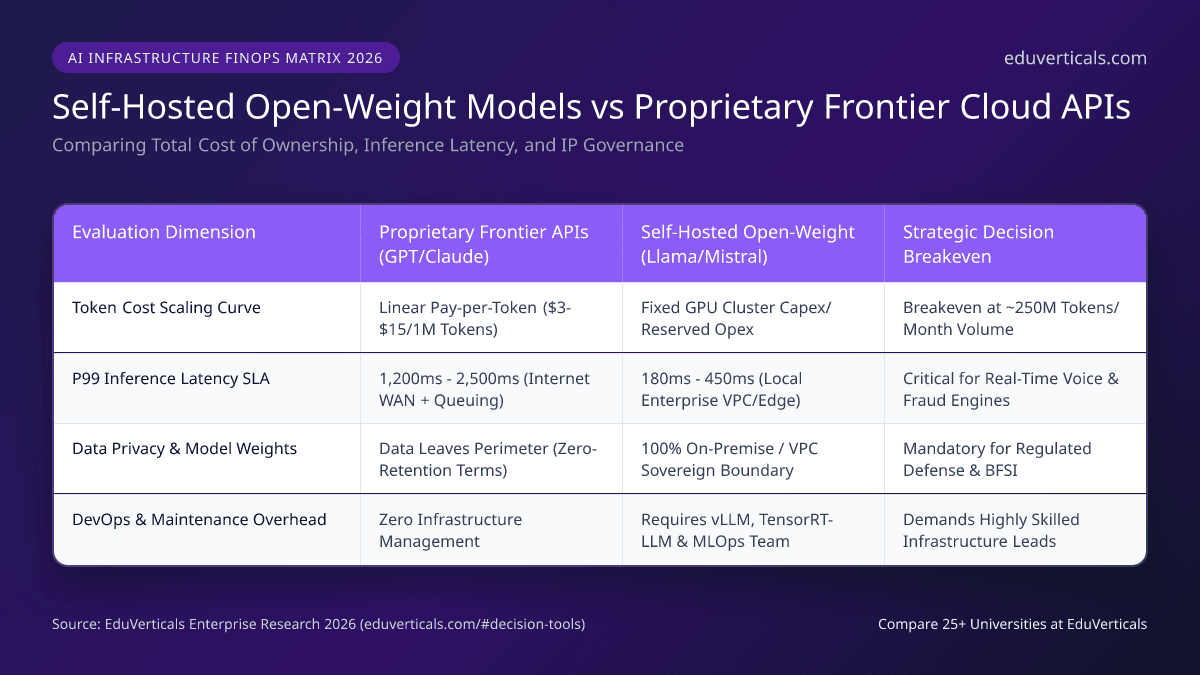
  • Linear API Scaling Costs: Consuming 500 million tokens monthly across enterprise workflows at a blended rate of $8 per million input/output tokens generates a monthly cloud API bill of $4,000 (roughly ₹3.3 Lakhs). When usage scales to 5 billion tokens per month across 10,000 enterprise users, monthly API burn explodes to $40,000 (₹33 Lakhs), amounting to nearly ₹4 Crore annually.
  • Fixed Reserved GPU Cluster Costs: Hosting fine-tuned Llama 3.3 70B models with vLLM continuous batching and TensorRT-LLM acceleration requires an 8-GPU Nvidia H100/H200 cluster. Securing reserved cloud instances on Indian sovereign clouds (such as Yotta Shakti or AWS Mumbai) costs approximately ₹8 Lakhs to ₹12 Lakhs monthly.
  • The TCO Inflection Point: At volumes exceeding 250 million tokens per month, self-hosted open-weight infrastructure achieves clear cost superiority. At 2 billion tokens per month, self-hosting delivers an astounding 65% net savings compared to frontier API pricing.
  • Inference Latency & Cold-Start SLAs: Public cloud APIs suffer from network WAN congestion, multi-tenant queuing, and unpredictable rate limits, producing P99 latencies of 1,500ms to 3,000ms. Self-hosted clusters in a local VPC deliver consistent sub-300ms response times, essential for real-time voice and financial trading applications.
Open-Weight AI Models vs Frontier APIs Enterprise TCO 2026
Comprehensive FinOps comparison between proprietary frontier cloud APIs and self-hosted open-weight AI models across TCO, latency, and governance.

2. Strategic IP Moats & Data Sovereignty Governance

Beyond pure token economics, enterprise leadership must weigh critical strategic variables regarding intellectual property and regulatory compliance.

  1. Absolute Data Perimeter Security: Even with enterprise zero-data-retention agreements, sending unencrypted proprietary source code, medical records, or banking transactions to third-party public API endpoints creates residual compliance vulnerabilities under the DPDPA. Self-hosted models keep all inference within air-gapped corporate boundaries.
  2. Domain-Specific Fine-Tuning & Weight Ownership: When an enterprise fine-tunes an open-weight model on proprietary internal documentation, customer interactions, and engineering logs, the resulting model weights become a defensible corporate intellectual property asset that cannot be revoked or deprecated by a third-party vendor.
  3. Mitigating Vendor Model Deprecation: Proprietary API providers routinely update, modify, or deprecate model checkpoints, causing unexpected behavioral drift and breaking production prompt pipelines. Open-weight models freeze model weights indefinitely, ensuring 100% deterministic reproducibility.
  4. The Hidden Opex of MLOps Talent: Self-hosting is not free of operational friction. It demands specialized MLOps talent skilled in vLLM orchestration, Kubernetes GPU scheduling, quantization (AWQ/FP8), and continuous model evaluation.
Interactive Career Pulse

Select your career goal to tailor advice

Decision note · Verified comparison01 / 03

What is your primary career bottleneck in enterprise AI leadership?

Mentor RecommendationMastering GPU FinOps & AI Infrastructure Budgeting

Develop quantitative capital budgeting and infrastructure modeling skills. Compare top programs on EduVerticals University Compare.

Tailored shortlist from our admission partners

3. Why Technical AI Leaders Must Master P&L Management

Engineering Managers, Lead Data Scientists, and Solutions Architects are no longer evaluated solely on model accuracy scores or benchmark F1 metrics. Chief Executive Officers and Board Audit Committees expect technology leaders to act as commercial business owners who can defend a ₹15 Crore multi-year GPU cluster commitment, negotiate hyperscaler enterprise discount agreements, and tie AI initiatives directly to EBITDA expansion.

Senior technical professionals who combine deep machine learning fluency with formal postgraduate business management education hold the most lucrative and influential positions in modern enterprise tech. Enrolling in an accredited Online MBA in Business Analytics & Data Science from premier institutions such as Manipal University Jaipur (MUJ) or exploring executive tracks in our comprehensive Academic Catalog equips engineering leaders with the executive vocabulary, managerial accounting acumen, and corporate strategy frameworks required to lead enterprise AI transformations.

Editorial Brief
Reading Brief
Lead the AI Enterprise Transformation: Benchmark accredited postgraduate business programs designed for technology executives and calculate your 5-year career ROI on .

Keep the details close

Common QuestionsThe full picture.

Explore key programme specifications, recognition terms, fee components, and career outcomes side by side before applying.

05 verified FAQs

Open-weight models (like Meta Llama or Mistral) release their pre-trained parameter weights for public download and enterprise deployment, though the training datasets and raw source code may remain proprietary, unlike traditional open-source software.

01 / The Facts, Side by Side
Live Comparison Dossier

University Comparison Report

Bring programme options, estimated fees and study flexibility into one view, with the trade-offs and questions to verify.

01Fee Structure
02Study Mode
03Career Fit

Tailored shortlist from our admission partners. Verify fees and eligibility before applying.

Meet Our Mentors

We have a team of over 12 experienced mentors with over 26+ years of collective experience available to guide you at a moment's notice.

Got Questions?

Online and distance learning programs provide: - Flexibility to learn at your own pace from anywhere. - Access to recorded lectures and digital study materials. - Opportunities to balance work, education, and personal commitments. - Affordable options compared to traditional on-campus programs. - Industry-relevant curriculum designed by academic experts.
Choosing the right university depends on: - Accreditation and recognition of the institution. - Quality and relevance of the curriculum. - Availability of academic and career support services. - Feedback and reviews from alumni and current students. - Flexibility in learning schedules and delivery modes.
Yes, online degrees from accredited universities are widely recognized and equivalent to regular degrees. Employers value the skills and qualifications gained from online programs, especially when offered by reputed institutions.
Assessment methods for online programs vary but typically include: - Online quizzes and assignments. - Virtual proctored exams. - Group projects and case studies. - Real-time presentations and viva sessions.
Many universities allow credit transfers, subject to: - Compatibility with the curriculum of the new program. - A minimum grade requirement in previously completed courses. - Approval by the academic administration of the new university.