 EduVerticals Editorials
Posted 1 day ago

Executive SummaryReading BriefExecutive Summary: As the global semiconductor industry crosses $1.2 trillion in annual market capitalization, the corporate battlefield has expanded far beyond transistor density and clock speeds. Executive succession planning at Nvidia—alongside the aggressive migration of enterprise hyperscalers toward custom Arm-based server silicon (AWS Graviton, Google Axion, Microsoft Cobalt)—highlights an acute vulnerability: extreme supply chain concentration. With over 90% of advanced Chip-on-Wafer-on-Substrate (CoWoS) packaging centralized in Taiwan, enterprise tech leaders must navigate unprecedented geopolitical, financial, and operational risks. For engineers in India’s burgeoning semiconductor and hardware ecosystem, transitioning into General Manager and VP-level roles demands deep fluency in semiconductor unit economics, fab capital allocation, and executive corporate strategy.
The modern technology landscape is defined by a paradox: computing power has never been more commoditized, yet the hardware that creates it has never been more monopolistic. Nvidia’s era-defining dominance in generative AI infrastructure was built not merely on graphics processing hardware, but on the impregnable software ecosystem of CUDA. However, as capital expenditures on frontier AI clusters cross $100 billion annually across major tech giants, CFOs are demanding hardware independence.
Hyperscalers are responding by standardizing server fleets on energy-efficient Arm architecture, drastically lowering data center thermal design power while slashing reliance on off-the-shelf accelerators. Meanwhile, India’s semiconductor mission—backed by $10 billion in government PLI incentives and major OSAT (Outsourced Semiconductor Assembly and Test) facility investments in Gujarat and Assam—is creating thousands of high-level engineering roles. But across multinational chip design centers in Bengaluru and Noida, CEOs voice a universal complaint: India has hundreds of thousands of brilliant verification engineers, but a crippling deficit of strategic leaders who can run a semiconductor business unit.
Enterprise hardware leaders can no longer treat silicon procurement as a simple operational line item. The entire global digital economy relies on a remarkably narrow manufacturing bottleneck. Advanced nodes below 3 nanometers depend on extreme ultraviolet lithography (EUV) systems manufactured exclusively by ASML in the Netherlands, fabricated primarily on wafer lines in Hsinchu and Tainan, and assembled using specialized packaging substrates.
A single geopolitical shock or shipping route disruption across the Taiwan Strait could halt enterprise server deliveries globally for 12 to 18 months. Tech leaders must evaluate silicon strategy through four macroeconomic pillars:
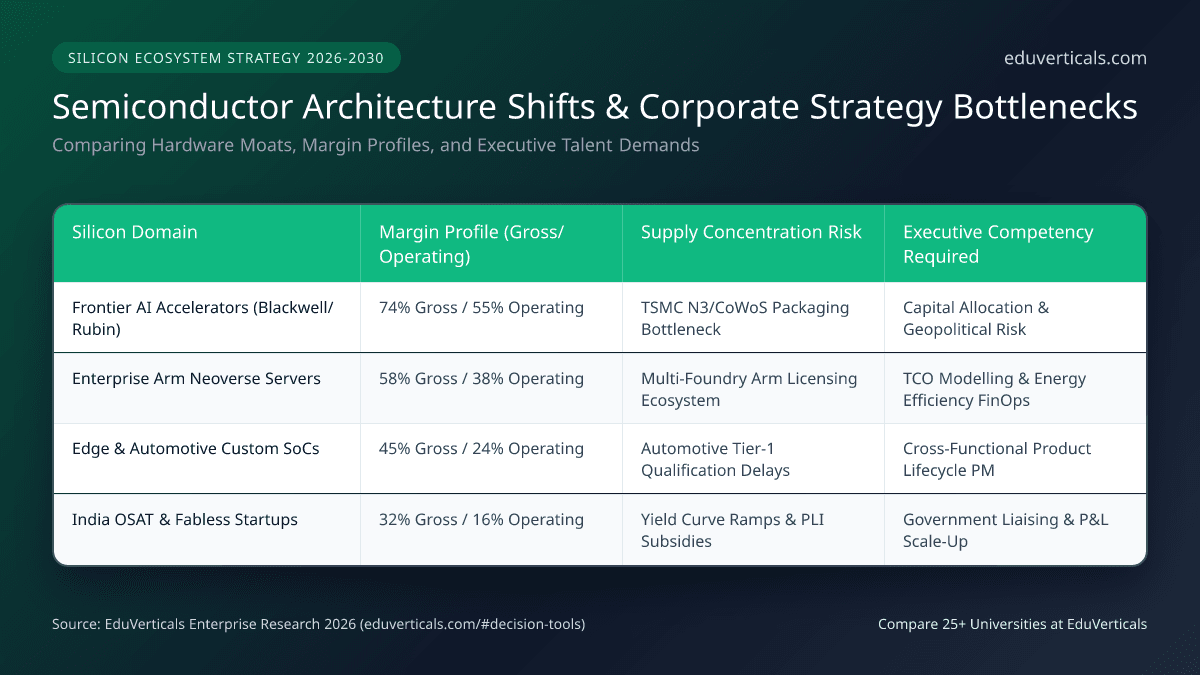
In semiconductor design centers across India, engineers spend years writing SystemVerilog, optimizing physical synthesis, or analyzing static timing analysis. Yet when an organization seeks a Vice President of Product or a Country Managing Director, pure technical mastery is rarely the deciding factor.
Select your career goal to tailor advice
Build formal expertise in tech marketing and product economics. Check EduVerticals University Compare for top executive degrees.
Hardware engineering professionals frequently hit a compensation and title ceiling around the 8-to-12-year experience mark. While technical fellows and principal architects remain highly valued, organizational authority and multi-crore P&L ownership are invariably handed to leaders who demonstrate executive business literacy.
Pursuing a high-caliber Executive or Online MBA Program enables senior engineers to master corporate finance, strategic management, and supply chain logistics while continuing their full-time technical responsibilities. Premier programs from institutions like VIT Online and Manipal University Jaipur (MUJ) provide the quantitative rigor and executive credibility necessary to bridge the gap between engineering execution and boardroom leadership.
Editorial BriefReading BriefChart Your Path to Tech Executive Leadership: Explore NIRF-ranked and UGC-DEB recognized programs designed for senior engineering and semiconductor professionals on EduVerticals Academic Catalog.
Keep the details close
Explore key programme specifications, recognition terms, fee components, and career outcomes side by side before applying.
Hyperscalers like AWS, Google, and Microsoft are adopting custom Arm-based processors (Graviton, Axion, Cobalt) to reduce power consumption, eliminate third-party hardware margins, and optimize specific cloud workloads.
Bring programme options, estimated fees and study flexibility into one view, with the trade-offs and questions to verify.
Tailored shortlist from our admission partners. Verify fees and eligibility before applying.


We have a team of over 12 experienced mentors with over 26+ years of collective experience available to guide you at a moment's notice.