 EduVerticals Editorials
Posted 1 day ago

Executive SummaryReading BriefExecutive Summary: When core Microsoft 365 enterprise services experienced a widespread routing engine cascade in late 2026, over 180 million commercial users lost real-time access to Teams, Exchange Online, and SharePoint document sync. For Indian Global Capability Centers (GCCs) in Bengaluru, Hyderabad, and Pune handling high-stakes client deliverables, the downtime represented an estimated $14,000 per minute in unrecoverable billing losses. Yet standard enterprise service agreements capped Microsoft’s liability at a negligible 10% monthly service credit—repaying barely $2.50 per seat. This structural imbalance has forced technology directors, engineering vice presidents, and infrastructure heads to pivot from simple vendor management to complex multi-cloud failover architecture, active-active communications resilience, and aggressive contractual SLA restructuring.
For over a decade, enterprise IT procurement teams celebrated the operational simplicity of consolidating all workplace communications, file collaboration, and calendar scheduling under a single cloud umbrella. However, the cascading outage of November 2026 shattered the illusion that hyperscale public cloud providers are impervious to global routing failures. A misconfigured border gateway protocol update within Microsoft’s wide-area network severed communications across European and Asia-Pacific availability zones simultaneously, leaving knowledge workers completely stranded.
In India’s tech corridors—where over 1,600 GCCs employ more than 1.9 million software engineers, financial analysts, and customer success teams—the disruption was immediate. Project handoffs to North American headquarters stalled, customer support queues backlogged across critical banking platforms, and emergency trading desks scrambled for secondary voice conduits. The crisis laid bare a fundamental leadership reality: technical engineering skill alone cannot resolve infrastructure crises when the underlying contract provides zero financial recourse. Enterprise leaders must master the intersection of cloud architecture, financial risk modeling, and executive vendor negotiation.
When enterprise CIOs review their master services agreements after a major outage, they almost universally encounter the same painful clause: the hyperscaler’s sole liability for downtime is limited to a tiered service credit. If an enterprise pays ₹1,800 ($22) per seat per month for Microsoft 365 E5 licensing, an eight-hour continuous global blackout triggers a credit of roughly 10% to 25% of that month’s subscription fee—amounting to less than ₹450 ($5.50) per employee. Meanwhile, the actual cost of idle payroll, missed delivery deadlines, and contractual client penalties can exceed ₹25,000 ($300) per employee per day.
Progressive IT leaders are completely rewriting enterprise vendor agreements to include:
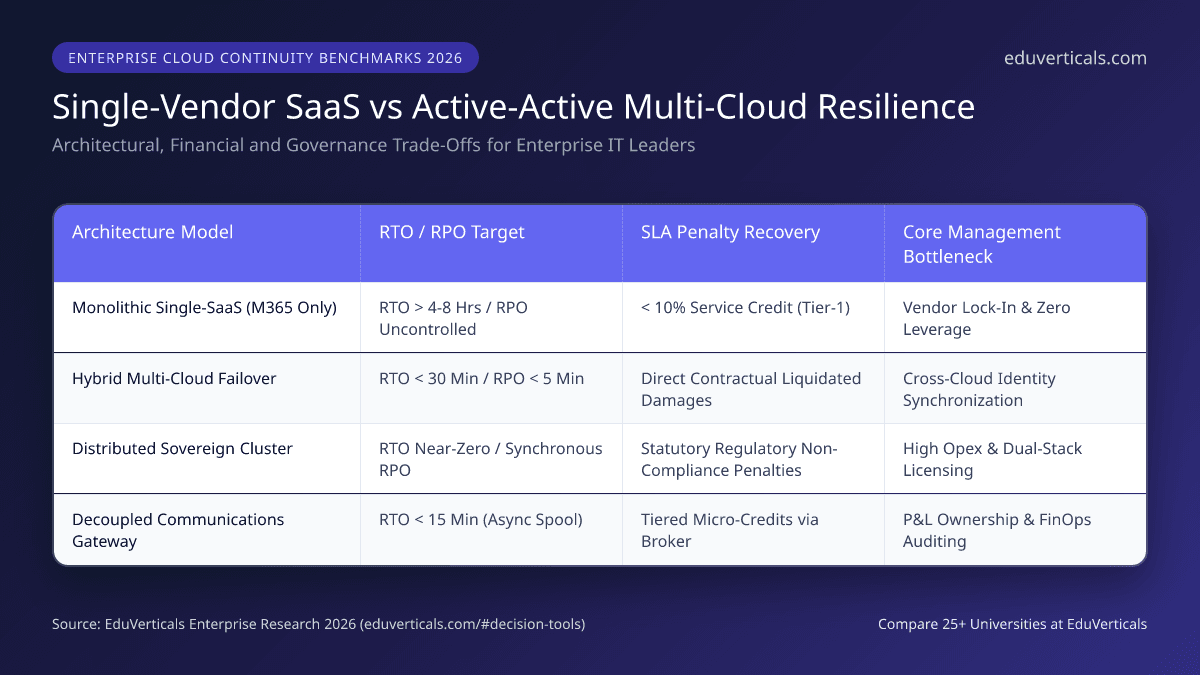
True enterprise resilience requires decoupling identity, communications, and storage so that no single vendor holds a monopoly over business continuity. While running dual-stack workplace software (such as pairing Microsoft 365 with Google Workspace or AWS WorkMail) historically carried prohibitive licensing overhead, modern FinOps strategies make hybrid failover commercially viable.
Select your career goal to tailor advice
Focus on cloud unit economics and vendor negotiations. Compare programs on EduVerticals University Compare to find an executive management track.
The transition from Senior Systems Engineer to Director of Infrastructure or Chief Technology Officer cannot be achieved through vendor certifications alone. While AWS, Azure, and Google Cloud credentials validate technical fluency, they do not prepare an engineering manager to defend a ₹40 Crore disaster recovery budget before an executive board or navigate high-stakes procurement disputes.
Executive boards and corporate risk committees do not evaluate cloud infrastructure in terms of subnets or Kubernetes clusters—they evaluate capital expenditure (Capex), operating expenditure (Opex), annual loss expectancy, and regulatory compliance under India’s Digital Personal Data Protection Act. Tech professionals who combine deep engineering backgrounds with formal postgraduate management education command a 40% to 65% salary premium across Indian GCCs and multinational technology firms.
By pursuing an accredited, flexible Online MBA in Technology & Business Analytics or specialized IT management degree from premier institutions like NMIMS Global Access or Symbiosis Centre for Distance Learning, working technology leaders master corporate finance, contract law, organizational leadership, and supply chain governance without stepping away from full-time leadership roles.
Editorial BriefReading BriefBenchmark Your Enterprise Leadership Trajectory: Explore specialized management programs tailored for technology leaders and calculate your 5-year ROI on .
Keep the details close
Explore key programme specifications, recognition terms, fee components, and career outcomes side by side before applying.
Indian Global Capability Centers manage real-time global workflows across IT operations, banking reconciliations, and customer support. The multi-hour disruption coincided with critical European business hours and North American market openings, causing severe cascading delivery bottlenecks.
Bring programme options, estimated fees and study flexibility into one view, with the trade-offs and questions to verify.
Tailored shortlist from our admission partners. Verify fees and eligibility before applying.


We have a team of over 12 experienced mentors with over 26+ years of collective experience available to guide you at a moment's notice.