 EduVerticals Editorials
Posted 4 months ago
Your MBA application will be judged in thirty seconds.
That is the average time an admissions officer spends on the first pass of any application. Thousands of candidates apply to top business schools every cycle — and most of them have strong grades, decent work experience, and well-intentioned cover letters.
What separates the shortlisted from the rejected is almost always the resume.
Not because one candidate worked harder. But because one candidate packaged their experience better.
This guide gives you the exact framework to write an MBA resume that commands attention — whether you are a working professional targeting an Executive MBA or a fresh graduate applying straight out of college.
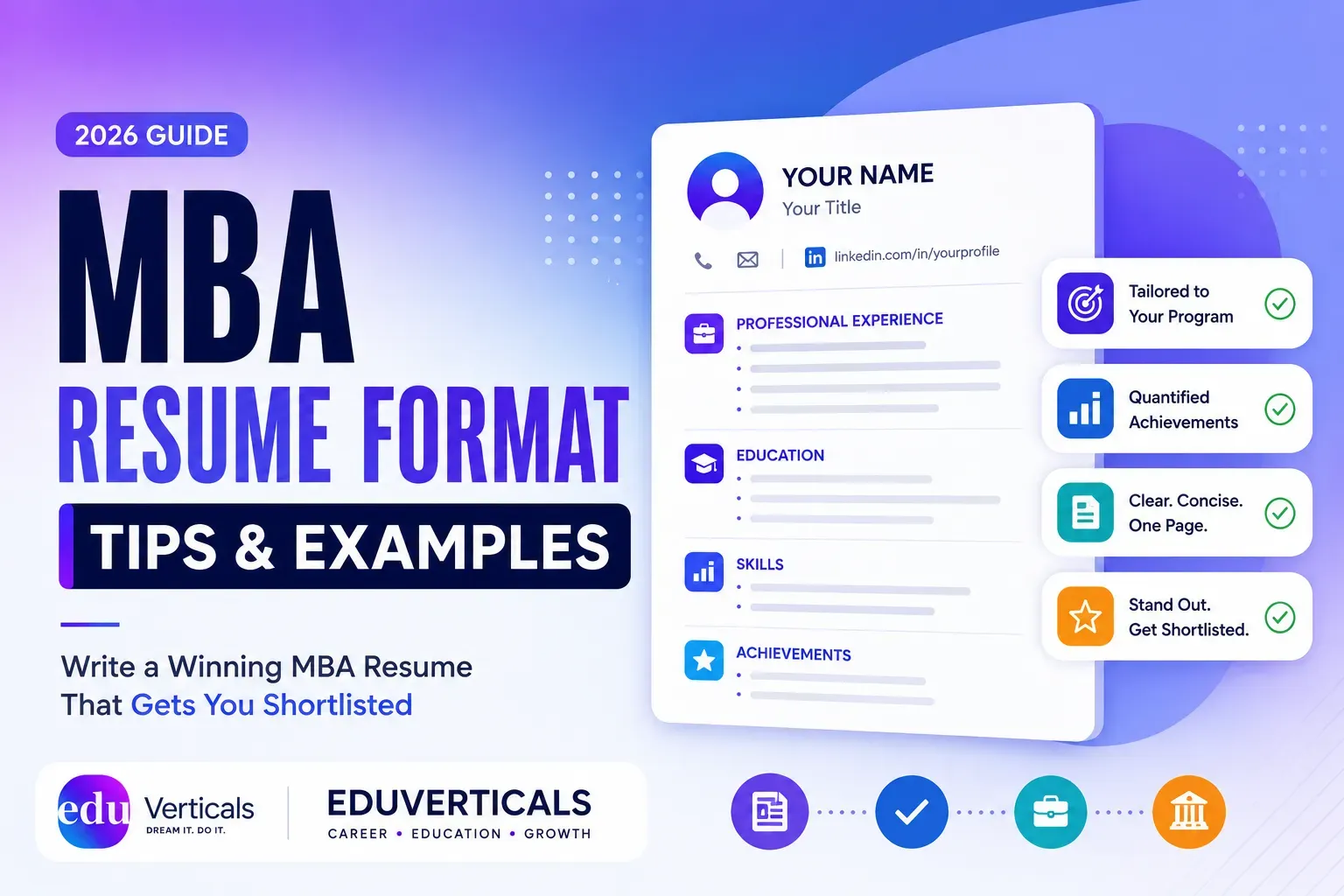
Quick Answer: A winning MBA resume in 2026 is one page, reverse chronological, built around quantified achievements, and tailored to your specific target program. This guide covers every section in detail.
This is where most applicants go wrong from the very beginning.
A job resume is written for a hiring manager evaluating whether you can perform a specific role. An MBA admission resume is written for an admissions committee evaluating whether your presence will add value to their classroom, their cohort, and their institution's reputation.
These are fundamentally different documents with fundamentally different objectives.
A corporate CV lists responsibilities. An MBA resume demonstrates leadership, strategic thinking, and measurable impact. If your current draft looks like a job description copied from your employment contract, you need to start over.
The central question every line of your MBA resume must answer:
How does my background add value to this program and the professionals around me?
Every bullet point, every achievement, every line of text must serve that single purpose.
Before you write a single word, get the format right. Admissions officers read hundreds of documents weekly. A cluttered, dense, or visually chaotic resume will be set aside before the content is even evaluated.
One page, strictly.
This is not a suggestion. A two-page MBA resume signals an inability to prioritise. Force yourself to include only your most impactful achievements. Everything else gets cut.
Reverse chronological order.
Your most recent and senior experience appears first. Admissions committees want to see where you are now, not where you started.
Clean, professional fonts.
Use Times New Roman, Garamond, or Arial at 10–12pt. One-inch margins on all sides. No photos, no colour graphics, no design flourishes. These distract human readers and confuse automated tracking software used by universities.
PDF format only.
Always submit as a PDF. Word documents shift formatting across different devices and operating systems. A broken layout on the reader's screen creates an immediately negative impression.
Bold section headers, standard body text.
Guide the reader's eye naturally down the page. Bold headers create visual anchors. Everything else remains clean and unformatted.
This is the single most important skill in MBA resume writing — and the one most applicants get completely wrong.
Every statement describing your professional experience must follow this formula:
Action + Context + Result
Do not write: "Managed social media accounts for the company."
Write: "Grew corporate social media following by 45% over six months through targeted content strategies, increasing inbound lead volume by 20%."
The difference is not embellishment. The difference is specificity.
Numbers build immediate credibility. Vague statements destroy it.
Wherever possible, quantify using:
Weak vs Strong: Side-by-Side Examples
Weak: Handled corporate social media accounts.
Strong: Grew corporate social media following by 45% over six months through targeted content strategies.
Weak: Responsible for department budget management.
Strong: Managed a ₹40 lakh annual department budget, reducing wasteful expenditure by 12% within the first year.
Weak: Led a team of software developers on a project.
Strong: Directed a cross-functional team of 8 developers to launch a mobile application two weeks ahead of the original deadline.
The formula is the same every time. Action. Context. Result. Numbers wherever possible.
Fresh graduates often assume they cannot compete against candidates with five or ten years of corporate experience.
That assumption is wrong — but only if you approach the document correctly.
A resume for MBA freshers must lean heavily on academic achievements, internship impact, and extracurricular leadership. The absence of corporate history is not a disqualifier. It simply means your evidence of leadership comes from a different arena.
What to highlight as a fresh graduate:
Academic performance. Include your GPA if it is strong. Highlight advanced coursework that aligns with your target MBA specialisation. If you are applying for a finance-focused program, your grades in statistics, economics, and financial modelling carry significant weight.
Internship achievements. Do not describe your internship duties. Describe your internship outcomes. Did you contribute to a project that reduced costs? Did you assist in a campaign that increased engagement? Quantify it the same way a senior professional would.
Leadership in student organisations. Did you lead a college festival? Manage a sponsorship drive? Organise a national-level competition? These experiences demonstrate initiative, team management, and the ability to deliver results under pressure — exactly what admissions committees are evaluating.
Specialised projects. Highlight any academic projects where you managed a budget, led a team, or solved a real-world business problem. Case competitions, research projects, and consulting simulations are particularly strong additions.
The goal is simple: prove that you possess raw intelligence, a strong work ethic, and the maturity to contribute meaningfully in a classroom alongside experienced professionals.
In 2026, technological literacy is not optional — it is a baseline expectation.
Every top MBA program expects candidates to have a working understanding of digital tools, data analysis, and the role of AI in modern business decision-making. If you are applying for a program with a Business Analytics or AI focus, your resume must make your technical competence immediately visible.
What to include:
Even for general management tracks, demonstrating that you understand how data and AI are reshaping business decisions positions you as a forward-thinking candidate — rather than one anchored to legacy business models.
Do not list tools you cannot speak to in an interview. Be specific, be honest, and be ready to discuss every technical skill you mention.
One of the most common — and most costly — mistakes MBA applicants make is sending the same resume to every institution.
Different programs look for fundamentally different profiles.
A full-time MBA program at a traditional institution may prioritise academic rigour, extracurricular involvement, and leadership potential in younger candidates. An Executive MBA program will weight strategic experience, budget authority, and direct team management far more heavily.
Then align your resume accordingly. Lead with the achievements that speak most directly to what that specific program values. Reframe the same experiences through different lenses for different applications.
Customisation is not extra effort. It is the difference between an interview invitation and a rejection email.
Follow this section order for a clean, high-impact layout:
Name, phone number, professional email address, and a direct link to your optimised LinkedIn profile. Nothing else. No home address, no date of birth, no profile photo.
This section takes up the majority of your page. List your most recent position first. Include company name, official job title, and dates of employment. Follow with three to four quantified achievement statements using the Action + Context + Result formula.
University name, degree, graduation year, and GPA if it is strong. If you are a fresher, this section moves above Professional Experience.
Technical skills, spoken languages, and notable volunteer or community work. This is not the place for generic hobbies. Only include activities that reflect leadership, discipline, or unique perspective — things that could spark a meaningful conversation in your personal interview.
Keep every section tight. If a line does not strengthen your candidacy, remove it.
A single spelling mistake on a one-page document tells an admissions officer everything they need to know about your attention to detail.
If you cannot proofread a document this short, they will assume you will bring the same carelessness to complex financial models, case analyses, and group projects inside their program.
Before you submit:
On honesty: never exaggerate your achievements. Premium MBA programs conduct thorough background checks as standard procedure. If you claim to have managed a team of twenty when you managed two, it will be discovered. If you claim sole credit for a result you contributed to, behavioural interview questions will expose it immediately.
Integrity is the foundation of business leadership. Your resume is the first test of it.
What is the ideal length for an MBA resume?
Strictly one page. This applies to both freshers and experienced professionals. Admissions committees interpret a two-page resume as an inability to prioritise — not as thoroughness.
Should I include an objective statement?
Skip the generic objective statement. Use that space for an additional achievement instead. If the program specifically requests a summary or profile statement, keep it to two concise sentences focused on your career trajectory and program fit.
How far back should my work experience go?
For working professionals, include the last 8–10 years. For senior executives, focus on the most strategic and impactful roles rather than early-career positions. For freshers, include all relevant internships and significant academic projects.
Should I include my undergraduate GPA?
Include it if it is strong — typically above 3.5 on a 4.0 scale or equivalent. If your GPA is average but you have strong professional achievements, prioritise those instead.
Can I use creative design or graphics to stand out?
No. Clean and standard always wins in MBA admissions. Creative design elements distract human readers and often fail to parse correctly through automated tracking systems used by universities.
Is one resume enough for all my applications?
Never. Tailor your resume to each institution based on their specific values, cohort profile, and program focus. The core document stays the same — the framing and emphasis shift for each target.
You have already done the hard work — in your career, in your academic life, in your leadership experiences.
The resume is simply the packaging.
Done correctly, it earns you an interview. Done poorly, it ends your application before anyone reads your essays.
Follow the framework in this guide: one page, reverse chronological, quantified achievements, tailored to your target program, proofread to perfection.
Your MBA journey begins with this document. Make it count.
Looking for guidance on choosing the right MBA program for your career goals? Explore EduVerticals →


We have a team of over 12 experienced mentors with over 26+ years of collective experience available to guide you at a moment's notice.