MBA for India’s Booming Beauty, Fashion & Luxury Retail Sector (2026): Top Specializations, D2C Brand Careers & Salary Guide
MBA in Fashion ManagementBeauty and Cosmetics Industry MBARetail Management Online MBALuxury Brand Management IndiaD2C Brand Management MBADigital Marketing MBAEduVerticals
EduVerticals Editorials
Posted 54 minutes ago
Executive Summary: India’s Beauty & Personal Care (BPC), Fashion, and Luxury Retail market is undergoing a historic expansion—projected to cross $30+ billion in beauty and $115+ billion in fashion/lifestyle by 2027–2028. From omnichannel giants like Nykaa, Reliance Tira, Trent (Zudio/Westside), Myntra, and Tata CLiQ Luxury to fast-scaling D2C skincare and apparel brands, companies are aggressively hiring MBA graduates who combine creative brand instinct with hard P&L, quick-commerce merchandising, performance marketing, and supply-chain analytics skills.
Ten years ago, graduates from NIFT, FDDI, mass communication, or commerce backgrounds who entered the fashion, cosmetics, or lifestyle industry often hit a career ceiling after 3–5 years as store managers, visual merchandisers, stylists, or social media executives. Breaking into corporate brand management, category P&L ownership, omnichannel retail strategy, or D2C leadership required a business school degree.
In 2026, the explosion of Indian Beauty & Personal Care (BPC), fast fashion, athleisure, and luxury retail has created one of the fastest-growing management job markets in the country. Even better, professionals already working in fashion, beauty, retail, e-commerce, or salon/wellness chains no longer need to quit their jobs to earn a specialized business credential—they are leveraging UGC-DEB Entitled Online MBAs on EduVerticals to pivot into ₹12L–₹28L+ LPA management roles while continuing to build industry experience.
1. Why India’s Beauty, Cosmetics & Fashion Industry Needs MBA Talent in 2026
Modern beauty and fashion companies are no longer run merely on seasonal lookbooks—they operate as high-velocity data, supply-chain, and consumer-tech enterprises. Four structural shifts are driving massive MBA hiring across Mumbai, Bengaluru, Gurugram, Delhi-NCR, and Hyderabad:
The Omnichannel Beauty Duopoly & Global Entrants: With Nykaa, Reliance Retail’s Tira, Tata Palette/CLiQ Luxury, and Shoppers Stop competing to onboard global beauty houses (Estée Lauder, L’Oréal, Shiseido, Sephora, MAC, Charlotte Tilbury), demand for Category Managers, Key Account Managers, and Retail Operations Leads is at an all-time high.
The D2C Skincare, Cosmetics & Apparel Boom: Venture-backed and profitable Indian D2C brands (Minimalist, Mamaearth/Honasa, Sugar Cosmetics, Foxtale, Plum, Mokobara, The Souled Store, Snitch, Rare Rabbit) need MBA-trained Growth Managers who understand Customer Acquisition Cost (CAC), Lifetime Value (LTV), retention cohorts, and marketplace unit economics.
Quick-Commerce (Blinkit, Zepto, Instamart) Merchandising: Beauty, grooming, and basic fashion essentials have become top-margin categories on 10-minute delivery platforms—creating an entirely new career track in Quick-Commerce Key Account Management and Dark-Store Inventory Planning.
Fast-Fashion Value Retail Expansion: Chains like Trent’s Zudio and Westside, Reliance Trends, Aditya Birla Fashion (ABFRL), and Marks & Spencer are opening hundreds of stores across Tier-2 and Tier-3 India, requiring regional P&L managers and supply-chain planners.
2. Top 4 Online MBA Specializations for Beauty, Fashion & Luxury Careers
You do not need a narrow, unaccredited “diploma in fashion” to lead a beauty or fashion brand. Corporate HR teams at L’Oréal, Nykaa, Myntra, and Reliance Retail actively prefer a full UGC-DEB entitled MBA from a NAAC A+/A++ university in one of these four functional specializations (which you can explore on our Course Catalogue):
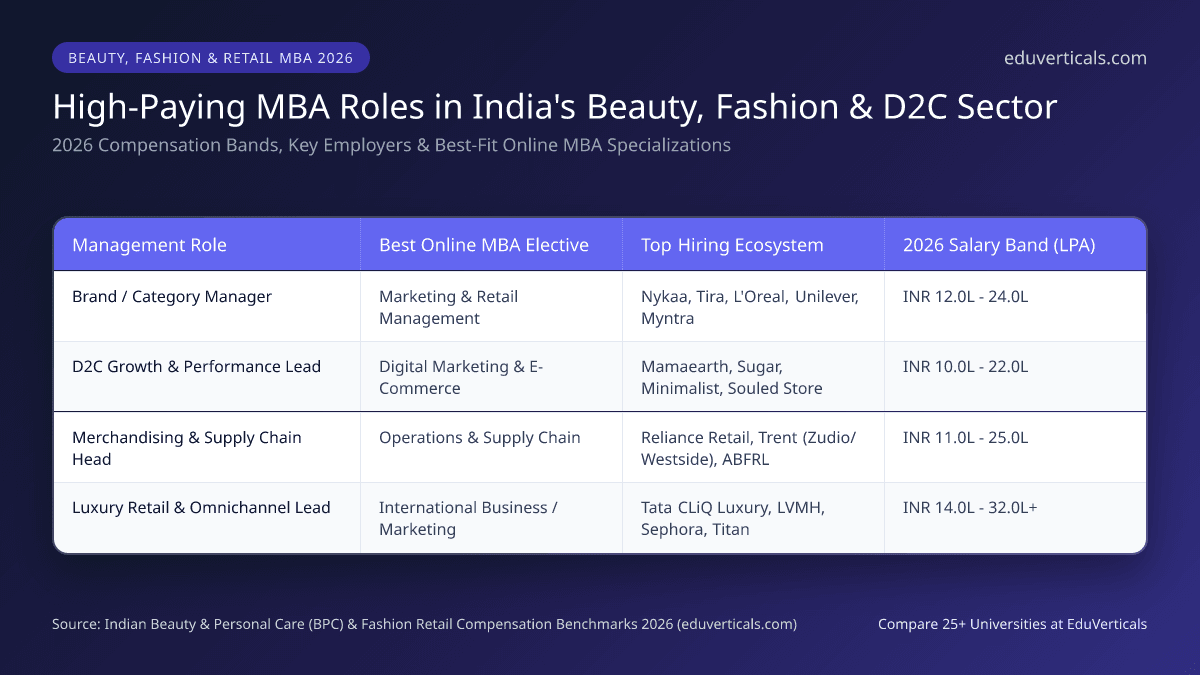
MBA in Marketing & Retail Management: The gold standard for aspiring Brand Managers, Category Heads, and Omnichannel Retail Planners. Covers consumer behaviour, pricing strategy, retail store economics, visual merchandising ROI, and trade marketing.
MBA in Digital Marketing & E-Commerce: Ideal for social media managers, content creators, and PR executives who want to move into ₹12L–₹22L LPA Performance Marketing, D2C E-Commerce P&L, and Influencer/Affiliate ROI leadership roles.
MBA in Operations & Supply Chain Management: The backbone of fast fashion and cosmetics—covering SKU demand forecasting, shelf-life/batch inventory management for skincare, vendor sourcing, and pan-India warehouse logistics.
MBA in International Business / Entrepreneurship: Designed for luxury brand managers importing global labels, export-house merchandisers, or founders launching their own D2C beauty clinic, skincare label, or boutique fashion brand.
2026 Career & Salary Matrix: Top MBA Roles in India’s Beauty, Fashion, D2C & Luxury Retail Sector
3. Which Online MBA Universities Are Best for Beauty, Fashion & Retail Professionals?
When selecting an Online MBA on EduVerticals Academic Catalogue, beauty and fashion professionals should prioritize universities with strong corporate links in Mumbai, Delhi-NCR, and Bengaluru:
NMIMS Online (Mumbai): With deep corporate roots in Mumbai—India’s fashion, FMCG, and beauty headquarters—NMIMS Online MBA in Marketing or Retail Management carries exceptional brand recall with recruiters at Nykaa, Reliance Retail, L’Oréal, Marico, Godrej Consumer, and Hindustan Unilever.
Symbiosis (SSODL, Pune): Symbiosis Online MBA (NAAC A++) is highly respected across marketing, media, retail, and lifestyle conglomerates.
Manipal University Jaipur (MUJ) & Amity Online: Both Manipal Online and Amity Online offer specialized electives in Retail Management, Digital Marketing, and Fashion/Hospitality adjacent tracks with flexible weekend classes and Coursera certifications.
VIT Online (NAAC A++): For professionals targeting E-Commerce Analytics, Marketplace Operations (Myntra, Ajio, Amazon Beauty), and Tech-Enabled Retail, VIT Online MBA provides strong analytical rigour at ₹1.80 lakh.
4. Career Switch Roadmap: From Creative/Store Roles to Corporate Brand Leadership
Whether you hold a B.Des (NIFT/Pearl/FDDI), B.Com, BBA, BA, or B.Sc in Cosmetology/Biotech, here is how to maximize your 2-year Online MBA ROI:
Semesters 1 & 2 (Master the Numbers): Transition your vocabulary from purely aesthetic terms to business metrics—Gross Margin, Inventory Turnover Ratio, Sell-Through Rate, ROAS (Return on Ad Spend), and Repeat Purchase Rate.
Semester 3 (Build a Live D2C or Retail Capstone): Use your MBA project to audit a live beauty or fashion brand’s omnichannel funnel, quick-commerce SKU strategy, or marketplace conversion rate.
Semester 4 (Target High-Growth Category & Brand Roles): Position your combination of 2–4 years of hands-on fashion/beauty domain experience + a NAAC A+/A++ MBA to interview for Brand Manager, Marketplace Category Lead, or Retail Planner roles.
Find Your Best-Fit Marketing & Retail Online MBA: Compare fees, EMI plans, and specializations across India’s top accredited universities using the .
Frequently Asked Questions
Common Questions Answered
Yes! Any candidate with a recognized 3-year or 4-year bachelor’s degree (including B.Des, B.FTech, B.Sc, BA, BBA, or B.Com) with at least 50% marks (45% for reserved categories) is eligible for a UGC-DEB entitled Online MBA.
01 / The Facts, Side by Side
University Comparison Report
Bring programme options, estimated fees and study flexibility into one view, with the trade-offs and questions to verify.
Tailored shortlist from our admission partners. Verify fees and eligibility before applying.
Meet Our Mentors
We have a team of over 12 experienced mentors with over 26+ years of collective experience available to guide you at a moment's notice.
Online and distance learning programs provide:
- Flexibility to learn at your own pace from anywhere.
- Access to recorded lectures and digital study materials.
- Opportunities to balance work, education, and personal commitments.
- Affordable options compared to traditional on-campus programs.
- Industry-relevant curriculum designed by academic experts.
Choosing the right university depends on:
- Accreditation and recognition of the institution.
- Quality and relevance of the curriculum.
- Availability of academic and career support services.
- Feedback and reviews from alumni and current students.
- Flexibility in learning schedules and delivery modes.
Yes, online degrees from accredited universities are widely recognized and equivalent to regular degrees. Employers value the skills and qualifications gained from online programs, especially when offered by reputed institutions.
Assessment methods for online programs vary but typically include:
- Online quizzes and assignments.
- Virtual proctored exams.
- Group projects and case studies.
- Real-time presentations and viva sessions.
Many universities allow credit transfers, subject to:
- Compatibility with the curriculum of the new program.
- A minimum grade requirement in previously completed courses.
- Approval by the academic administration of the new university.
 EduVerticals Editorials