 EduVerticals Editorials
Posted 1 day ago

Executive SummaryReading BriefExecutive Summary: In the high-stakes arena of global corporate finance, closing a multi-million-dollar cross-border acquisition is merely the opening gambit. Historical empirical data from McKinsey, Bain, and Harvard Business Review confirms a sobering reality: over 65% of cross-border mergers and acquisitions fail to achieve their projected financial synergies, destroying billions of dollars in enterprise value. In late 2026, as Indian conglomerates and cash-rich tech enterprises aggressively acquire European engineering assets, US SaaS platforms, and Southeast Asian supply chains, CXO search panels are screening ruthlessly for Post-Merger Integration (PMI) and P&L execution skills.
Investment bankers, private equity partners, and corporate development heads receive intense praise when a landmark transaction is announced in the financial press. Deal announcements feature glossy investor decks highlighting projected revenue synergies, cost optimizations, and expanded market footprint. Champagne flutes are clinked, press releases are distributed, and stock prices frequently surge.
Then Day 1 arrives—and the brutal operational reality of Post-Merger Integration begins. Suddenly, executive leadership must reconcile conflicting Enterprise Resource Planning (ERP) databases, harmonise divergent multi-GAAP accounting practices (Ind AS, US GAAP, and IFRS), resolve contentious transfer-pricing disputes, and prevent a devastating exodus of top revenue-generating talent who resent centralized corporate oversight. Without an exceptional executive steering the PMI process, deals rapidly unravel into balance-sheet catastrophes.
When corporate integrations collapse, they almost never fail due to flawed valuation spreadsheets; they disintegrate across four operational fault lines:
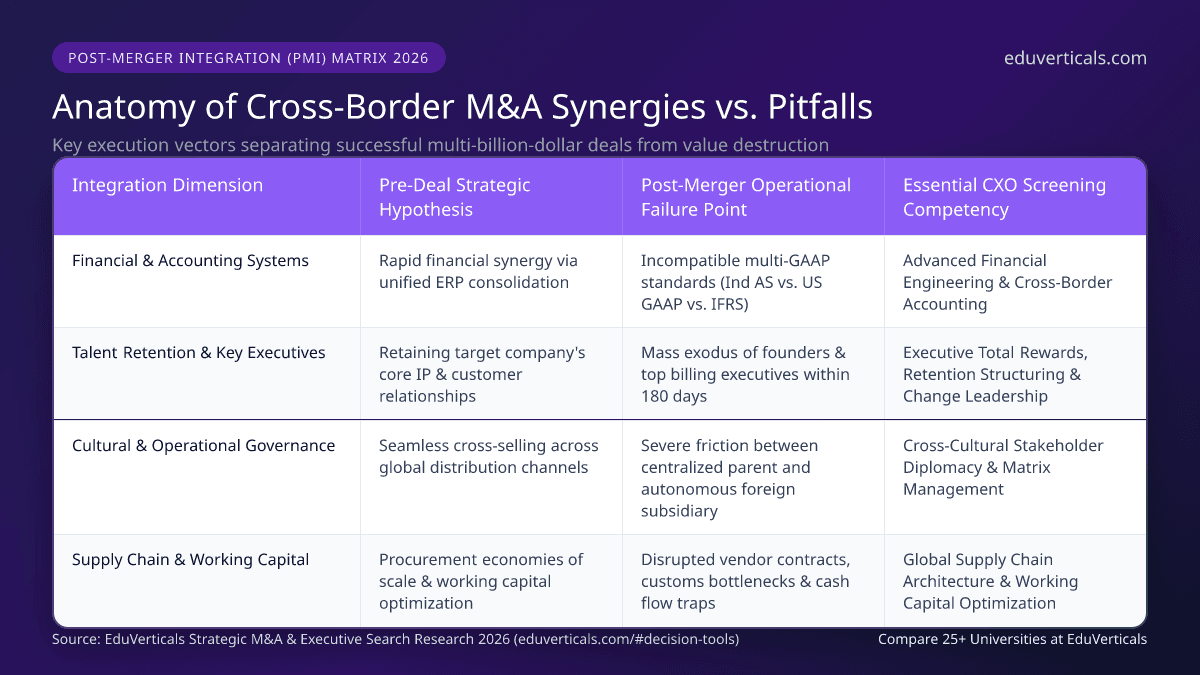
Because post-merger execution is fraught with immense balance-sheet peril, executive search committees (Egon Zehnder, Korn Ferry, Spencer Stuart) and private equity operating partners screen candidates with surgical precision. They are not interested in generalist executives who speak in vague corporate platitudes; they seek proven operators with battle-tested cross-border P&L ownership.
Search panels rigorously evaluate whether a prospective Chief Executive Officer, Chief Financial Officer, or Business Unit Head possesses the quantitative rigor to model discounted cash flows (DCF), manage complex foreign currency hedging programs, and demonstrate empathetic cross-cultural diplomacy. Leaders who have mastered both corporate finance theory and practical organizational integration command extraordinary compensation packages.
Select your career goal to tailor advice
Focus on enterprise systems integration, operational workflow audits, and supply chain synergy.
Ambitious professionals aiming for General Manager, Vice President, or CXO designations must actively build capabilities in corporate finance, valuation, and post-merger integration. Relying solely on narrow functional expertise in sales, marketing, or technology creates an insurmountable barrier when competing for top-tier enterprise leadership roles.
By pursuing an accredited Executive or Online MBA, mid-career professionals can acquire comprehensive corporate finance, strategic management, and international business competencies without taking a two-year career break. Explore leading programmes on the EduVerticals Academic Catalog and compare finance and strategy tracks from premier institutions like NMIMS Global and Symbiosis Centre for Distance Learning (SSODL).
Editorial BriefReading BriefPosition Yourself for Board-Level M&A Leadership: Discover how accredited executive management degrees equip you to lead multi-million-dollar cross-border integrations. Obtain a tailored shortlist from our admission partners on .
Keep the details close
Explore key programme specifications, recognition terms, fee components, and career outcomes side by side before applying.
Most cross-border deals fail during post-merger integration (PMI) due to incompatible financial reporting systems (multi-GAAP), cultural friction, the departure of key technical and commercial talent, and poor operational execution.
Bring programme options, estimated fees and study flexibility into one view, with the trade-offs and questions to verify.
Tailored shortlist from our admission partners. Verify fees and eligibility before applying.


We have a team of over 12 experienced mentors with over 26+ years of collective experience available to guide you at a moment's notice.