logo

Indian Software Engineers Transitioning to AI Product Leads: 2026 Guide

Indian Software EngineersTech to Product ManagementAI Product Lead CareersIT Sector Transition IndiaBTech to MBA OnlineOnline MBA Tech ProfessionalsEduVerticals
EduVerticals EditorialsEduVerticals Editorials

Posted 1 day ago

Indian Software Engineers Transitioning to AI Product Leads: 2026 Guide
Executive Summary
Reading Brief
Executive Summary: Across Indian technology corridors—from Bengaluru’s Bellandur and Whitefield to Hyderabad’s Financial District and Pune’s Hinjawadi—the software engineering profession has reached an unprecedented historical turning point. In late 2026, autonomous coding agents, multi-modal reasoning models, and automated continuous delivery pipelines generate and debug 50% to 70% of routine boilerplate syntax. The era where a B.Tech graduate could command ₹25 LPA to ₹35 LPA solely for implementing CRUD endpoints, writing standard React components, or maintaining legacy Java Spring Boot services has permanently closed. Conversely, the market compensation for technical professionals who can bridge the chasm between raw software architecture and enterprise business outcomes—transitioning into AI Product Leads, Group Product Managers, and Technical Business Directors—has surged into the ₹50 LPA to ₹90 LPA bracket.

For India’s 5.5 million software professionals, this technological shift represents either an existential career trap or the single greatest wealth-creation opportunity of their professional lives. Those who double down exclusively on learning yet another JavaScript framework or syntax nuance are experiencing flattening annual appraisal increments and mounting vulnerability to automated workforce rationalization.

In contrast, engineers who proactively pivot into Product Management, Unit Economics, and Commercial P&L Leadership find themselves at the center of corporate strategy. Global Capability Centers (GCCs) and fast-growing Indian tech platforms are not looking for pure project coordinators who merely move Jira tickets; they are desperately hunting for technical product visionaries who understand API latency and vector embeddings just as deeply as they understand Customer Acquisition Cost (CAC), Lifetime Value (LTV), and Gross Margin defense.

1. The Code Generation Reality: Why Pure Syntax Skills Face Diminishing Returns

The economic devaluation of manual coding is driven by structural advancements in software engineering automation in 2026:
  • Autonomous End-to-End Pull Request Generation: Reasoning agent systems ingest product requirement documents (PRDs), scaffold microservices, generate comprehensive unit tests, and resolve merge conflicts autonomously with minimal human oversight.
  • Compression of Software Development Lifecycles: Features that historically required a six-person engineering pod working for three months are routinely completed by two senior engineers directing automated agent swarms in ten days.
  • The IT Services Billing Crisis: Traditional time-and-materials Indian IT services contracts are collapsing as multinational clients demand fixed-fee, outcome-based pricing, forcing service firms to dramatically reduce junior billable headcount.
  • The Product Ownership Premium: As software creation becomes nearly free, the scarce economic asset is no longer "can we build it?" but "should we build it, who will pay for it, and how does it generate sustainable enterprise profit?"
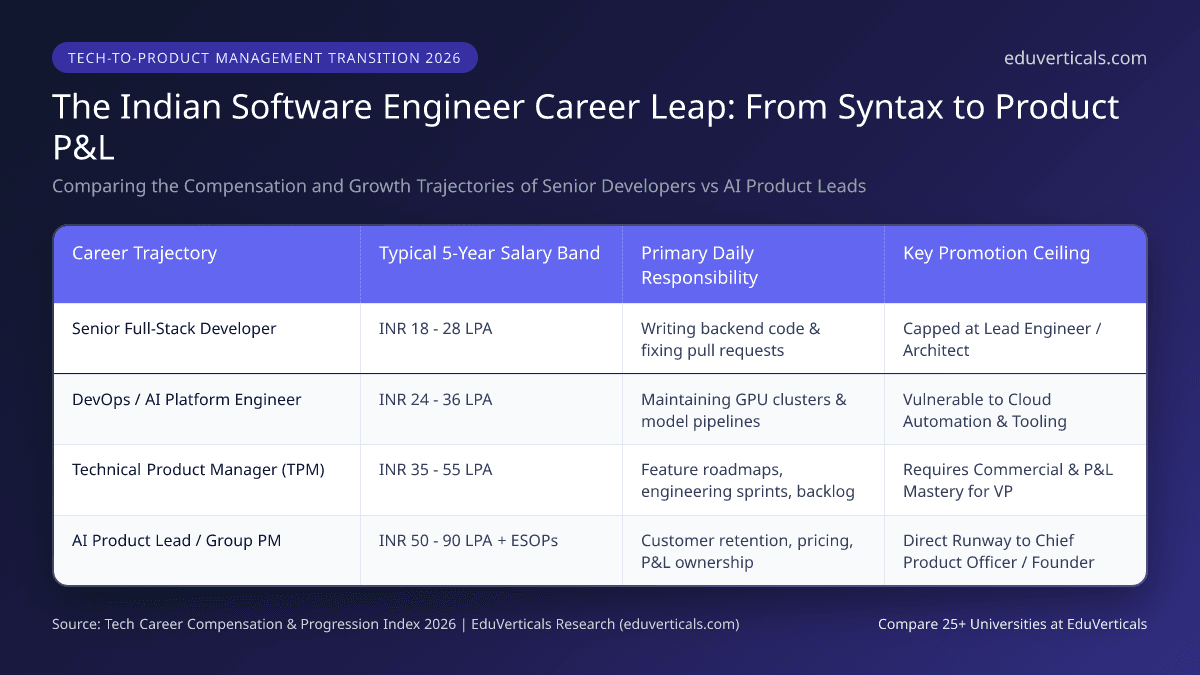
Indian Software Engineer Career Leap Syntax to Product PnL 2026
Comparison of Indian Tech Career Trajectories: From Senior Developer Syntax Roles to High-Earning AI Product Leads.

2. The Four Capabilities Engineers Must Acquire to Lead AI Products

Transitioning from an engineering individual contributor into a high-impact AI Product Lead requires mastering four core non-technical disciplines. As highlighted in our strategic report, Will AI Replace the MBA Degree?, modern product leadership demands a rigorous commercial toolkit:

  1. Problem Discovery and Customer Empathy: Conducting deep qualitative customer interviews, identifying unarticulated enterprise pain points, and resisting the engineer’s instinct to build technologically complex solutions for non-existent problems.
  2. Financial Modeling and Unit Economics: Calculating compute cost-to-serve, estimating customer churn elasticity, setting value-based SaaS pricing tiers, and constructing defensible product P&L projections.
  3. Cross-Functional Stakeholder Diplomacy: Negotiating feature trade-offs with Sales Directors, convincing Legal teams on data privacy boundaries, and aligning corporate CXOs behind a unified product roadmap.
  4. Data-Driven Outcome Prioritization: Using rigorous experimentation, cohort retention curves, and causal inference rather than subjective opinions or executive whims to decide what to build next.
Interactive Career Pulse

Select your career goal to tailor advice

Decision note · Verified comparison01 / 03

What is your biggest hurdle when transitioning from software engineering to product management?

Mentor RecommendationTranslating Code into Business Value

Focus on how feature releases directly impact monthly recurring revenue (MRR) and customer churn. Use our University Comparison Report to explore specialized product analytics electives.

Tailored shortlist from our admission partners

3. The Zero-Opportunity-Cost Career Upgrade: Online MBA for Working Techies

Historically, an engineer seeking to pivot into product management had to make an agonizing financial sacrifice: resign from a lucrative tech job, forgo two years of full-time income (costing ₹40 LPA to ₹60 LPA in lost wages), and spend an additional ₹25 Lakhs to ₹35 Lakhs on a residential business school program.

In 2026, Corporate India has embraced a far more rational pathway: the UGC-DEB Entitled Online MBA. Forward-thinking engineers are enrolling in premier programs such as the VIT Online MBA in Product Management & Digital Business Strategy, which allows working professionals to acquire full postgraduate management credentials entirely on weekends and evenings, retaining 100% of their current tech salary while immediately applying business frameworks to their day jobs.

  • Bridge the Credential Gap: Eliminate recruiter resume filters for Group PM and Director roles that mandate a formal postgraduate management degree alongside technical depth.
  • Explore Accredited University Portfolios: Inspect comprehensive curriculum comparisons on the EduVerticals Academic Catalog to identify leading management programs.
  • Explore Specialized Degree Options: Review competitive specialization offerings on the EduVerticals Course Catalog to find programs that match your exact career goals.
  • Model Your Long-Term ROI: Evaluate how an accredited executive degree impacts your five-year salary progression via .

Keep the details close

Common QuestionsThe full picture.

Explore key programme specifications, recognition terms, fee components, and career outcomes side by side before applying.

05 verified FAQs

Autonomous coding agents have commoditized routine syntax implementation, squeezing software developer salary increments, while compensation for AI Product Leads who can translate technical architectures into profitable business outcomes has surged.

01 / The Facts, Side by Side
Live Comparison Dossier

University Comparison Report

Bring programme options, estimated fees and study flexibility into one view, with the trade-offs and questions to verify.

01Fee Structure
02Study Mode
03Career Fit

Tailored shortlist from our admission partners. Verify fees and eligibility before applying.

Meet Our Mentors

We have a team of over 12 experienced mentors with over 26+ years of collective experience available to guide you at a moment's notice.
Got Questions?

Online and distance learning programs provide: - Flexibility to learn at your own pace from anywhere. - Access to recorded lectures and digital study materials. - Opportunities to balance work, education, and personal commitments. - Affordable options compared to traditional on-campus programs. - Industry-relevant curriculum designed by academic experts.
Choosing the right university depends on: - Accreditation and recognition of the institution. - Quality and relevance of the curriculum. - Availability of academic and career support services. - Feedback and reviews from alumni and current students. - Flexibility in learning schedules and delivery modes.
Yes, online degrees from accredited universities are widely recognized and equivalent to regular degrees. Employers value the skills and qualifications gained from online programs, especially when offered by reputed institutions.
Assessment methods for online programs vary but typically include: - Online quizzes and assignments. - Virtual proctored exams. - Group projects and case studies. - Real-time presentations and viva sessions.
Many universities allow credit transfers, subject to: - Compatibility with the curriculum of the new program. - A minimum grade requirement in previously completed courses. - Approval by the academic administration of the new university.