 EduVerticals Editorials
Posted 1 day ago

Executive SummaryReading BriefExecutive Summary: In late 2026, the Indian Rupee crossed the psychological milestone of ₹94.20 against the US Dollar, driven by resilient US treasury yields, persistent import bills in crude and electronics, and global capital realignments. While conventional wisdom assumes a depreciated rupee automatically supercharges India’s $260-billion IT services sector, the corporate reality inside boardroom balance sheets is vastly more nuanced. Escalating USD-denominated software licensing, rising onshore delivery compensation, and volatile cross-currency hedging costs are squeezing operating margins. Simultaneously, for ambitious Indian professionals, ₹94/USD has permanently altered higher education economics: sending the fully loaded cost of an overseas two-year MBA above ₹2.10 crore, making accredited Indian Online MBAs the unrivaled champion of post-graduate return on investment (ROI).
Currency depreciation functions as a double-edged sword for an emerging economic superpower. For IT services giants—including TCS, Infosys, HCLTech, and Wipro—and over 2,100 Global Capability Centers (GCCs) across Bengaluru, Hyderabad, and Pune, a weaker rupee theoretically expands rupee revenues when dollar invoices are collected. However, in late 2026, the net operating margin benefit of rupee depreciation has shrunk dramatically. Today, between 35% and 45% of an Indian tech firm’s operating expenses are directly or indirectly linked to the US Dollar: from hyperscaler cloud hosting contracts (AWS, Microsoft Azure, Google Cloud) and enterprise SaaS licenses to onshore engineering salaries paid in dollar-pegged currencies.
As a consequence, corporate treasury management has evolved from a passive back-office settlement function into a mission-critical strategic boardroom driver. Chief Financial Officers (CFOs) and Group Treasurers are urgently recruiting finance managers who possess quantitative fluency in layered forward contracts, cross-currency interest rate swaps (CCIRS), and dynamic value-at-risk (VaR) modeling to insulate quarterly earnings from sudden currency swings.
When the rupee traded stably near ₹83/USD in 2023, corporate hedging policies were frequently linear, relying on simple 3-month to 6-month forward contracts covering 50% of net foreign currency inflows. At ₹94.20/USD, that complacency has evaporated amid sharp intra-day currency volatility driven by geopolitical turbulence and shifting US interest rate expectations.
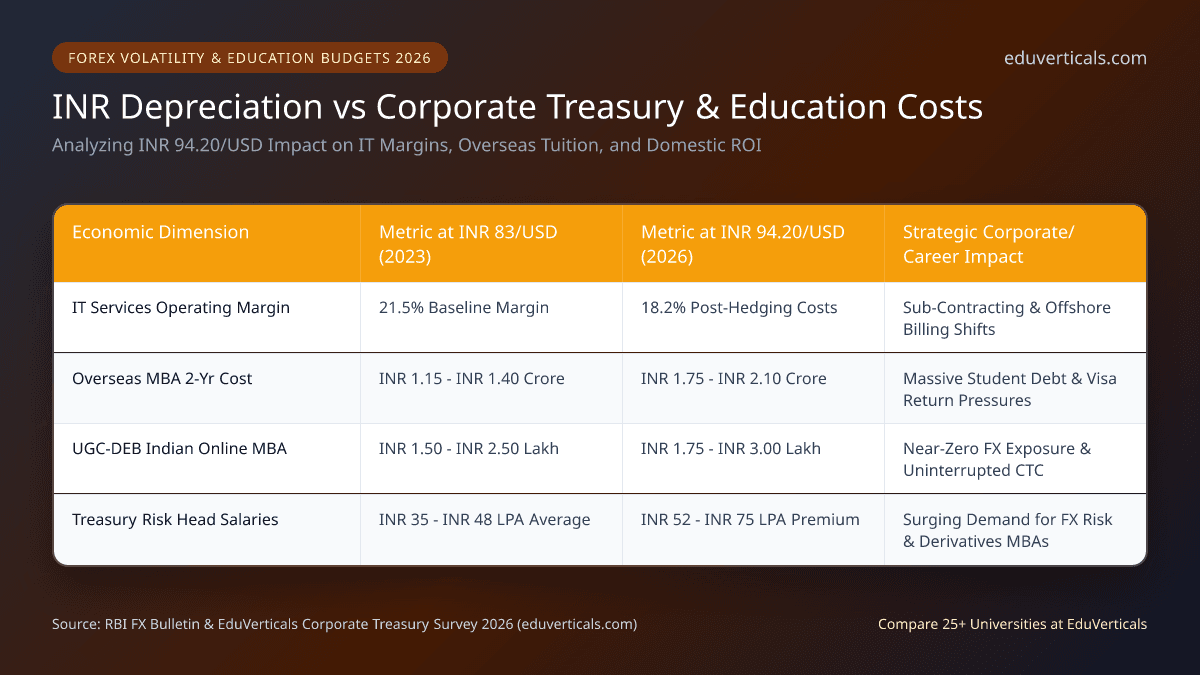
While corporate treasurers fight to defend balance sheet margins, Indian working professionals confront an equally decisive financial calculation in their personal careers: the astronomical inflation of overseas higher education. In 2020, when the rupee averaged ₹74/USD, a two-year flagship MBA at a top-25 US or European business school cost approximately ₹1.10 to ₹1.35 crore, all-inclusive. At ₹94.20/USD in late 2026, that same degree requires an astonishing financial outlay of ₹1.85 to ₹2.25 crore when factoring tuition fees, living expenses in inflated metropolitan hubs, and international student health insurance.
Compounding this financial burden, international students face restrictive post-study work visa environments, mandatory sponsorship thresholds, and hiring slowdowns in Western tech and consulting sectors. An Indian professional borrowing ₹1.80 crore at an 11.5% education loan interest rate faces monthly loan EMIs exceeding ₹2.2 lakh for a decade. If they are forced to return to India due to lottery visa caps, servicing a dollar-linked debt obligation with Indian Rupee compensation becomes financially devastating.
Select your career goal to tailor advice
Target specialized finance curricula covering forex hedging. Access the University Comparison Report or discuss with our mentors via Free Mentor Call.
As Indian multinationals and global GCCs expand their treasury operations across Mumbai, Gurugram, and Bengaluru, demand for specialized Corporate Finance and Forex Risk Managers has outstripped supply. Compensation packages for Treasury Directors and Senior Financial Analysts with 6 to 12 years of experience have escalated by 35% to 50%, reaching ₹45 LPA to ₹85 LPA.
Ambitious professionals aiming for these high-margin leadership roles are increasingly earning accredited degrees from premier Indian distance and online institutions. Leading providers such as Symbiosis Centre for Distance Learning / SSODL offer rigorous finance curricula designed by senior corporate bankers and treasury specialists. These programs cover derivatives accounting, international financial management, working capital optimization, and regulatory reporting under RBI foreign exchange guidelines.
By pairing deep industry domain experience with an accredited, UGC-DEB recognized postgraduate management degree, professionals achieve senior financial controllership credentials at a tiny fraction of the cost and zero percent of the foreign currency risk of overseas programs. To explore specialized corporate finance syllabi, review the EduVerticals Course Catalog or compare approved institutions on the EduVerticals Academic Catalog.
Analyze Your Financial Management ROI: Compare salary trajectories, university accreditations, and semester fee structures using .
Keep the details close
Explore key programme specifications, recognition terms, fee components, and career outcomes side by side before applying.
While IT services companies earn revenue in US dollars, 35% to 45% of their modern cost structures are also dollar-denominated—including enterprise cloud hosting (AWS, Azure), SaaS licenses, US onshore visa salaries, and subcontracting costs. Without active treasury hedging, these dollar expenses expand rapidly.
Bring programme options, estimated fees and study flexibility into one view, with the trade-offs and questions to verify.
Tailored shortlist from our admission partners. Verify fees and eligibility before applying.


We have a team of over 12 experienced mentors with over 26+ years of collective experience available to guide you at a moment's notice.