 EduVerticals Editorials
Posted 1 day ago

Executive SummaryReading BriefExecutive Summary: India’s telecommunications sector has reached an urgent financial crossroads. After deploying over ₹2.5 Lakh Crore ($30 Billion) in cumulative capital expenditures for 5G spectrum auctions and nationwide cell-tower infrastructure, telecom operators—led by Reliance Jio, Bharti Airtel, and Vodafone Idea—are executing coordinated tariff hikes to drive Average Revenue Per User (ARPU) past the critical ₹250-to-₹300 threshold. Achieving healthy double-digit Return on Capital Employed (ROCE) requires moving beyond subsidized connectivity into sophisticated subscription tiering, 5G Fixed Wireless Access (FWA), and enterprise private networks. This high-stakes transformation is sparking intense demand for commercial telecom managers skilled in pricing elasticity, subscriber churn modeling, and B2B solution architecture.
For nearly a decade, Indian telecommunications was defined by brutal price wars, unlimited data bundles, and rapid subscriber addition. The launch of 4G in 2016 delivered digital connectivity to over 800 million citizens, propelling India into the world’s largest consumer of mobile data per capita. Yet this consumer paradise came at a devastating cost to operator balance sheets: rock-bottom Average Revenue Per User (ARPU) hovering between ₹120 and ₹150 per month.
By late 2026, the economic reality of the 5G rollout rendered this ultra-cheap data paradigm financially unviable. With operators investing staggering sums in 5G standalone networks, fiber backhaul, and carrier spectrum, the imperative for industry-wide monetization has become existential. The target is non-negotiable: driving blended ARPU past ₹250 and ultimately toward ₹300 per subscriber.
Telecommunications is among the most capital-intensive industries on earth. Deploying modern 5G networks required Indian operators to purchase expensive 3.3 GHz and 26 GHz spectrum bands, upgrade thousands of urban cell sites with massive MIMO antennas, and lay millions of kilometers of high-capacity optical fiber.
When capital outlays reach ₹2,50,000 Crore while cost of capital lingers near 10%, generating a sustainable Return on Capital Employed (ROCE) requires massive operating cash flow generation. Operators can no longer justify giving away unlimited 5G data for free as a promotional gimmick; 5G speed must be monetized through premium data tiers and fair-usage-policy (FUP) caps.
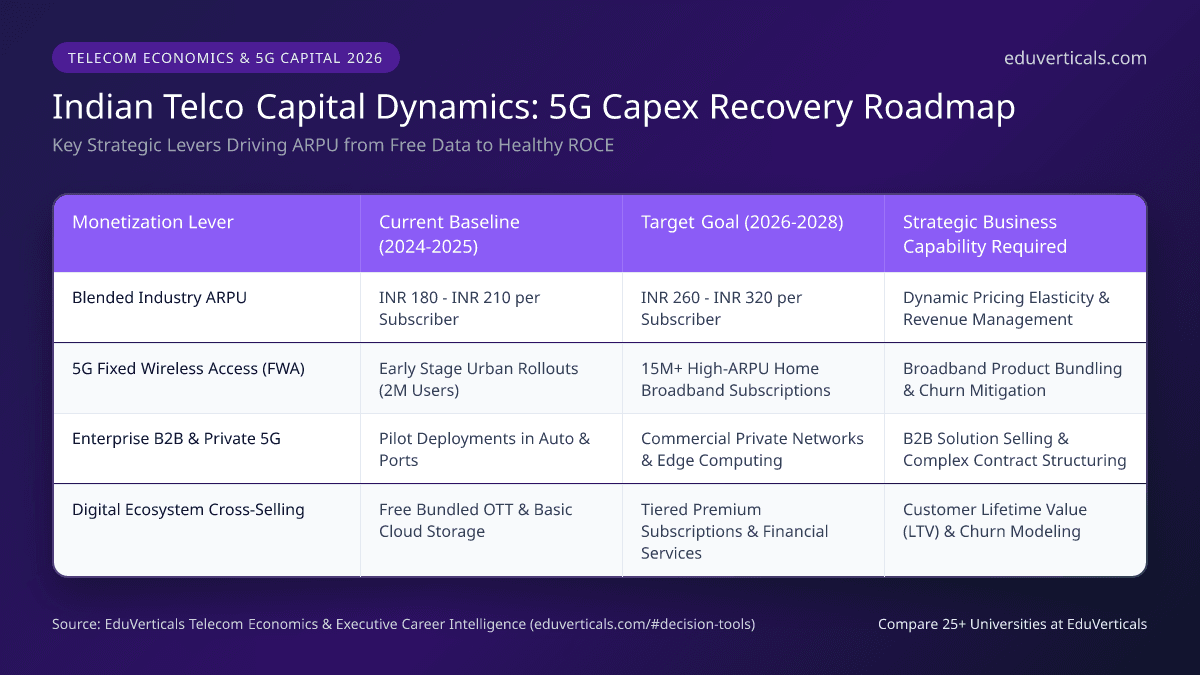
Executing tariff hikes in a competitive three-player market requires delicate pricing elasticity analysis. When operators raise mobile plan tariffs by 15% to 20%, consumer behavior splits across distinct demographic segments:
Select your career goal to tailor advice
Design tiered pricing structures, data monetization buckets, and OTT retention bundles for consumer telecommunications.
The most lucrative frontier in 5G monetization does not involve mobile smartphones; it centers on home broadband and enterprise infrastructure. India has approximately 300 million households, yet fewer than 40 million possess high-speed fiber-to-the-home (FTTH) wireline connections due to the high logistical cost of digging roads in dense urban neighborhoods.
5G Fixed Wireless Access (such as JioAirFiber and Airtel Xstream AirFiber) bypasses last-mile physical cabling by beaming gigabit wireless broadband directly into homes via rooftop antennas. With FWA broadband plans commanding monthly ARPUs of ₹600 to ₹1,000—three to four times the revenue of a mobile SIM—scaling FWA to 20 million households represents the primary growth engine for Indian telecom profitability.
This commercial transformation explains why telecommunications operators are aggressively hiring and promoting executives who possess an accredited Master of Business Administration. Designing radio-frequency (RF) cell grids is an engineering task, but optimizing multi-billion-rupee spectrum investments, negotiating OTT content syndications, and structuring enterprise private 5G contracts requires formal business training.
Specialized programs such as the VIT Online MBA with technology and operations tracks, or management degrees from Manipal University Jaipur, empower telecom engineers and sales managers to step into high-paying commercial strategy, pricing analytics, and enterprise product leadership roles.
Explore accredited technology management degrees on the Academic Catalog and model your career advancement on . Connect with our admission partners for a tailored shortlist matching your telecom experience and professional goals.
Keep the details close
Explore key programme specifications, recognition terms, fee components, and career outcomes side by side before applying.
Average Revenue Per User (ARPU) measures the monthly revenue an operator generates per subscriber. A ₹250+ ARPU is required for Indian telcos to service over ₹2.5 Lakh Crore in 5G spectrum and capex debt while generating a healthy return on capital employed (ROCE).
Bring programme options, estimated fees and study flexibility into one view, with the trade-offs and questions to verify.
Tailored shortlist from our admission partners. Verify fees and eligibility before applying.


We have a team of over 12 experienced mentors with over 26+ years of collective experience available to guide you at a moment's notice.