 EduVerticals Editorials
Posted 1 day ago
Executive SummaryReading BriefExecutive Summary: Eicher Motors’ impressive 15% quarterly net profit jump—driven by Royal Enfield’s expanding dominance in the mid-size motorcycle segment (>350cc) and growing global export realizations—stands in stark contrast to sluggish sales volumes across entry-level 100cc commuter two-wheelers. This divergence highlights India’s accelerating "K-shaped" economic consumption pattern: while price-sensitive mass rural consumers battle inflationary pressures, affluent urban cohorts are fueling unprecedented booms in premium mobility, luxury lifestyle goods, and branded experiences. For marketing and corporate strategy professionals, this structural shift requires a profound transition from low-margin volume chasing to high-margin brand equity, pricing power, and customer lifetime value (LTV) management.
Financial earnings reports in late 2026 delivered an undeniable macroeconomic revelation: the Indian consumer economy has officially split into two divergent trajectories. While mass-market consumer manufacturers struggle to generate single-digit volume growth in rural and semi-urban belts, premium brands are reporting record gross margins and surging profitability.
Nowhere is this phenomenon clearer than in India’s automotive sector. Eicher Motors—the parent entity of iconic leisure motorcycle manufacturer Royal Enfield—announced a stellar 15% YoY net profit increase in Q2. Even as entry-level 100cc commuter motorcycle sales remained stagnant across rural India, Royal Enfield’s premium 350cc, 450cc, and 650cc twins witnessed robust domestic waiting lists and lucrative export demand across Europe, Latin America, and Southeast Asia.
Traditional consumer product strategies in India were built around a pyramid thesis: an enormous base of budget-conscious rural consumers, a burgeoning middle class seeking modest upgrades, and a tiny luxury apex. In 2026, the consumer pyramid has morphed into an hourglass.
Entry-level consumers—impacted by persistent food inflation, erratic weather patterns, and informal wage stagnation—have cut discretionary purchases, postponing vehicle upgrades and switching to unbranded daily goods. Conversely, upper-middle-class and high-net-worth urban households have seen their personal wealth surge via equity market gains, residential real estate appreciation, and booming tech salaries. These affluent consumers are not buying products; they are purchasing self-actualization, status, and community membership.
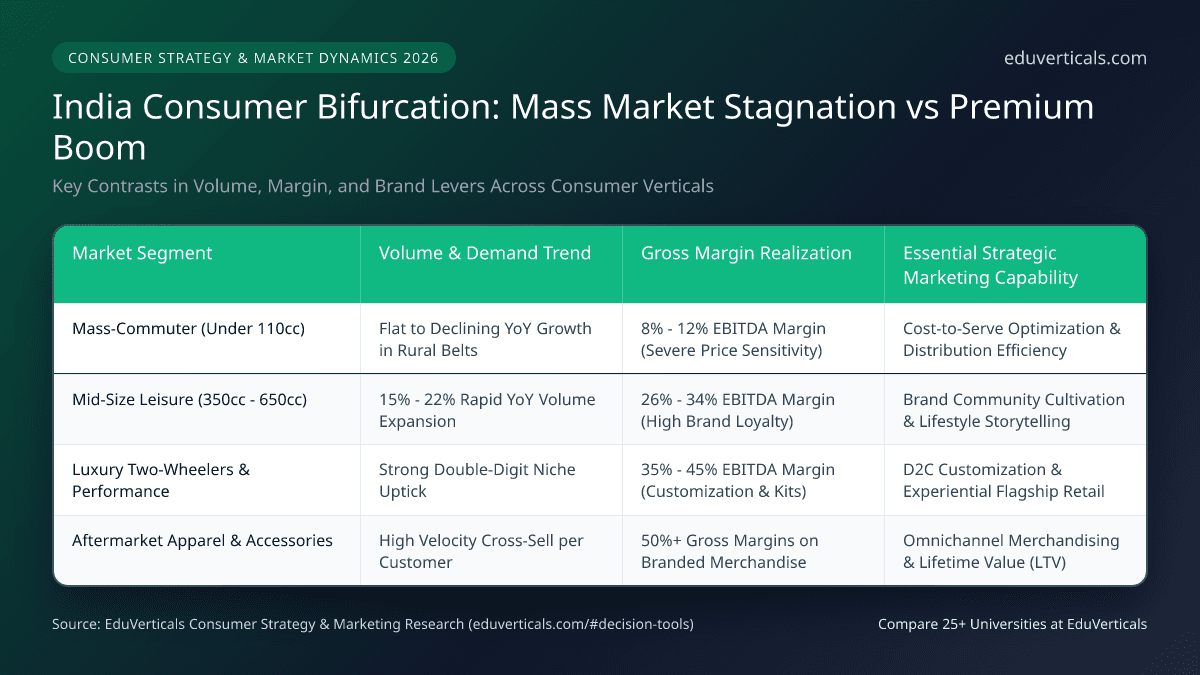
The economic engine behind premiumization lies in gross margin elasticity. Selling one million commuter bikes with an 8% EBITDA margin requires immense physical assembly infrastructure, extensive rural dealer subsidies, and cutthroat price competition where a ₹2,000 price increase causes consumers to defect to a competitor.
Select your career goal to tailor advice
Specialize in value-based pricing, luxury brand equity preservation, and experiential marketing for premium lifestyle brands.
India’s premiumization surge has exposed a severe skill deficit in corporate marketing departments. For decades, Indian marketing managers were trained as tactical sales drivers: managing dealer trade discounts, running festival price slashes, and executing FMCG volume distribution schemes.
Today, leading consumer enterprises—from luxury automotive and D2C personal care to craft beverages and boutique hospitality—are replacing tactical sales managers with strategic brand leaders. These modern executives possess deep fluency in behavioral economics, customer data platform (CDP) analytics, omnichannel retail architecture, and premium brand storytelling.
To transition from traditional sales execution into high-paying strategic marketing, brand director, and category head roles, professionals are earning an accredited Master of Business Administration in Marketing. Renowned institutions such as NMIMS CDOE and Symbiosis Centre for Distance and Online Learning (SSODL) offer specialized online marketing curricula covering luxury brand management, consumer psychology, and digital analytics.
These UGC-DEB entitled programs enable working professionals to acquire cutting-edge strategic marketing competencies on weekends without sacrificing their corporate momentum. Explore accredited marketing degrees on the Course Catalog and evaluate your postgraduate salary growth on . Connect with our admission partners for a tailored shortlist matching your marketing and commercial background.
Keep the details close
Explore key programme specifications, recognition terms, fee components, and career outcomes side by side before applying.
A K-shaped recovery describes a bifurcated economic reality where upper-income urban households experience rising wealth and spend aggressively on premium goods, while lower-income and rural households face inflationary pressures and curtail discretionary spending.
Bring programme options, estimated fees and study flexibility into one view, with the trade-offs and questions to verify.
Tailored shortlist from our admission partners. Verify fees and eligibility before applying.


We have a team of over 12 experienced mentors with over 26+ years of collective experience available to guide you at a moment's notice.