 EduVerticals Editorials
Posted 1 day ago

Executive SummaryReading BriefExecutive Summary: India’s headline Consumer Price Index (CPI) inflation breached the upper tolerance band of the Reserve Bank of India, reaching 6.09% in November 2026. Driven by volatile agricultural food staples, elevated imported energy prices, and persistent industrial input costs, this inflationary spike has effectively frozen expectations of immediate central bank rate cuts. With the benchmark repo rate remaining anchored at 6.50%, corporate India faces sustained borrowing hurdles: commercial paper yields hovering between 7.85% and 8.40% and bank working capital facilities costing upwards of 9.5%. In this high-cost liquidity environment, enterprise survival and career advancement no longer hinge on top-line volume growth alone; they demand rigorous working capital optimization, inventory cash-conversion compression, and disciplined financial management.
Every quarter, economic observers parse the post-policy statements of the RBI’s Monetary Policy Committee (MPC) for hints of monetary easing. But inside mid-market manufacturing companies, retail distribution chains, and consumer goods enterprises across India, the impact of 6% CPI inflation is immediate and tangible: operating cash flow is under severe stress from both ends of the value chain. Suppliers demand shorter credit terms to protect themselves from rising input costs, while enterprise customers and retail consumers extend payment cycles to preserve their own bank balances.
When money was cheap during the post-pandemic liquidity expansion, companies could afford lax inventory tracking, extended receivables, and generous customer credit. In late 2026, an extended Cash Conversion Cycle (CCC) represents an immediate drain on net profitability. Chief Financial Officers (CFOs) are prioritizing business unit managers and department heads who understand the vital math of working capital: Days Sales Outstanding (DSO), Days Inventory Outstanding (DIO), and Days Payable Outstanding (DPO).
The Reserve Bank of India operates under a strict statutory mandate to anchor consumer price inflation at 4% with a 2% tolerance band on either side. At 6.09%, inflation has breached the upper boundary, driven by structural pressures that cannot be solved by monetary policy alone.
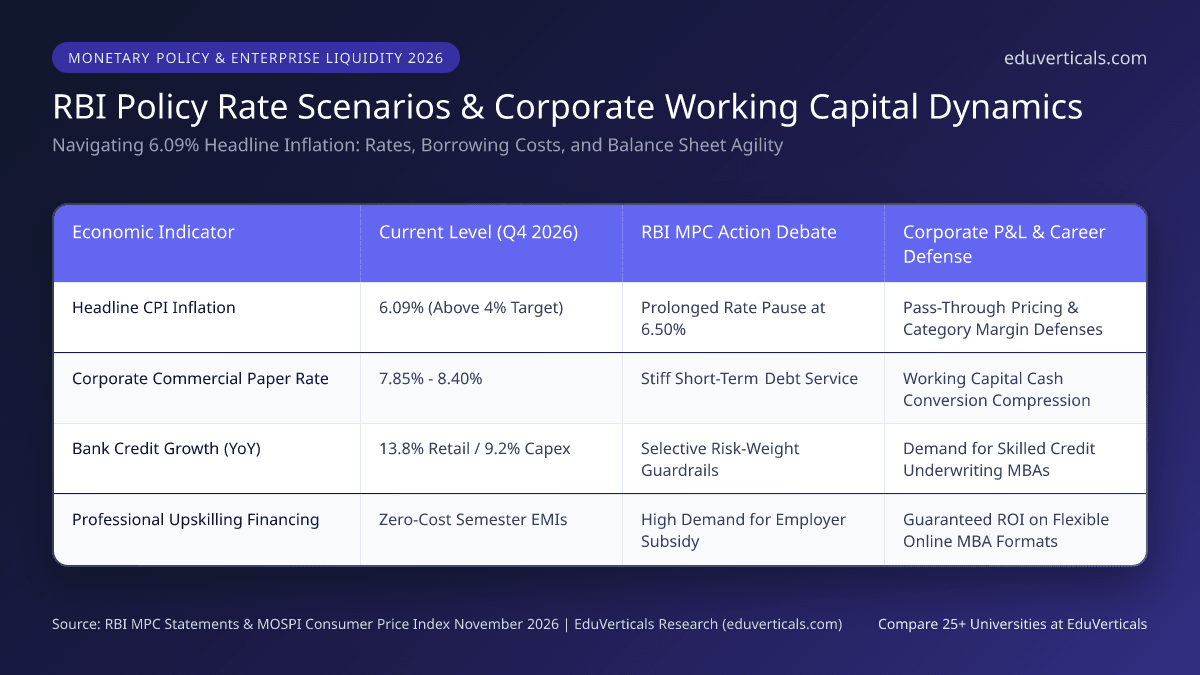
When borrowing costs are high, the cheapest source of corporate capital is not a commercial bank line or a private equity debt tranche—it is the cash trapped inside the company’s own balance sheet. Corporate leaders who understand working capital engineering can liberate tens of crores of rupees in idle liquidity without raising a single rupee of outside debt.
Consider a mid-sized consumer goods manufacturer with ₹400 crore in annual turnover. If the operations and finance team can reduce the Cash Conversion Cycle from 85 days to 65 days through better demand forecasting, inventory slotting, and automated receivables management, they permanently liberate over ₹21 crore in free operating liquidity. In an 8.5% interest rate environment, that single operational achievement delivers nearly ₹1.8 crore directly to the bottom-line EBITDA.
Select your career goal to tailor advice
Develop advanced working capital modeling skills. Benchmark top finance MBAs with our University Comparison Report or book a Free Mentor Call.
Just as corporate treasurers must optimize debt service during high-interest cycles, individual working professionals must carefully manage their personal education financing. Taking on an expensive ₹15-to-₹25-lakh personal education loan with commercial interest rates exceeding 12% creates severe personal cash flow anxiety during periods of economic uncertainty.
This is where accredited Indian Online MBAs offer a decisive financial advantage. Leading UGC-DEB entitled institutions such as Vellore Institute of Technology (VIT Online) and NMIMS CDOE provide flexible semester-wise fee payment options and zero-cost monthly EMI plans starting under ₹7,500 to ₹10,000 per month. By funding an accredited management degree out of monthly cash flow without taking high-interest loans or liquidating personal savings, working managers protect their personal balance sheets while acquiring the exact corporate finance, budgeting, and strategic P&L skills demanded by top employers.
To compare approved online universities offering flexible payment schedules, explore the EduVerticals Academic Catalog or evaluate degree tracks across financial management and analytics.
Plan Your Debt-Free Executive Upskilling: Calculate semester EMIs, evaluate NAAC A++ accreditations, and compare university ROI metrics on .
Keep the details close
Explore key programme specifications, recognition terms, fee components, and career outcomes side by side before applying.
Inflation was driven by a combination of climate-induced agricultural supply shocks in food essentials (vegetables and pulses), imported energy and chemical costs exacerbated by a weaker rupee (near ₹94/USD), and persistent logistics freight surcharges.
Bring programme options, estimated fees and study flexibility into one view, with the trade-offs and questions to verify.
Tailored shortlist from our admission partners. Verify fees and eligibility before applying.


We have a team of over 12 experienced mentors with over 26+ years of collective experience available to guide you at a moment's notice.