
logo

India’s $5 Trillion Economy & The Middle-Management Boom: Why MBA Demand Is Surging in 2026

India 5 Trillion EconomyMBA Demand India 2026Middle Management Jobs IndiaIndian Economic GrowthCorporate Hiring 2026Online MBA ROIEduVerticals
EduVerticals EditorialsEduVerticals Editorials

Posted 53 minutes ago

India’s $5 Trillion Economy & The Middle-Management Boom: Why MBA Demand Is Surging in 2026
Executive Summary: As India’s nominal GDP accelerates past the $4.2–$5.0 trillion corridor between 2026 and 2028, the structural bottleneck facing Indian corporations is no longer entry-level labor or capital availability—it is a severe deficit of "execution-ready middle managers." Across PLI-backed manufacturing, 2,100+ Global Capability Centers, Tier-2 financial services, and quick-commerce supply chains, enterprises are paying a 30%–50% compensation premium for professionals who combine domain execution with formal MBA strategic, financial, and analytical literacy.

Whenever headlines debate AI automation or tech hiring cycles, a much larger macroeconomic transformation often goes unnoticed: the rapid formalization and scaling of the Indian enterprise economy. Over the last five years, physical and digital public infrastructure (UPI, ONDC, GST formalization, dedicated freight corridors) has allowed Indian mid-market companies and multinational subsidiaries to scale across 50+ Tier-2 and Tier-3 cities simultaneously.

Yet when CEOs and CHROs try to expand a regional business unit from ₹100 Crore to ₹1,000 Crore in revenue, they hit a wall: they have plenty of junior executives who can follow instructions, and a small circle of CXOs at the top, but a critical shortage of P&L-literate middle managers (Team Leads, AVPs, Product Heads, Plant Operations Managers, and Regional Cluster Heads).
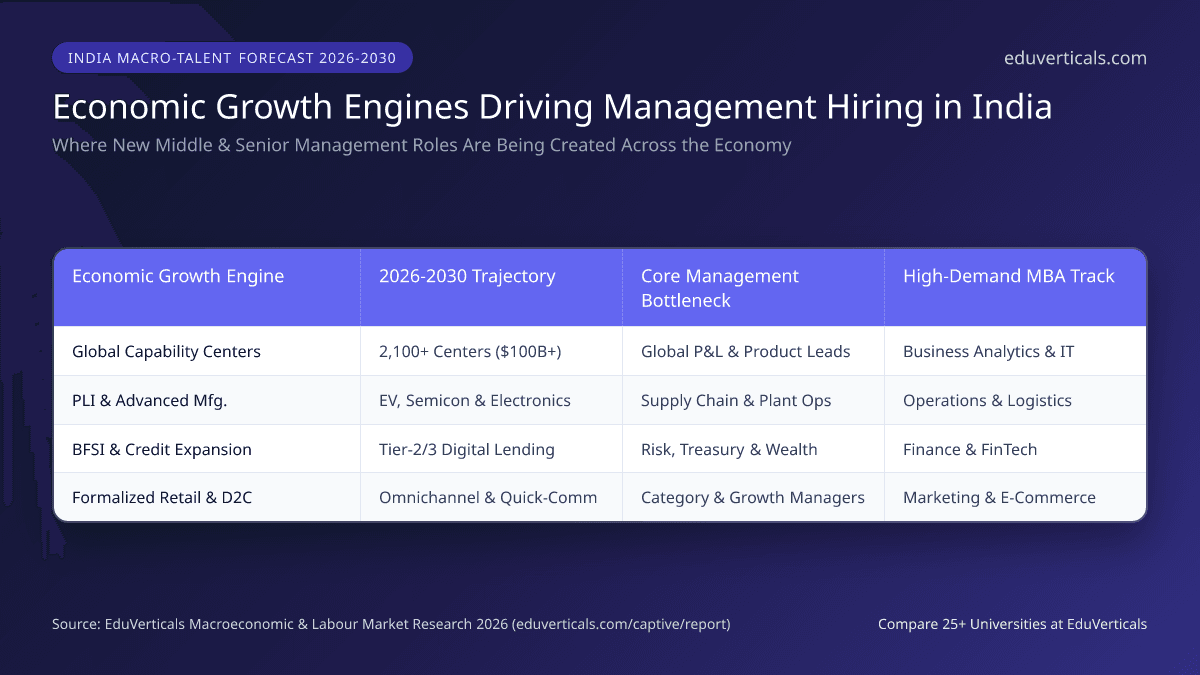
1. Four Macroeconomic Tailwinds Fueling MBA Hiring in 2026

  1. The Shift from Unorganized to Formal Corporate Enterprises: Family-owned MSMEs, regional hospital chains, and logistics fleets are professionalizing their boards, adopting ERP systems, and hiring MBA-qualified Finance, HR, and Operations heads to prepare for private equity funding and SME/Mainboard IPOs.
  2. The PLI Manufacturing & China+1 Supply Chain Surge: From electronics assembly in Tamil Nadu and Karnataka to EV battery corridors in Gujarat and Maharashtra, modern factories require quantitative supply-chain, procurement, and quality-assurance managers.
  3. Deepening Financialization of Household Savings: Mutual fund SIPs, wealth management, insurance penetration, and retail credit in Tier-2/3 towns are driving sustained hiring across NBFCs, private banks, and FinTech lenders.
  4. The Services Export Upgrade: As we explored in Why Companies Are Funding Executive Education Again in 2026, Indian service firms are moving up the value chain into high-margin advisory and product engineering.
India 5 Trillion Economy Middle Management MBA Demand 2026
2026–2030 Macroeconomic Growth Engines Driving MBA and Middle-Management Demand in India.

2. Why Traditional Campus B-Schools Cannot Fill the Gap Alone

All 21 IIMs and top tier-1 residential B-schools combined graduate fewer than 15,000 full-time flagship MBA students per year—less than 5% of the annual managerial leadership demand of a $5 trillion economy! Worse, companies cannot afford to lose their best 26-to-34-year-old engineers, analysts, and territory supervisors for two years of residential schooling.

That economic reality is why UGC-DEB Entitled Online MBAs and Blended Executive MBAs have become the primary talent-upgrading engine of Corporate India—allowing professionals to acquire financial modelling, operations research, and strategic leadership credentials while actively building the economy.

3. How to Position Yourself for the 2026–2030 Management Wave

  • Move from "Task Executor" to "Metric Owner": Whether you work in software, sales, or operations, learn to tie your daily work to Gross Margin, EBITDA, Customer Lifetime Value (LTV), and Working Capital cycles.
  • Build Cross-Functional AI & Data Literacy: Middle managers in 2026 are expected to interpret automated dashboards, run scenario simulations, and allocate capital across human and AI workflows without waiting for a separate data-science team.
  • Target High-Growth Domestic & Export Corridors: Align your capstone project and elective choices with sectors expanding faster than headline GDP—including GCC advisory, electronics/EV supply chains, wealth management, and organised healthcare.
  • Pair Domain Depth with an Accredited Management Degree: Compare NAAC A++ and NIRF-ranked institutions on EduVerticals University Compare to add a recognized postgraduate management qualification to your profile before your next appraisal cycle.
Calculate Your Personal 5-Year Economic Trajectory: See how adding an accredited Online or Executive MBA shifts your 5-year earnings curve on .
Frequently Asked Questions

Common Questions Answered

Global Capability Centers (GCCs), BFSI & FinTech, E-Commerce & Quick-Commerce Supply Chains, Healthcare & Hospital Networks, EV/Electronics Manufacturing, and Renewable Energy Infrastructure are projected to lead managerial hiring through 2030.

01 / The Facts, Side by Side

University Comparison Report

Bring programme options, estimated fees and study flexibility into one view, with the trade-offs and questions to verify.

Tailored shortlist from our admission partners. Verify fees and eligibility before applying.

Meet Our Mentors

We have a team of over 12 experienced mentors with over 26+ years of collective experience available to guide you at a moment's notice.

Got Questions?

Online and distance learning programs provide: - Flexibility to learn at your own pace from anywhere. - Access to recorded lectures and digital study materials. - Opportunities to balance work, education, and personal commitments. - Affordable options compared to traditional on-campus programs. - Industry-relevant curriculum designed by academic experts.
Choosing the right university depends on: - Accreditation and recognition of the institution. - Quality and relevance of the curriculum. - Availability of academic and career support services. - Feedback and reviews from alumni and current students. - Flexibility in learning schedules and delivery modes.
Yes, online degrees from accredited universities are widely recognized and equivalent to regular degrees. Employers value the skills and qualifications gained from online programs, especially when offered by reputed institutions.
Assessment methods for online programs vary but typically include: - Online quizzes and assignments. - Virtual proctored exams. - Group projects and case studies. - Real-time presentations and viva sessions.
Many universities allow credit transfers, subject to: - Compatibility with the curriculum of the new program. - A minimum grade requirement in previously completed courses. - Approval by the academic administration of the new university.