 EduVerticals Editorials
Posted 4 months ago
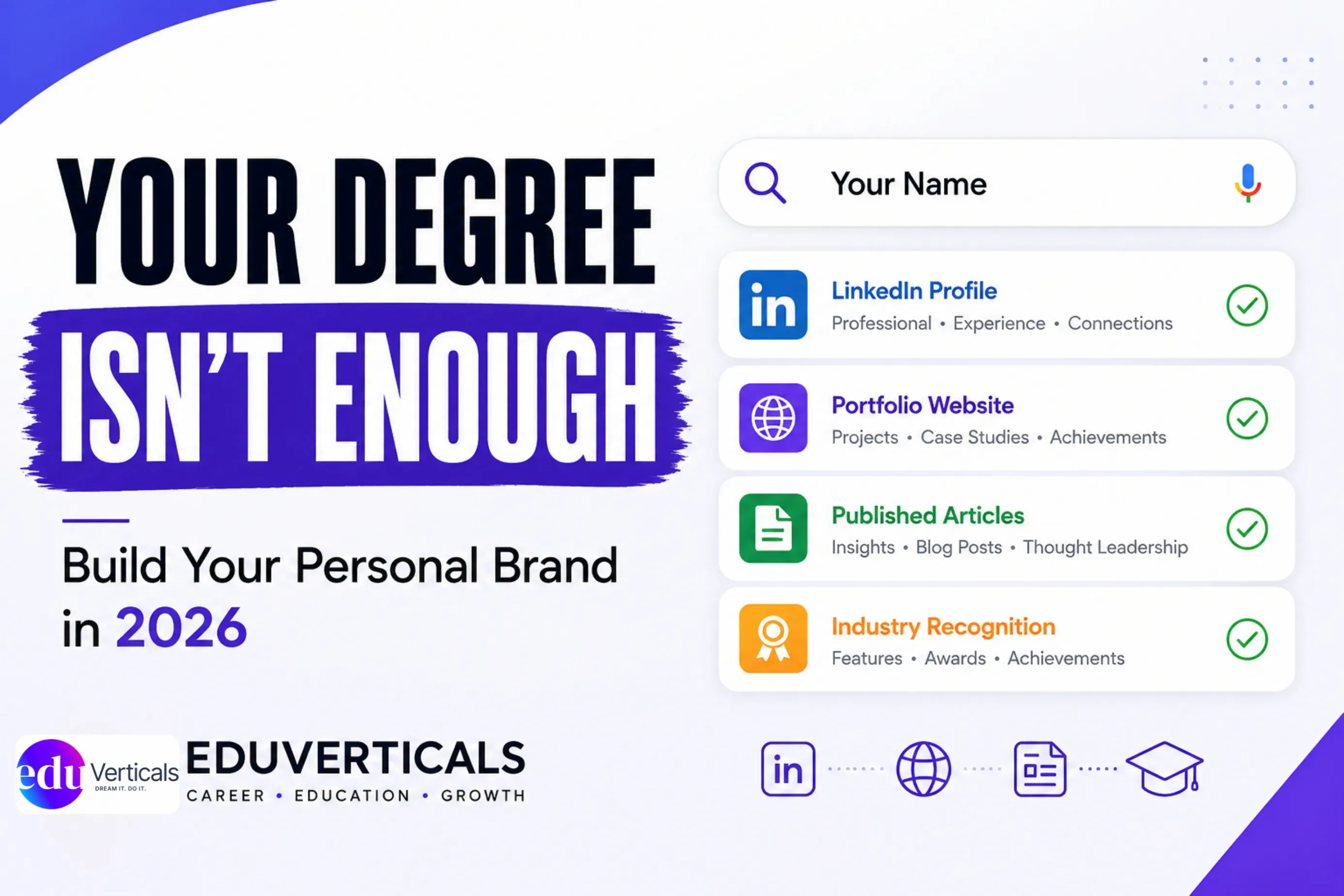
Five years ago, a degree was enough to get noticed.
Today, thousands of candidates hold the same degree, the same certifications, and access to the same AI tools.
The difference is no longer just what you know.
It's whether people remember you.
That's where personal branding comes in — and in 2026, it may be the single most important career investment you make.
Quick Answer: Building a personal brand in 2026 means defining a clear niche, optimising your LinkedIn profile, creating problem-solving content, and building consistent visibility over time. This guide walks you through every step.
Personal branding is the deliberate process of shaping how others perceive you professionally.
It's the combination of your expertise, your online presence, your communication style, your achievements, your values, and your reputation.
Think of it this way: when someone mentions a well-known entrepreneur, marketer, or industry leader, certain ideas immediately come to mind. That perception is their brand.
Your personal brand works exactly the same way.
Whether you're a student pursuing an Online MBA, a working professional aiming for a promotion, or a freelancer building credibility — your personal brand is your digital reputation. And it's being built whether you manage it or not.
The internet has never been louder.
AI can generate generic content in seconds. Thousands of professionals are applying for the same roles. Everyone is posting.
Very few are memorable.
Visibility alone is no longer enough. What matters in 2026 is differentiation and clarity. Professionals who stand out are those who offer unique perspectives and solve specific problems — not those who simply post often.
A strong personal brand helps you:
In many industries, your online presence has become your new resume.
EduVerticals helps professionals build career-ready profiles, build yours!
Most people fail at personal branding for one reason: they try to be relevant to everyone.
"Marketing Expert." "Business Enthusiast." "Passionate Learner."
Nobody remembers those.
Specificity creates memorability. The narrower your positioning, the easier it becomes for people to associate your name with a clear area of expertise.
Strong positioning examples:
Ask yourself: What problem do I solve, and for whom? That answer is your positioning.
For professional personal branding, LinkedIn is your most important platform.
Recruiters, hiring managers, and industry leaders actively use LinkedIn to evaluate candidates and discover talent. A weak or incomplete profile is a missed opportunity every single day.
Start by optimising these three sections:
Your Headline
Don't settle for a job title. Make it value-driven.
❌ "MBA Student"
✅ "Helping Working Professionals Choose the Right Online MBA | Career Growth & Higher Education"
Your About section should tell your story, communicate your expertise, state your mission, and clearly explain the value you provide to others.
Use this space to showcase case studies, certifications, published blogs, projects, achievements, and testimonials. This is prime real estate that most professionals leave empty.
A fully optimised LinkedIn profile dramatically increases both your discoverability and your credibility with recruiters.
The biggest content mistake? Posting motivational quotes.
The internet already has plenty of "Believe in yourself" and "Success takes time." Nobody shares that anymore.
Instead, create content that educates, challenges, and provides genuine value:
"5 Mistakes Students Make While Choosing an Online MBA"
"How One Professional Got a 40% Salary Hike After an Online MBA"
"Why Skills Alone Are Not Enough in 2026"
"Do Employers Really Accept Online MBA Degrees?"
"What I Learned From My First 90 Days of Content Creation"
The formula is simple: problem-solving content → trust → authority → opportunities.
Social media algorithms change. Reach drops overnight. Platforms come and go.
Your website is the one digital asset you fully own.
A personal website can include your About page, portfolio, resume, blog, testimonials, and contact information. More importantly, it allows you to rank on Google for searches related to your expertise.
SEO-driven blog content can continue bringing organic traffic for years after publication — creating compounding career visibility that no social post can match.
Most people optimise their content. Very few optimise themselves.
Personal SEO is the practice of creating content that helps you appear in search results when people search for your name, your expertise, or your niche.
Target phrases like:
Personal SEO creates long-term visibility that builds on itself over time. Combined with a strong educational foundation, it becomes one of the most powerful career tools available.
One of the biggest personal branding shifts in 2026 is the premium placed on authenticity.
People connect with journeys, not perfection.
Instead of only posting achievements, share:
As AI-generated content floods every platform, genuine human perspective is becoming one of the strongest differentiators available. Real experience, honest judgment, and original viewpoints are things no AI can replicate.
A personal brand is not measured by follower count.
It is measured by influence.
A profile with 1,000 engaged followers who trust you can outperform one with 100,000 passive followers who scroll past your posts.
Focus on:
Relationships create opportunities. Vanity metrics rarely do.
The strongest personal brands are instantly recognisable.
Consider your writing style, your design aesthetic, your recurring content themes, and your tone of voice. When someone can identify your content before seeing your name, your branding is working.
Consistency → Familiarity → Trust → Authority
Pick a style, commit to it, and let it compound over time.
The result is always the same: you appeal to nobody. Niche down.
People follow originals. Inspiration is fine; imitation is a dead end.
Opportunities come from credibility and relationships, not metrics.
Random content produces random results. Start with a simple content calendar.
Most successful personal brands are built over months and years of consistency. There are no shortcuts.
Students often assume personal branding is only for CEOs and influencers.
That assumption is costing them opportunities.
Recruiters search candidates' names before interviews. What they find — or don't find — shapes hiring decisions before you ever enter the room.
Students can build powerful personal brands by:
When a recruiter searches your name and finds evidence of curiosity, initiative, and expertise, that creates a competitive advantage before the interview even begins.
Explore how EduVerticals supports students in building career-ready profiles alongside their academic journey.
The future belongs to professionals who combine expertise, communication, authenticity, and consistency.
AI will make content creation easier for everyone. That means generic content will become increasingly invisible.
The professionals who stand out in 2026 and beyond will not necessarily be the loudest. They will be the clearest.
Those who communicate unique perspectives, solve real problems, and provide consistent value will continue attracting opportunities — regardless of changing algorithms or emerging platforms.
How long does it take to build a personal brand?
Most professionals begin seeing meaningful results after 3–6 months of consistent effort. A strong personal brand typically takes 12–24 months to fully establish, though early opportunities often come much sooner.
Can students build a personal brand with no experience?
Absolutely. Students can document their learning journey, share internship insights, publish opinions on industry trends, and participate in professional conversations. The absence of experience is not a barrier — it's your starting point.
Is LinkedIn enough for personal branding in 2026?
LinkedIn is the most important platform for professional branding, but pairing it with a personal website and Personal SEO creates significantly stronger long-term visibility.
Does personal branding help with Online MBA applications or career growth?
Yes. A strong personal brand signals initiative, communication skills, and professional seriousness — qualities that admissions panels and hiring managers actively look for.
What's the difference between personal branding and self-promotion?
Personal branding is about consistently providing value to your audience and building a reputation over time. Self-promotion is transactional. The best personal brands feel generous, not boastful.
Your personal brand is already being built.
Every LinkedIn post. Every comment. Every article. Every interaction.
They're all shaping how people perceive you — whether you're managing that perception or not.
Start small. Stay consistent. Focus on genuinely helping people.
Over time, your name becomes more than a name. It becomes a signal of trust.
Ready to invest in your career growth? Explore EduVerticals' programmes for students and working professionals →


We have a team of over 12 experienced mentors with over 26+ years of collective experience available to guide you at a moment's notice.