
logo

GTA VI Pre-Orders & Live-Service SaaS: Cohort LTV, Pricing & Product Leadership (2026)

GTA VI Pre OrdersLive Service MonetizationGaming SaaS EconomicsCustomer Lifetime ValueProduct Management IndiaConsumer Tech MBAEduVerticals
EduVerticals EditorialsEduVerticals Editorials

Posted 1 day ago

GTA VI Pre-Orders & Live-Service SaaS: Cohort LTV, Pricing & Product Leadership (2026)
Executive Summary
Reading Brief
Executive Summary: When Take-Two Interactive and Rockstar Games crossed an unprecedented $1 Billion in verified digital pre-orders and pre-commitments for Grand Theft Auto VI in late 2026, the milestone represented far more than entertainment hype: it marked the ultimate triumph of modern live-service SaaS economics. By transforming a traditional single-transaction media product into an ongoing subscription-like digital economy with multi-tiered passes, virtual asset ownership, and scheduled live drops, the gaming industry has established the gold standard for cohort retention and lifetime value (LTV) maximization. For consumer tech product managers across Indian gaming, fintech, quick-commerce, and edtech platforms, dissecting GTA VI’s monetization mechanics provides a masterclass in unit economics, behavioral pricing tiers, and recurring revenue retention.

Historically, the economics of consumer software and interactive entertainment were brutal and hit-driven. Studios invested tens or hundreds of millions of dollars over five-to-seven-year development cycles, released a physical or digital product at a fixed ₹3,500 to ₹5,000 price point, and generated 85% of their total lifecycle revenue within the first ninety days. If the title failed to achieve immediate cultural velocity, the capital investment was permanently impaired.

The live-service revolution completely inverted this financial vulnerability. Modern interactive entertainment platforms operate as perpetual recurring software-as-a-service (SaaS) businesses. Initial box purchases serve merely as the top-of-funnel customer acquisition gateway; the real enterprise value lies in multi-year Net Revenue Retention (NRR) exceeding 130% through seasonal battle passes, cosmetic drops, and exclusive digital real estate. Product leaders across Indian consumer tech must understand these behavioral monetization models to thrive in a competitive digital landscape.

1. The Mathematical Anatomy of Live-Service Cohort LTV

In conventional B2B or B2C SaaS, product managers track Customer Acquisition Cost (CAC), monthly churn, and Average Revenue Per User (ARPU). In high-velocity live-service ecosystems, revenue generation follows an extreme Pareto distribution driven by user segmentation:
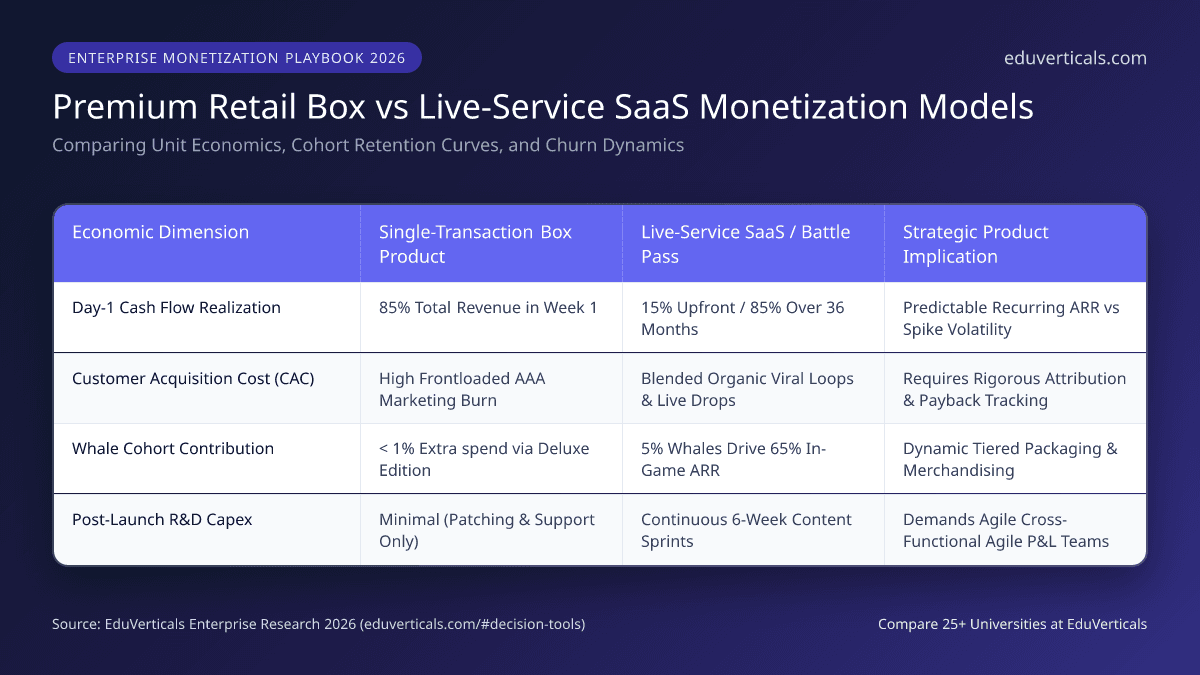
  • The Minnow Tier (75%–80% of Users): Engage with base game content and generate zero marginal recurring revenue. However, their critical economic role is providing matchmaking liquidity, viral social proof, and organic community engagement that attracts paying cohorts.
  • The Dolphin Tier (15%–18% of Users): Consistently purchase entry-level battle passes (₹800–₹1,500 quarterly) and seasonal expansion packs, providing predictable, recurring baseline operating cash flows.
  • The Whale Cohort (2%–5% of Users): Account for 60% to 70% of all ongoing micro-transaction revenue. These users willingly spend ₹25,000 to ₹2,50,000 annually on limited-edition vehicles, custom vanity skins, and virtual status symbols.
  • Dynamic Payback Period Acceleration: Because digital pre-orders frontload millions in non-refundable capital, the effective CAC payback period drops to zero days before public server launch, allowing companies to self-fund post-launch content sprints without debt financing.
GTA VI Billion-Dollar Pre-Orders Live-Service SaaS Monetization 2026
Comparison of single-transaction box products versus live-service SaaS monetization models across unit economics, retention curves, and churn.

2. Applying Gaming Monetization to Indian Consumer Tech Products

The principles driving billion-dollar gaming pre-orders are being aggressively adopted by consumer product managers across India’s digital economy:

  1. Fintech & Neobanking Gamification: Platforms like CRED, PhonePe, and Groww use tiered gamified milestone drops, mystery reward boxes, and social leaderboard competitions to drive daily active usage and habituation.
  2. Quick-Commerce Loyalty Lock-In: Blinkit, Zepto, and Instamart deploy tiered subscription passes (VIP delivery passes) that mimic battle passes, effectively locking household wallet share while monetizing access to priority delivery windows.
  3. Edtech Gamified Cohort Learning: Online education platforms incorporate milestone streak badges, peer accountability cohorts, and unlocked masterclass modules to boost course completion rates from 8% to over 65%.
  4. Algorithmic Behavioral Pricing: Utilizing real-time analytics to display personalized promotional bundles based on past spending velocity, time of day, and session engagement depth.
Interactive Career Pulse

Select your career goal to tailor advice

Decision note · Verified comparison01 / 03

What is your primary career goal in consumer tech and product management?

Mentor RecommendationTransition from Engineering to Product Management

Master user cohort analytics, wireframing, and product unit economics. Compare top programs on EduVerticals University Compare.

Tailored shortlist from our admission partners

3. Why High-Growth Product Managers Need an Accredited MBA

In the early stages of a product management career, technical familiarity with Jira, SQL, and Figma is often sufficient. However, advancing to Group Product Manager (GPM), Vice President of Product, or Chief Product Officer requires deep commercial and financial mastery. Product leaders must defend customer acquisition CAC budgets, justify lifetime value projections to private equity investors, and balance gross margins against aggressive marketing burn.

Enrolling in an accredited Online MBA in Marketing & E-Commerce or deep-tech management program from prestigious institutions like IIT Patna Online or NMIMS Global Access provides technology professionals with the strategic frameworks, managerial accounting rigor, and behavioral economics foundation necessary to build category-defining consumer software.

Editorial Brief
Reading Brief
Accelerate Your Product Leadership Trajectory: Explore accredited online postgraduate programs designed for aspiring consumer tech and product leaders on EduVerticals Academic Catalog.

Keep the details close

Common QuestionsThe full picture.

Explore key programme specifications, recognition terms, fee components, and career outcomes side by side before applying.

05 verified FAQs

Take-Two combined a decade of cultural anticipation with tiered digital pre-order bundles, exclusive digital assets, closed early-access testing access, and seamless digital distribution across modern consoles and PC launchers.

01 / The Facts, Side by Side
Live Comparison Dossier

University Comparison Report

Bring programme options, estimated fees and study flexibility into one view, with the trade-offs and questions to verify.

01Fee Structure
02Study Mode
03Career Fit

Tailored shortlist from our admission partners. Verify fees and eligibility before applying.

Meet Our Mentors

We have a team of over 12 experienced mentors with over 26+ years of collective experience available to guide you at a moment's notice.

Got Questions?

Online and distance learning programs provide: - Flexibility to learn at your own pace from anywhere. - Access to recorded lectures and digital study materials. - Opportunities to balance work, education, and personal commitments. - Affordable options compared to traditional on-campus programs. - Industry-relevant curriculum designed by academic experts.
Choosing the right university depends on: - Accreditation and recognition of the institution. - Quality and relevance of the curriculum. - Availability of academic and career support services. - Feedback and reviews from alumni and current students. - Flexibility in learning schedules and delivery modes.
Yes, online degrees from accredited universities are widely recognized and equivalent to regular degrees. Employers value the skills and qualifications gained from online programs, especially when offered by reputed institutions.
Assessment methods for online programs vary but typically include: - Online quizzes and assignments. - Virtual proctored exams. - Group projects and case studies. - Real-time presentations and viva sessions.
Many universities allow credit transfers, subject to: - Compatibility with the curriculum of the new program. - A minimum grade requirement in previously completed courses. - Approval by the academic administration of the new university.