 EduVerticals Editorials
Posted 4 months ago
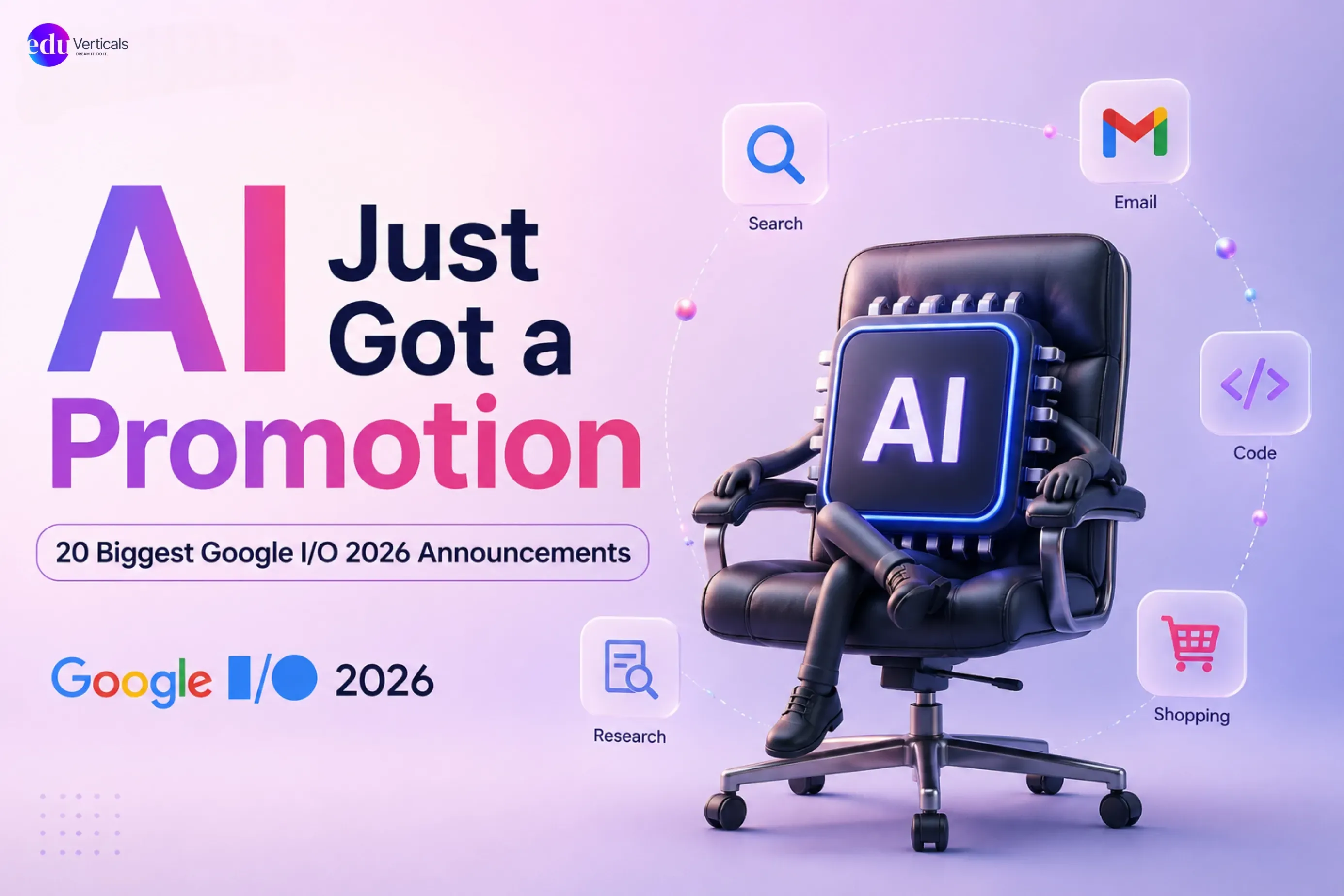
Google I/O 2026 changed everything. Here are the top 20 AI announcements — from Gemini 3.5 Flash to AI Mode — and what they mean for your career in 2026.
Google just changed the rules again.
At Google I/O 2026, held on May 19–20, Google didn't just launch new products. It signalled a fundamental shift in how AI works — moving from a tool that assists you to a system that acts on your behalf, autonomously, intelligently, and at scale.
For students mapping their career paths. For working professionals navigating an AI-first workplace. For anyone building skills in 2026 — these announcements are not background news. They are a direct signal of where the world is heading and what skills will matter next.
Here are all 20 announcements explained clearly, with what each one actually means for you.
Quick Answer: Google I/O 2026 introduced Gemini 3.5 Flash, AI Mode as the new default in Google Search, autonomous agents, scientific research AI, and a range of developer tools — marking the definitive shift from assistive AI to agentic AI.
This is the single biggest consumer-facing announcement from Google I/O 2026.
Google has made AI Mode the default search experience for all users in the United States. Traditional blue links are being replaced by a conversational, agent-powered interface that generates synthesised, contextual answers with cited sources — and supports follow-up questions natively within the same session.
This is not an incremental update. It is the transition of Google Search from an information retrieval system to an intelligent reasoning agent.
What this means for you: SEO, content strategy, and digital discoverability are being fundamentally restructured. For students studying marketing or business, and professionals working in digital roles, understanding how AI-mode search works is now a core career skill — not an optional one.
Google launched Gemini 3.5 Flash at I/O 2026 — the most capable model in the Flash family to date. Gemini 3.5 Pro is currently in testing and expected to follow within weeks.
Gemini 3.5 Flash was engineered using a co-design approach between model architecture and hardware, enabling significantly deeper reasoning at Flash-series speeds and at less than half the cost of comparable flagship models.
Key benchmark results:
It is available today on the Gemini Enterprise Agent Platform, Google AI Studio, and Antigravity.
What this means for you: Powerful AI reasoning is now faster and cheaper than ever. Professionals and students who learn to work with models like Gemini 3.5 Flash — through tools like Google AI Studio — will have a significant advantage in building AI-powered products and workflows.
Google introduced Information Agents as a new class of AI embedded directly in Search — designed to autonomously execute complex, multi-step research tasks.
These agents can browse the web, synthesise information across multiple sources, compare options, draft summaries, and surface relevant data — all within a single search session, directed through natural language.
What this means for you: Competitive analysis, market research, and academic literature reviews that once took hours can now be compressed into minutes. For MBA students, analysts, and business professionals, this changes the standard for what thorough research looks like — and how fast it needs to happen.
Gemini Spark is Google's new 24/7 personal AI agent, available to Gemini Enterprise and Google Workspace customers.
It connects to Gmail, Google Calendar, Docs, and Drive — and can autonomously draft emails, schedule meetings, summarise documents, surface action items, and execute multi-step workflows without requiring manual prompting for each task.
What this means for you: This is the clearest real-world demonstration of agentic AI so far. For working professionals managing heavy administrative loads, Gemini Spark represents a genuine productivity multiplier. Understanding how to direct and configure personal AI agents is rapidly becoming a workplace skill, not a technical luxury.
Google introduced native Kotlin support within Google AI Studio, allowing developers to build full Android applications using natural language prompts. Alongside this, Antigravity 2.0 launched as a centralised desktop workspace for orchestrating multi-agent pipelines.
Projects can be seamlessly exported from AI Studio to Antigravity, where developers manage subagents, automate code generation, and create complex workflows. An Antigravity CLI also offers a terminal-first option for rapid agent deployment.
What this means for you: Android app development is being compressed from weeks of work into hours. For tech students and software professionals, this is a direct signal that the skill set of the future combines AI direction with traditional development fundamentals.
Google unveiled a Computational Discovery Research Engine — an AI-powered scientific research platform that allows researchers to pose high-level scientific questions and receive synthesised, evidence-backed answers by autonomously analysing vast bodies of literature and experimental data.
It integrates Gemini's long-context reasoning with scientific databases, experimental corpora, and structured knowledge graphs — capable of identifying research gaps, surfacing contradictory findings, and generating structured literature summaries with full citation trails.
What this means for you: For students in science, healthcare, or analytics — and professionals working in research-adjacent industries — the barrier to deep literature analysis has collapsed. The ability to frame the right research questions is now more valuable than the ability to manually search for answers.
Building on the research engine, Google expanded its Co-Scientist platform with autonomous hypothesis generation — enabling AI to propose novel, testable scientific hypotheses based on existing experimental evidence.
Hypotheses are ranked by novelty, plausibility, and testability, giving researchers a structured starting point for experimental design.
What this means for you: AI is beginning to contribute to the creative phase of scientific work, not just the retrieval phase. For students in research, medicine, or data science, this expands the scope of what AI collaboration looks like in professional practice.
Google announced the Universal Cart — a Gemini-powered shopping agent that enables users to add products from multiple retailers into a single, unified checkout experience directly within Google Search.
It uses natural language shopping queries, compares prices, verifies availability, and personalises recommendations based on browsing and purchase history.
What this means for you: Google is positioning itself as a direct commerce intermediary. For students studying e-commerce, marketing, or business strategy, this is a live case study in how AI is restructuring entire industry models — and a signal that product data quality and API integration are becoming critical business competencies.
Google expanded SynthID — its digital watermarking framework for AI-generated content — to embed imperceptible, cryptographically verifiable watermarks into AI-generated text, images, audio, and video.
These watermarks persist through editing, compression, and reformatting, enabling downstream verification of whether content was produced by a generative AI model.
What this means for you: As AI-generated content becomes ubiquitous in media, finance, legal, and healthcare contexts, the ability to verify content provenance is a governance priority. For business and management students, AI ethics and responsible AI deployment are no longer elective knowledge — they are board-level concerns.
Google introduced Managed Agents via the Gemini API — a service that provisions fully operational AI agents with a single API call, removing the need to manage infrastructure, containers, or sandboxes manually.
What this means for you: The barrier to building production-grade agentic applications has dropped significantly. For developers and tech professionals, this is the equivalent of serverless computing arriving for AI agents. For non-technical professionals, it means AI-powered tools will proliferate faster than ever across every industry.
Google introduced Stitch — an AI-powered design and prototyping tool that translates natural language descriptions, wireframe sketches, or written specifications into HTML, CSS, and component-level code.
It supports iterative refinement through natural language follow-up and exports to popular frontend frameworks.
What this means for you: The design-to-code pipeline has been compressed dramatically. Product managers, UX researchers, and business professionals can now generate functional UI prototypes without engineering support — making design thinking a universal professional skill, not just a designer's tool.
Google proposed WebMCP as an open web standard — enabling developers to annotate existing web page elements and functions with machine-readable metadata, so browser-based AI agents can interact with web applications far more reliably.
An experimental WebMCP origin trial begins in Chrome 149, with Gemini in Chrome support following shortly after.
What this means for you: This has the potential to fundamentally transform how AI agents navigate the web — shifting from fragile, heuristic-based interaction to well-defined, developer-exposed APIs. For web developers and product teams, understanding WebMCP will become a foundational competency in building AI-compatible digital products.
With Antigravity 2.0, developers can define AI agents through human-readable Markdown files — specifying persona, instructions, knowledge boundaries, and available tools — which are then parsed and executed by the Antigravity agent harness.
These configurations can be stored in Git repositories, supporting standard software development practices including peer review, branching, and CI/CD pipelines.
What this means for you: Agent configuration is moving out of the hands of pure engineers and into collaborative, cross-functional teams. Product managers, solutions architects, and domain experts can now co-author agent behaviour alongside developers — broadening who can meaningfully contribute to AI system design.
Antigravity now supports Generative UI — using Gemini 3.5 Flash to dynamically generate HTML, CSS, and JavaScript components in real time from natural language specifications, integrating directly with live databases, APIs, and backend services.
What this means for you: Frontend development timelines are collapsing. For tech students and developers, this accelerates prototyping and production. For non-technical professionals, it democratises UI creation — making it possible to build functional digital interfaces without writing a line of code.
15. Google Pics & Nano Banana Model
Google Pics is a new image generation and editing tool integrated directly into Google Workspace — powered by Nano Banana, Google's latest multimodal image model.
It supports precision editing, style transfer, background replacement, and object removal — available to Gemini Enterprise and Workspace subscribers directly within Gmail, Docs, Slides, and Drive.
What this means for you: Enterprise image generation is now embedded inside productivity tools rather than requiring separate creative software. For marketing, communications, and business professionals, on-brand visual content creation is becoming a native workflow capability.
NotebookLM received a major upgrade — with new Literature Insights features allowing users to upload multiple documents and receive thematic summaries, contradiction identification, key claim extraction, cross-document synthesis, and timeline generation, all with precise citations.
What this means for you: For students managing research assignments, professionals staying current in fast-moving industries, and analysts tracking large volumes of information, NotebookLM's upgrades make deep document analysis accessible without specialist skills. The ability to ask the right questions of large knowledge bases is now a standard professional competency.
Google introduced Chrome DevTools for Agents — extending Chrome's existing developer tooling to allow AI agents to perform quality audits, debug code, emulate user environments, and monitor Core Web Vitals in real time, without manual developer oversight.
What this means for you: Automated QA and performance benchmarking tasks that currently require skilled engineers can now be delegated to AI agents. For software professionals and DevOps teams, this compresses testing lifecycles and raises the quality floor for AI-generated code.
Google announced the AI Ultra Plan — a premium subscription tier bundling access to Gemini 3.5 Flash (and soon 3.5 Pro), higher token throughput, Managed Agents, Google AI Studio Pro features, and early access to experimental capabilities.
What this means for you: Google is competing aggressively for developer ecosystem share. For startups and enterprise teams scaling agentic applications, the bundled access model offers a compelling cost-to-capability ratio. For students and early-career professionals, keeping track of these ecosystem shifts is part of staying relevant in AI-adjacent roles.
Modern Web Guidance is a new expert-vetted skill set for coding agents — delivering contextual, up-to-date best practices on performance, accessibility, and security directly into the agent's context during development.
It integrates with Google's Baseline cross-browser compatibility standard and supports over 100 use cases at launch.
What this means for you: AI-generated code has historically regressed on quality standards without domain-specific guidance. Modern Web Guidance corrects this systematically — raising the baseline quality of AI-built web applications and reducing the rework burden on development teams.
Google announced a global developer competition — the Build with Gemini Hackathon — with a $2 million prize pool, challenging developers to build innovative applications across categories including agentic applications, generative media, developer tooling, and scientific research tools.
What this means for you: Beyond the prize money, this hackathon signals Google's investment in building a broad developer ecosystem around Gemini. For students and early-career professionals, participating in or following hackathons like this is one of the fastest ways to develop portfolio-worthy AI experience in a short timeframe.
If there is one overarching signal from Google I/O 2026, it is this:
The AI transition is no longer coming. It is here.
Every announcement points toward the same reality — AI systems are increasingly autonomous, embedded in everyday workflows, and operating across every professional domain from healthcare and law to marketing and software development.
For students, this means the degrees and certifications you pursue should equip you not just with knowledge, but with the ability to work alongside AI systems — directing them, evaluating their outputs, and understanding their limitations.
For working professionals, this means the skills that defined your career five years ago are not sufficient to define it five years from now. Staying ahead requires continuous upskilling — particularly in AI literacy, data-informed decision making, and strategic thinking that AI cannot replicate.
The professionals who will thrive are not necessarily those who know the most about AI. They are those who know how to apply it most effectively in their specific domain.
EduVerticals helps students and professionals build future-ready skills; Build your career→
What was the most important announcement at Google I/O 2026?
AI Mode becoming the default in Google Search is arguably the most consequential consumer-facing announcement. It marks the transition of Search from an information retrieval system to an intelligent reasoning agent — fundamentally changing how people interact with the internet and how businesses approach digital visibility.
What is Gemini 3.5 Flash and why does it matter?
Gemini 3.5 Flash is Google's most capable Flash-series model to date — offering deep reasoning at high speed and at less than half the cost of comparable flagship models. It powers many of the new tools announced at I/O 2026 and is available to developers via Google AI Studio and the Gemini API.
What is agentic AI and why is it significant?
Agentic AI refers to AI systems that can autonomously execute multi-step tasks on behalf of users — rather than simply responding to individual queries. Google I/O 2026 marked the mainstream arrival of agentic AI across search, productivity, development, and research, with tools like Gemini Spark, Managed Agents, and Information Agents.
How does Google I/O 2026 affect career planning for students?
The announcements signal a clear acceleration toward AI-integrated workplaces across every sector. Students should prioritise building skills in AI literacy, data analysis, and domain-specific application of AI tools — alongside their core academic or professional qualifications.
What is SynthID and why does it matter for professionals?
SynthID embeds verifiable watermarks into AI-generated content — text, images, audio, and video — enabling downstream verification of AI provenance. For professionals in media, legal, finance, and healthcare, understanding AI content verification is becoming a governance and compliance requirement.
What is WebMCP?
WebMCP is an open web standard proposed by Google that allows developers to expose structured tools within web applications so browser-based AI agents can interact with them reliably. It represents a foundational shift toward an agentic web — where AI agents navigate and act on websites through defined APIs rather than fragile scraping.
Google I/O 2026 was not a product launch event.
It was a statement of direction.
Agentic AI is the new default. Autonomous reasoning, workflow execution, scientific discovery, and generative creation are no longer research concepts — they are live, production-ready capabilities being deployed at scale.
The question for every student and professional is no longer whether AI will affect your career.
It is whether you are building the skills to lead in a world where it already has.
Stay ahead of the curve. Explore EduVerticals' programs for students and working professionals →


We have a team of over 12 experienced mentors with over 26+ years of collective experience available to guide you at a moment's notice.