 EduVerticals Editorials
Posted 1 day ago

Executive SummaryReading BriefExecutive Summary: In November 2026, Indian ambitious professionals face a historic reassessment of international education economics. With US post-election immigration rhetoric tightening H-1B lottery scrutiny, Canadian post-graduation work permits restricted by federal caps, British post-study visas facing salary threshold hikes, and US campus MBA tuition breaching $160,000 (translating to a crushing ₹1.5 Crore debt burden at ₹94+/USD exchange rates), the traditional playbook of mortgaging family assets for an overseas residential MBA has become financially irrational for the median candidate. Meanwhile, the explosive expansion of 2,100+ Global Capability Centers (GCCs) in Bengaluru, Hyderabad, and Pune—combined with accessible points-based migration corridors in Germany (EU Opportunity Card), Singapore, and Dubai—has created an alternative pathway: acquiring a portable, UGC-DEB entitled Online MBA with verified WES equivalency while retaining full-time compensation and compounding long-term net wealth.
For decades, Indian upward mobility relied on a familiar path: study engineering, work two years, borrow ₹1.2 Crore for a US/UK master’s degree, and rely on OPT to pay off debt. In late 2026, that formula broke down under tuition inflation, high interest rates, and visa curbs across Western capitals.
In the US, H-1B lottery selection for the master’s cap remains under 22%, leaving indebted graduates vulnerable to repatriation. Canada and the UK have similarly capped post-study work routes. Ambitious professionals are asking a fundamental question: Why take on ₹1.5 Crore in dollar debt with high rejection risk when you can build an executive career through strategic, debt-free corridors?
The financial math of pursuing a foreign residential MBA in late 2026 has become brutally unfavorable:
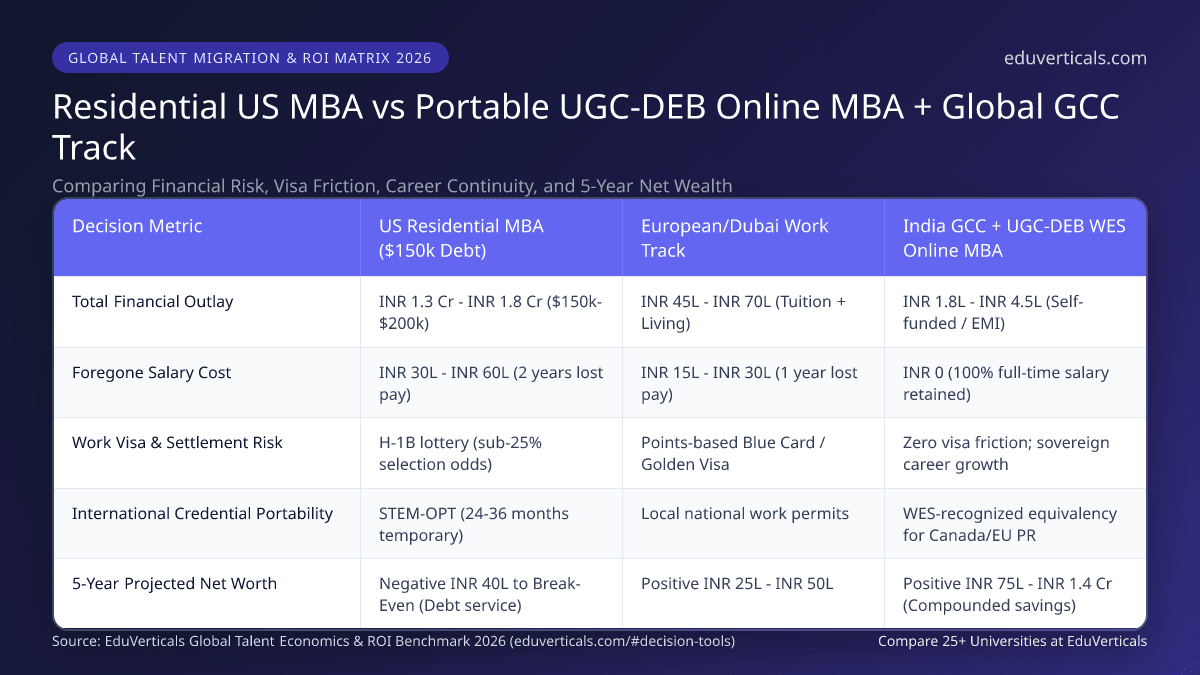
Rather than accepting the lottery roulette of the US H-1B system, strategic Indian professionals are pursuing diversified mobility tracks across regions actively competing for senior managerial talent:
Germany and the broader European Union have streamlined the EU Blue Card and Opportunity Card (Chancenkarte), lowering statutory salary thresholds for STEM and management professionals and granting permanent residency eligibility within 21 to 27 months. Singapore’s COMPASS framework awards explicit points for recognized accredited qualifications, while Dubai’s Golden Visa program provides ten-year residency for executive talent earning over AED 30,000 per month.
Even more compelling is the domestic Global Capability Center track. Over 2,100 GCCs in India now manage end-to-end global product lines, corporate treasury operations, and AI centers of excellence, paying senior managers ₹45L to ₹90L with international transfer (L-1/internal mobility) opportunities that bypass external lottery quotas.
Select your career goal to tailor advice
Target Global Capability Centers in Bengaluru or Hyderabad while completing an accredited Online MBA to capture senior P&L roles. Explore top options on EduVerticals.
The game-changer for Indian working professionals is the emergence of portable, globally evaluated online management degrees. Leading Indian universities entitled by the UGC-DEB and accredited with NAAC A+ or A++ status (such as NMIMS CDOE, Manipal MUJ, and Symbiosis SSODL) provide formal degrees that are fully evaluated by World Education Services (WES) in the United States and Canada.
Under WES evaluation, an accredited two-year Indian master’s degree is officially certified as equivalent to a North American four-year bachelor’s plus two-year master’s degree. This qualification awards maximum educational points for Canadian Express Entry (Comprehensive Ranking System) and European immigration points systems—without requiring the candidate to spend a single dollar on foreign tuition or take on ruinous student debt.
Professionals complete their coursework over flexible weekend schedules while retaining their full-time corporate salaries in India. By the time their peers graduate from overseas universities burdened with debt, Online MBA graduates possess an accredited postgraduate degree, zero educational debt, and two years of senior managerial promotions.
Choosing the right institution is essential for international credential portability. Through the EduVerticals Academic Catalog, candidates can evaluate and compare premier UGC-DEB entitled institutions such as NMIMS CDOE, Manipal University Jaipur (MUJ), and Symbiosis SSODL.
These programmes deliver comprehensive instruction in Corporate Finance, International Business Strategy, Supply Chain Management, and Digital Marketing. For a total tuition fee between ₹1.8L and ₹3.5L (payable in flexible, no-cost monthly EMIs), working professionals secure an internationally recognized credential that yields lifetime career dividends.
For an in-depth exploration of international credential recognition, read our detailed analysis on Can You Go Abroad After an Online MBA? or calculate your personal 5-year wealth accumulation curve using .
Editorial BriefReading BriefBuild a Borderless Career Without Debt: Explore portable, globally accredited Online MBA programmes on EduVerticals Course Catalog and speak with an experienced career advisor today.
Keep the details close
Explore key programme specifications, recognition terms, fee components, and career outcomes side by side before applying.
Yes. UGC-DEB entitled Online MBAs from NAAC A+/A++ accredited Indian universities (such as NMIMS, Manipal MUJ, and Symbiosis) are evaluated by World Education Services (WES) as equivalent to a Canadian/US Master’s degree.
Bring programme options, estimated fees and study flexibility into one view, with the trade-offs and questions to verify.
Tailored shortlist from our admission partners. Verify fees and eligibility before applying.


We have a team of over 12 experienced mentors with over 26+ years of collective experience available to guide you at a moment's notice.