 EduVerticals Editorials
Posted 1 day ago
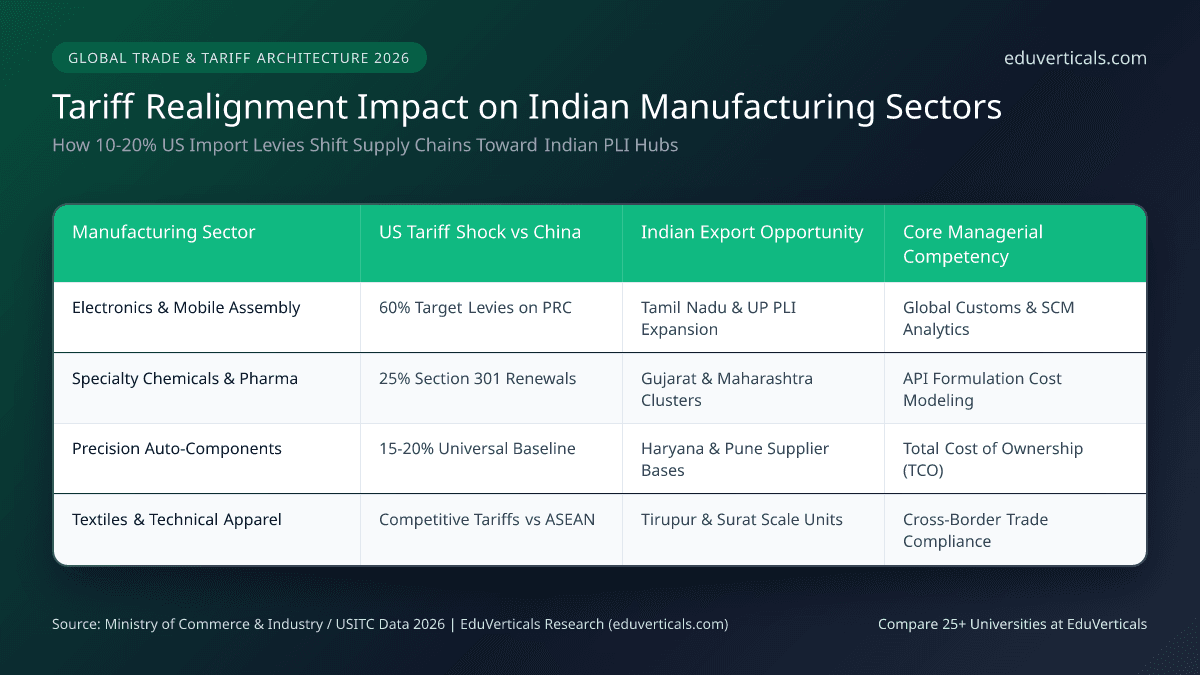
Executive SummaryReading BriefExecutive Summary: The late-2026 global tariff realignment—marked by proposed 10% to 20% universal US baseline import levies alongside punitive 60%+ tariff schedules on Chinese intermediate and finished goods—is triggering the fastest reallocation of industrial supply chains since the launch of the World Trade Organization. For India, this structural shock represents an unprecedented $150-billion industrial export window. However, capturing this production shift across Production-Linked Incentive (PLI) clusters in Tamil Nadu, Gujarat, Maharashtra, and Uttar Pradesh requires far more than assembly-line floor space. Multinationals and domestic conglomerates are confronting an acute deficit of quantitatively trained operations directors, customs compliance strategists, and cross-border trade finance leaders capable of defending operating margins under complex rules of origin, bonded warehousing mandates, and shifting freight indices.
When trade analysts examine the geopolitical fractures reshaping international commerce in late 2026, headlines frequently focus on bilateral tariff announcements and retaliatory diplomatic rhetoric. Yet inside the executive suites of global electronics manufacturers, automotive Tier-1 suppliers, and specialty chemical conglomerates, the conversation is intensely practical: how to re-route multi-tier bills of materials (BOMs) into India without incurring fatal margin erosion from universal import duties, transfer-pricing penalties, or port dwell congestion. Over the past four years, India’s Production-Linked Incentive (PLI) schemes across 14 vital sectors have mobilized over ₹1.4 lakh crore in committed capital expenditures. But physical infrastructure alone cannot execute global supply agreements without rigorous managerial architecture.
American and European procurement executives are no longer simply seeking low factory wages. In an era where universal baseline tariffs penalize mismanaged value addition, corporate buyers demand audited value-chain transparency: verified local value addition (LVA) percentages, automated customs documentation, and seamless enterprise resource planning (ERP) integration between Indian shop floors and global distribution centers. For Indian enterprise leaders, this transition marks the decisive end of informal plant supervision and the dawn of data-driven, strategic supply chain engineering.
The first phase of the China+1 strategy (2018–2023) was characterized by exploratory pilot investments and peripheral assembly relocation, primarily to Vietnam, Malaysia, and Mexico. By contrast, the 2026 tariff shock represents a permanent structural decoupling. With US trade policy tightening scrutiny around transshipment origins and third-country value manipulation, superficial screwdriver assembly is actively penalized. Global brands must demonstrate authentic, multi-tier industrial localization.
For decades, Indian manufacturing facilities relied on shop-floor supervisors promoted primarily on mechanical tenure or basic technical diplomas. In 2026, that legacy operational model is breaking down. When an export consignment encounters customs scrutiny at the Port of Long Beach or Rotterdam over rule-of-origin documentation, an operations manager cannot solve the crisis with mechanical troubleshooting alone.
Today’s manufacturing leaders must operate as cross-functional P&L owners. They must understand the direct financial interplay between Incoterms 2020 rules, foreign exchange forward hedging, freight container spot pricing, and working capital cash conversion cycles. When a container sits idle for five days due to misaligned Harmonized System (HS) code classifications, the resulting demurrage and working capital drag can wipe out the entire net operating margin of the production run.
Select your career goal to tailor advice
Deepen financial modeling and plant P&L skills. Compare accredited programs on the University Comparison Report or book a Free Mentor Call with EduVerticals.
India’s top manufacturing conglomerates—including Tata, Mahindra, Reliance, and multinational contract assemblers—face an acute leadership deficit. They report thousands of unfilled senior roles for Operations Directors, Global Procurement Heads, and Supply Chain Vice Presidents with annual compensation packages spanning ₹35 LPA to ₹75 LPA. Yet engineers and factory managers cannot afford to abandon their operational responsibilities for two years to attend a full-time residential business school.
This structural reality has made accredited, UGC-DEB entitled Online MBAs in Operations and Supply Chain Management the strategic credential of choice for ambitious industrial professionals. Leading institutions such as NMIMS CDOE and Manipal University Jaipur (MUJ) provide specialized curricula covering quantitative operations research, global procurement law, corporate finance, and enterprise analytics. Because these programs are delivered asynchronously with live weekend executive masterclasses, plant managers can immediately apply advanced cost-modeling and inventory optimization frameworks to their daily shop-floor P&L without sacrificing full-time salary or promotional momentum.
To evaluate which university curriculum matches your operational domain, visit the EduVerticals Academic Catalog to benchmark NAAC A++ accreditation, faculty credentials, and specialization modules.
Editorial BriefReading BriefMap Your Industrial Leadership Trajectory: Explore specialized Operations, Logistics, and Corporate Finance MBA tracks tailored for working engineers on .
Keep the details close
Explore key programme specifications, recognition terms, fee components, and career outcomes side by side before applying.
While universal 10% to 20% US baseline tariffs increase the landed cost of goods entering America, punitive 60%+ duties on Chinese merchandise create a decisive relative cost advantage for Indian manufacturers under PLI schemes, particularly in electronics, automotive components, and specialty pharmaceuticals.
Bring programme options, estimated fees and study flexibility into one view, with the trade-offs and questions to verify.
Tailored shortlist from our admission partners. Verify fees and eligibility before applying.


We have a team of over 12 experienced mentors with over 26+ years of collective experience available to guide you at a moment's notice.