 EduVerticals Editorials
Posted 1 day ago

Executive SummaryReading BriefExecutive Summary: Coordinated global enforcement actions resulting in the seizure of over $1.2 Billion in illicit digital assets by US, European, and Indian regulatory agencies have shattered the myth of unregulated shadow cryptocurrency. In India, the aggressive enforcement of Financial Intelligence Unit (FIU-IND) registration, Prevention of Money Laundering Act (PMLA) provisions, and mandatory 1% Tax Deducted at Source (TDS) reporting has transformed digital assets from speculative novelties into strictly supervised institutional instruments. Regulated FinTechs, multinational banks, and Global Capability Centers are hiring managers who bridge distributed ledger analytics with enterprise compliance and P&L risk management.
Late 2026 marked the definitive transition of digital assets from the unregulated fringes of the internet into the tightly supervised core of global financial architecture. A multi-jurisdictional enforcement operation spanning the US Department of Justice, Europol, and India’s Enforcement Directorate resulted in the forfeiture of over $1.2 Billion linked to illicit mixer protocols, money-laundering syndicates, and non-compliant offshore digital exchanges.
For corporate executives and FinTech leaders, the signal is unambiguous: the era of regulatory arbitrage is permanently closed. In its place stands a multi-billion-dollar enterprise requirement for institutional-grade compliance architecture, on-chain forensic auditing, and cross-border regulatory diplomacy.
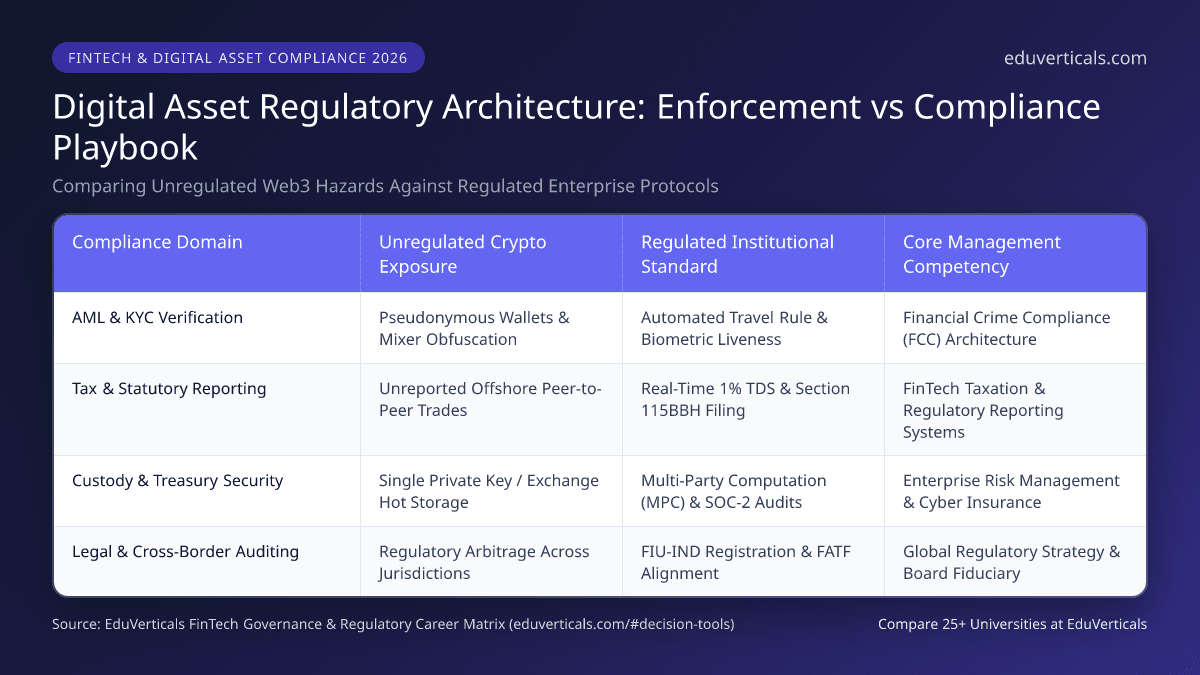
India’s regulatory framework for Virtual Digital Assets has evolved into one of the most comprehensive statutory enforcement regimes globally. Under the aegis of the Financial Intelligence Unit (FIU-IND) and the Ministry of Finance, the operational rules governing digital asset platforms are uncompromising:
While speculative retail crypto trading has consolidated, institutional compliance operations are experiencing an unprecedented boom across India’s major tech corridors. Global financial institutions—including JPMorgan Chase, Standard Chartered, HSBC, and BNY Mellon—run their worldwide Financial Crime Compliance (FCC) and anti-money laundering (AML) operations out of sprawling centers in Bengaluru, Hyderabad, Chennai, and Mumbai.
These global teams monitor billions of dollars in daily transactions, conduct forensic wallet clustering using tools like Chainalysis and Elliptic, and respond to international law enforcement subpoenas. The operational bottleneck is no longer software code; it is a severe shortage of managers who combine technical understanding with regulatory legal literacy and enterprise financial acumen.
Select your career goal to tailor advice
Specialize in financial crime compliance, FIU statutory filings, and international regulatory licensing for digital platforms.
Software developers who understand blockchain cryptography often lack foundational training in corporate treasury management, contractual liability, and central bank prudential regulations. Conversely, traditional legal practitioners frequently struggle with decentralized consensus mechanisms, smart contract vulnerabilities, and automated market makers.
This divide has created a highly lucrative niche for executives who complete an accredited Master of Business Administration in FinTech, Business Analytics, or Financial Risk Management. These programs teach working professionals how to design institutional governance frameworks that protect multi-million-dollar balance sheets while enabling digital innovation.
To capture these high-paying corporate roles without disrupting your current career, look into accredited programs like IIT Patna Online with technology management electives, or the cutting-edge FinTech and Analytics tracks offered by Manipal University Jaipur (MUJ).
These UGC-DEB recognized programs provide rigorous instruction in regulatory technologies (RegTech), financial data science, and digital banking strategy. Review university profiles on the Course Catalog and compare accredited institutions on the Academic Catalog. Connect with our admission partners for a tailored shortlist matching your technical background and career goals.
Keep the details close
Explore key programme specifications, recognition terms, fee components, and career outcomes side by side before applying.
FinTech and digital asset companies must register as reporting entities, enforce strict KYC and AML verification protocols, deduct 1% TDS on transactions, maintain transactional records for five years, and submit Suspicious Transaction Reports (STRs) to regulatory authorities.
Bring programme options, estimated fees and study flexibility into one view, with the trade-offs and questions to verify.
Tailored shortlist from our admission partners. Verify fees and eligibility before applying.


We have a team of over 12 experienced mentors with over 26+ years of collective experience available to guide you at a moment's notice.